

Phylogeny
Phylogenetically, lepidopterans are closest to caddis flies ( Trichoptera ), with which they form the Amphiesmenoptera group. Representatives of both groups are characterized by a number of common features: females, not males, are heterogametic , which is not characteristic of other orders of insects; there are dense hairs on the wings; specific venation of the front wings; the presence in the larvae of specialized glands producing silk.
Probably, the superorder Amphiesmenoptera, began to evolve directly in the Jurassic period , having separated from the extinct group Necrotaulidae . Lepidoptera, in turn, differ from caddis flies in some features of venation of the wings , as well as the shape of the hairs, which they have modified into scales.
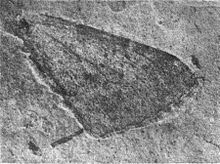
The petrified remains of Lepidoptera are found much less frequently than other insects. This is due to the fragility of their bodies. The oldest fossils of Lepidoptera were found in sediments of the early Jurassic period near Dorset in the UK and are known as Archaeolepis mane . Their age is estimated at 190 million years [1] . They are an imprint of a pair of wings, covered with scales, with venation similar to that of representatives of the caddis group. The extinct genus of the early Lepidoptera Archaeolepis described on the basis of these residues is the earliest known fossil of Lepidoptera. It belongs to the primitive extinct family Archaeolepidae [1] [2] .
The emergence and development of the squad
The appearance and development of the detachment probably occurred in the Cretaceous period . The oldest Microptyregidae are known from sediments of the second half of the Lower Cretaceous (Lebanon and Transbaikalia). As a detachment of insects, lepidopterans were distinguished by active herbivorous larvae that fed on green plant tissues and a winged adult phase ( imago ), which initially had low activity and a poorly developed oral apparatus. As they evolved, through simple rearrangements, their mouth organs lengthened and formed a soft and long proboscis , which was able to absorb fluids, which allowed them to actively feed on nectar. Life expectancy and absolute size of the winged phase increased, and flight improved. Lepidoptera also developed various bright colors of the wings on which complex patterns arose. The appearance of a bright coloration of Lepidoptera undoubtedly reflects to some extent their close ties with angiosperms (flowering) plants, the flowers of which they visit to feed on nectar. The rapid flowering of Lepidoptera is directly related to the spread of flowering plants , which occurred in the middle of the Cretaceous period - about 100 million years ago. Butterflies, in turn, contributed to the spread of flowering plants, acting as their pollinators. Undoubtedly, flowering plants had a great and decisive influence on the evolution of the entire detachment. The history of the formation of Lepidoptera and angiosperms is a vivid example of the syngenetic development of two groups of organisms, which proceeded relatively rapidly in both groups of organisms.
Geological History
The geological history of Lepidoptera is very fragmented. In short, it can be presented in the following form. The remains of the oldest Lepidoptera, along with Archaeolepis mane from Great Britain, were found in sediments of the second half of the Lower Cretaceous in Lebanon and Transbaikalia and belong to the representatives of the most primitive suborder Micropterygina. Along with them, in Lebanon, the oldest Hepjalina ( Incurvarioidea ) were also discovered. Most likely, the formation of the detachment and its primary divergence occurred directly in the early Cretaceous period. Already in the Upper Cretaceous, along with Micropterygina , Papilionina is also found. Also, from the very beginning of the Upper Cretaceous, numerous mines on the leaves of angiosperms were found in a number of locations, most likely belonging to eriocraniin or non-articleoids. Burmese amber probably also dates from the Cretaceous period with the remains of one species from the Eriocraniidae group. The widespread development of miner species in the late Cretaceous is also indirectly indicated by the high number of their parasites in Senonian resins found in Taimyr . A number of superfamilies ( Leafworms , Yponomeutoidea , Gelechioidea , Pyraloidea ) are known from the Eocene , and Mole-like from the Upper Cretaceous. The oldest finds of representatives of the families of woodworm ( Cossoidea ), spotted ( Zeganoidea ), thick-headed ( Hesperioidea ), Papilionoidea and scoops ( Noctuoidea ) are dated by the Oligocene , moths ( Geometroidea ) and brazhnitsa ( Sphingoidea ), myocene , Pliocenidae , amyocenidae , Notocenidae , Pterophoroidea , Calliduloidea, and Bombycoidea have not yet been found in a fossil state.
Lepidoptera finds in the Paleocene sediments are unknown, but representatives of 17 families were found in the Eocene. Mostly their findings are associated with Baltic amber . Representatives of the families Thyrididae and mine Phyllocnistidae are known from the Eocene deposits of the United States. Almost all known Eocene lepidopterans belong to extinct genera. In the finds of Baltic amber, the Oecophoridae family is most abundantly represented. It is noteworthy that from the Upper Cretaceous and Lower Paleogene, only butterflies with crypto-living ( detritophages , miners , mycetophages) or with portable covers ( Mesochnitsa and Chekhlonoski ) caterpillars are known . The number of Lepidoptera finds in the Paleogene sharply increases in comparison with the Cretaceous.
Lepidoptera with open-living caterpillars first appear in the Oligocene - representatives of the families: thick-headed (Hesperioidea), Papilionoidea, speckled (Zygaenoidea) and scoops (Noctuoidea). A characteristic feature of the Oligocene fauna is the sharp predominance of nymphalids ( Nymphalidae ) of the subfamily Nymphalinae among Papilionoidea and a wide variety of woodworms (Cossidae) and Libytheidae. The family of scoops (Noctuoidea) is represented only by primitive Amatidae . Extinct births are still prevailing. In the Miocene, the systematic composition of Lepidoptera, apparently, is already approaching the modern; at this time, such large modern families were first discovered as lycaenidae ( Lycaenidae ), moths ( Geometridae ), hawks ( Sphingidae ), scoops ( Noctuidae ) and others. Of all the large superfamilies, only representatives of such families as Notodontoidea and Silkworms were not found in Miocene sediments. Poor study of Lepidoptera Miocene deposits makes it difficult to estimate the number of extinct genera, but apparently they still occur. Pliocene Lepidoptera are almost unknown. It is in the Pliocene that the first appearance of the Notodontidae family and the presence of a number of modern species are noted. Due to the insufficient knowledge of the fossils of Lepidoptera it is difficult to judge how much their known geological history reflects the actual history of the detachment. In particular, the absence of pre-Oligocene finds of Papilionoidea, Noctuoidea, Cossoidea, and a number of others may be due to the fact that older butterflies are known mainly from fossil resins, where large insects are practically not found. In various types of burials, pre-Oligocene butterflies are also rare and are represented by the same groups. Thus, only Yponomeutidae and Thyrididae are known from the Eocene fauna of Green River (USA), although small butterflies are much less common in sedimentary rocks . Therefore, it is very likely that butterflies with open-living caterpillars appeared only in the Oligocene. The prevalence of forms among them, ecologically associated with presumably tree and shrub vegetation ( Nymphalinae , Libytheidae ) or with vines (primitive sailboats ) in the absence of many important groups associated with herbaceous plants ( Nymphalidae, Satyrinae , Lycaenidae , etc., appearing only in Miocene), is a reflection of the weak development of open grassy landscapes in the Paleogene and a sharp increase in their area in the Neogene.
Fossil Lepidoptera
Hesperioidea superfamily
Hesperiidae Family
- † Pamphilites Scudder, 1875
- † Pamphilites abdita Scudder, 1875 (Aix-en-Provence, Oligocene)
- † Thanatites Scudder, 1875
- † Thanatites vetula (Heyden, 1859) (West Germany, Cenozoic) (originally described as Nymphalidae)
Papilionoidea superfamily
incertae sedis
- † Lithodryas Cockerell, 1909 - Lycaenidae , Nymphalidae ?
- † Lithodryas styx (Scudder, 1889)
- † Lithopsyche Butler, 1889 - Lycaenidae , Riodinidae ?
- † Lithopsyche antiqua Butler, 1889
- † Riodinella Durden & Rose, 1978
- † Riodinella nympha Durden & Rose, 1978 (Colorado, Middle Eocene) - Nymphalidae , Pieridae , Riodinidae ?
Lycaenidae Family
- † Aquisextana Theobald, 1937
- † Aquisextana irenaei Theobald, 1937 (France, Early Oligocene)
Nymphalidae Family
- † Apanthesis Scudder, 1889
- † Apanthesis leuce Scudder, 1889 (Colorado, Florissant)
- † Barbarothea Scudder, 1892
- † Barbarothea florissanti Scudder, 1892 (Colorado, Florissant)
- Doxocopa Hübner, 1819
- † Doxocopa wilmattae (Cockerell, 1907) (Colorado, Florissant)
- Hestina Westwood, 1850
- Hestina japonica (C. et R. Felder)
- † Jupitellia Carpenter, 1985
- † Jupitellia charon (Scudder, 1889)
- † Lethites Scudder, 1875
- † Lethites reynesii (Scudder, 1872)
- Undescribed Limenitis species
- † Mylothrites Scudder, 1875
- † Mylothrites pluto (Heer, 1850) (Europe, Oligocene) (original description, as Vanessa)
- † Neorinella Martins, Kucera-Santos, Vieira & Fr, 1993
- † Neorinella garciae Martines-Neto, 1993
- † Neorinopis Butler, 1873
- † Neorinopis sepulta (Boisduval, 1840) (France, Early Oligocene)
- † Nymphalites Scudder, 1889
- † Nymphalites obscurum Scudder, 1889 (Colorado, Florissant)
- † Nymphalites scudderi Beutenmller and Cockerell, 1908
- † Nymphalites zeuneri Jarembowski, 1980
- † Prodryas Scudder, 1878
- † Prodryas persephone Scudder, 1878
- † Prolibythea Scudder, 1889
- † Prolibythea vagabunda Scudder, 1889 (Colorado, Florissant)
- Vanessa Fabricius, 1807
- † Vanessa amerindica Miller and Brown, 1989 (Colorado, Florissant)
Papilionidae Family
- † Doritites Rebel, 1898
- † Doritites bosniackii Rebel, 1898 (Italy, Tuscany, Miocene) (sometimes referred to the genus Luehdorfia)
- † Praepapilio Durden & Rose, 1978
- † Praepapilio colorado Durden & Rose, 1978
- † Praepapilio gracilis Durden & Rose 1978
- † Thaites Scudder, 1875
- † Thaites ruminianus Scudder, 1875 (France, Aix-en-Provence, Oligocene)
Pieridae Family
- † Coliates Scudder, 1875
- † Coliates proserpina Scudder, 1875
- † Oligodonta Brown, 1976
- † Oligodonta florissantensis Brown, 1976 (Colorado, Oligocene)
- Pontia Fabricius, 1807
- † Pontia freyeri (Heer, 1849)
- † Stolopsyche Scudder, 1889
- † Stolopsyche libytheoides Scudder, 1889 (Colorado, Cenozoic)
Riodinidae Family
- Voltinia Stichel, 1910
- † Voltinia dramba Hall, Robbins & Harvey 2004
Bombycoidea superfamily
Saturniidae Family
- Aglia Ochsenheimer, 1810
- Aglia tau (Linnaeus, 1758)
- Rothschildia Grote, 1896
- † Rothschildia fossilis Cockerell, 1914
Sphingidae Family
- † Mioclanis Zhang, Sun & Zhang, 1994
- † Mioclanis shanwangiana Zhang, Sun & Zhang, 1994
- † Sphingidites Kernbach, 1967
- † Sphingidites weidneri Kernbach, 1967
Copromorphoidea superfamily
Copromorphidae Family
- Copromorpha Meyrick, 1886
- † Copromorpha fossilis Jarzembowski, 1980
Cossoidea superfamily
Cossidae Family
- † Adelopsyche Cockerell, 1926
- † Adelopsyche frustrans Cockerell, 1926
- † Gurnetia Cockerell, 1921
- † Gurnetia durranti Cockerell, 1921 (Isle of Wight)
Superfamily † Eolepidopterigoidea
† Eolepidopterigidae family
- † Daiopterix Skalski, 1984
- † Daiopterix rasnitsyni Skalski, 1984
- † Daiopterix olgae Kozlov, 1989
- † Eolepidopterix Rasnitsyn, 1983
- Eolepidopterix jurassica Rasnitsyn, 1983
- Gracilepteryx Martins-Neto and Vulcano, 1989
- † Gracilepteryx pulchra Martins-Neto and Vulcano, 1989
- † Netoxena Sohn in Sohn et al. , 2012
- † Netoxena nana (Martins-Neto, 1999)
- † Psamateia Martins-Neto, 2002
- † Psamateia calipsa Martins-Neto, 2002
- † Undopterix Skalski, 1979
- † Undopterix sukatshevae Skalski, 1979
- † Undopterix cariensis Martins-Neto and Vulcano, 1989
Superfamily Eriocranioidea
Eriocraniidae Family
- † Eriocranites Kernbach, 1967
- † Eriocranites hercynicus Kernbach, 1967
Superfamily Gelechioidea
Autostichidae Family
- † Symmocites Kusnezov , 1941
- † Symmocites rohdendorfi Kusnezov, 1941
Elachistidae Family
- † Elachistites Kozlov, 1987
- † Elachistites inclusus Kozlov, 1987
- † Elachistites sukatshevae Kozlov, 1987
Ethmiidae Family
- Ethmia Hübner, [1819]
- † Ethmia mortuella Scudder, 1890
Oecophoridae Family
- † Borkhausenites Rebel, 1934
- † Borkhausenites angustipenella Rebel, 1935
- † Borkhausenites bachofeni Rebel, 1934
- † Borkhausenites crassella Rebel, 1935
- † Borkhausenites implicatella Rebel, 1935
- † Borkhausenites incolumella Rebel, 1934
- † Borkhausenites ingentella Rebel, 1935
- † Borkhausenites vulneratella Rebel, 1935
- † Depressarites Rebel, 1936
- † Depressarites blastuliferella Rebel, 1935
- † Depressarites levipalpella Rebel, 1935
- † Epiborkhausenites Skalski, 1973
- † Epiborkhausenites obscurotrimaculatus Skalski, 1973
- † Glesseumeyrickia Kusnezov, 1941
- † Glesseumeyrickia henrikseni Kusnezov, 1941
- † Hexerites Cockerell, 1933
- † Hexerites primalis Cockerell, 1933
- † Microsymmocites Skalski, 1977
- † Microsymmocites Skalski, 1977
- † Neoborkhausenites Skalski, 1977
- † Neoborkhausenites incertella (Rebel, 1935)
- † Palaeodepressaria Skalski, 1979
- † Palaeodepressaria hannemanni Skalski, 1979
- † Paraborkhausenites Kusnezov, 1941
- † Paraborkhausenites innominatus Kusnezov, 1941
- † Paraborkhausenites vicinella (Rebel, 1935) (
Symmocidae Family
- † Oegoconiites Kusnezov, 1941
Superfamily Geometroidea
Geometridae Family
- † Geometridites Clark et al., 1971
- † Geometridites jordani Kernbach, 1967
- † Geometridites larentiiformis Jarzembowski, 1980
- † Geometridites repens Kernbach, 1967
- Hydriomena Hübner, (1825)
- † Hydriomena? protrita Cockerell, 1922
Superfamily Gracillarioidea
Bucculatricidae Family
- Bucculatrix Zeller, 1839
- † Bucculatrix platani Kozlov, 1988
Gracillariidae Family
- † Gracillariites Kozlov, 1987
- † Gracillariites lithuanicus Kozlov, 1987
- † Gracillariites mixtus Kozlov, 1987
- Two undescribed Phyllocnistis species
- One undescribed Lithocolletis species
Hepialoidea superfamily
Hepialidae family
- † Oiophassus JF Zhang, 1989
- † Oiophassus nycterus Zhang, 1989
- † Prohepialus Piton, 1940
- † Prohepialus incertus Piton, 1940
- † Protohepialus Pierce, 1945
- † Protohepialus comstocki Pierce, 1945
Incurvarioidea superfamily
Adelidae Family
- Adela Latreille, 1796
- † Adela kuznetzovi Kozlov, 1987
- † Adela similis Kozlov, 1987
- † Adelites Rebel 1934
- † Adelites electrella Rebel, 1934
- † Adelites purpurascens Rebel, 1935
- † Adelites serraticornella Rebel, 1935
- An undescribed † Adelites species
Incurvariidae Family
- † Incurvarites Rebel, 1934
- † Incurvarites alienella Rebel, 1934
- † Prophalonia Rebel, 1936
- † Prophalonia gigas Rebel, 1935
- † Prophalonia scutitarsella Rebel, 1935
Micropterigoidea superfamily
Micropterigidae Family
- † Auliepterix Kozlov, 1989
- † Auliepterix minima Kozlov, 1989
- † Auliepterix mirabilis Kozlov, 1989
- † Baltimartyria Skalski, 1995
- † Baltimartyria rasnitsyni Mey, 2011
- † Baltimartyria proavitella (Rebel, 1936)
- Micropterix Hübner, 1825
- † Micropterix anglica Jarzembowski, 1980
- † Micropterix gertraudae Kurz M. A & ME Kurz, 2010
- † Micropterix immensipalpa (Kusnezov, 1941)
- † Moleropterix Engel & Kinzelbach, 2008
- † Moleropterix kalbei Engel & Kinzelbach, 2008
- † Palaeolepidopterix Kozlov, 1989
- † Palaeolepidopterix aurea Kozlov, 1989
- † Palaeosabatinca Kozlov, 1989
- † Palaeosabatinca zherichini Kozlov, 1988
- † Parasabatinca Whalley, 1978
- † Parasabatinca aftimacrai Whalley, 1978
- † Parasabatinca caldasae Martins Neto & Vulcano, 1989
- Sabatinca Walker, 1863
- † Sabatinca perveta (Cockerell, 1919)
Superfamily Nepticuloidea
Nepticulidae Family
- † Foliofossor Jarzembowski, 1989
- † Foliofossor cranei Jarzembwoski, 1989
- † Stigmellites Kernbach, 1967
- † Stigmellites araliae (Fric, 1882)
- † Stigmellites baltica (Kozlov, 1988)
- † Stigmellites caruini-orientalis Straus, 1977
- † Stigmellites heringi Kernbach, 1967
- † Stigmellites kzyldzharica (Kozlov, 1988)
- † Stigmellites messelensis Straus, 1976
- † Stigmellites pliotityrella Kernbach, 1967
- † Stigmellites samsonovi Kozlov, 1988
- † Stigmellites serpentina (Kozlov, 1988)
- † Stigmellites sharovi (Kozlov, 1988)
- † Stigmellites tyshchenkoi (Kozlov, 1988)
- † Stigmellites zelkovae Straus, 1977
Noctuoidea superfamily
Arctiidae Family
- † Oligamatites Kusnezov, 1928
- † Oligamatites martynovi Kusnezov, 1928
- † Stauropolia Skalski, 1988
- † Stauropolia nekrutenkoi Skalski, 1988
Lymantriidae Family
- Euproctis
Noctuidae Family
- † Noctuites Heer, 1849
- † Noctuites haidingeri Heer, 1849
- † Xyleutites Kozhanchikov, 1957
- † Xyleutites miocenicus Kozhanchikov, 1957
Notodontidae Family
- † Cerurites Kernbach, 1967
- † Cerurites wagneri Kernbach, 1967
Надсемейство Pterophoroidea
Семейство Pterophoridae
- Pterophorus Schäffer, 1766
- † Pterophorus oligocenus Bigot, Nel & Nel, 1986
Надсемейство Pyraloidea
Семейство Pyralidae
- † Gallerites Kernbach, 1967
- † Gallerites keleri Kernbach, 1967
- † Glendotricha Kusnezov, 1941
- † Glendotricha olgae Kusnezov , 1941
- † Pyralites Heer, 1856
- † Pyralites obscures Heer, 1856
- † Pyralites preecei Jarzembowski, 1980
Надсемейство Sesioidea
Семейство Castniidae
- † Dominickus Tindale, 1985
- † Dominickus castinodes Tindale, 1985
Надсемейство Tineoidea
Семейство Psychidae
- Dahlica Enderlein, 1912
- Dahlica triquetrella (Hübner, 1813)
- † Palaeopsyche Sobczyk & Kobbert, 2009
- † Palaeopsyche secundum Sobczyk & Kobbert, 2009
- † Palaeopsyche transversum Sobczyk & Kobbert, 2009
- † Psychites Kozlov, 1989
- † Psychites pristinella Kozlov, 1989
- Siederia Meier, 1957
- Siederia pineti (Zeller, 1852)
- Sterrhopterix Hübner, 1825
- † Sterrhopteryx pristinella Rebel, 1934
- Taleporia Hübner, 1825
- Taleporia tubulosa (Retzius, 1783)
- Bacotia Tutt, 1899
- Bacotia claustrella (Bruand, 1845)
Семейство Tineidae
- † Architinea Rebel, 1934
- † Architinea balticella Rebel, 1934
- † Architinea sepositella Rebel, 1934
- † Dysmasiites Kusnezov, 1941
- † Dysmasiites carpenteri Kusnezov, 1941
- † Electromeessia Kozlov, 1987
- † Electromeessia zagulijaevi Kozlov, 1987
- † Glessoscardia Kusnezov, 1941
- † Glessoscardia gerasimovi Kusnezov, 1941
- † Martynea Kusnezov, 1941
- † Martynea rebeli Kusnezov, 1941
- † Monopibaltia Skalski, 1974
- † Monopibaltia ignitella Skalski, 1974
- † Palaeoinfurcitinea Kozlov, 1987
- † Palaeoinfurcitinea rohdendorfi Kozlov, 1987
- † Palaeoscardiites Kusnezov, 1941
- † Palaeoscardiites mordvilkoi Kusnezov, 1941
- † Palaeotinea Kozlov, 1987
- † Palaeotinea rasnitsyni Kozlov, 1987
- † Paratriaxomasia Jarzembowski, 1980
- † Paratriaxomasia solentensis Jarzembowski, 1980
- † Proscardiites Kusnezov, 1941
- † Proscardiites martynovi Kusnezov, 1941
- † Pseudocephitinea Kozlov, 1987
- † Pseudocephitinea svetlanae Kozlov, 1987
- † Scardiites Kusnezov, 1941
- † Scardiites meyricki Kusnezov, 1941
- † Simulotenia Skalski, 1977
- † Simulotenia intermedia Skalski, 1977
- † Tillyardinea Kusnezov, 1941
- † Tillyardinea eocaenica Kusnezov, 1941
- Tinea Linnaeus, 1758
- † Tinea antique Rebel, 1822
- † Tineitella Fletcher, 1940
- † Tineitella crystalli Kawall, 1876
- † Tineitella sucinacius Kozlov, 1987
- † Tineolamima Rebel, 1934
- † Tineolamima aurella Rebel, 1934
- † Tineosemopsis Skalski, 1974
- † Tineosemopsis decurtatus Skalski, 1974
Надсемейство Tortricoidea
Семейство Tortricidae
- † Electresia Kusnezov, 1941
- † Electresia zalesskii Kusnezov, 1941
- † Spatalistiforma Skalski, 1992
- † Spatalistiforma submerga Skalski, 1981
- † Tortricibaltia Skalski, 1992
- † Tortricibaltia diakonoffi Skalski, 1981
- † Tortricidrosis Skalski, 1973
- † Tortricidrosis inclusa Skalski, 1973
- Tortrix Linnaeus, 1758
- † Tortrix? destructus Cockerell, 1916
- † Tortrix? florissantana Cockerell, 1907
Надсемейство Yponomeutoidea
Семейство Heliodinidae
- † Baltonides Skalski, 1981
- † Baltonides roeselliformis Skalski, 1981
Семейство Lyonetiidae
- † Prolyonetia Kusnezov, 1941
- † Prolyonetia cockerelli Kusnezov, 1941
Семейство Yponomeutidae
- † Epinomeuta Rebel, 1936
- † Epinomeuta truncatipennella Rebel, 1936
Надсемейство Zygaenoidea
Семейство Zygaenidae
- Neurosymploca Wallengren, 1858
- † Neurosymploca? oligocenica Fernández-Rubio & Nel, 2000 (Франция)
- Zygaena Fabricius, 1775
- † «Zygaena» miocaenica Reiss, 1936 (Германия)
- † «Zygaena» turolensis Fernández-Rubio, de Olano & Cunarro, 1991
- † Zygaenites Burgeff, 1951
- † Zygaenites controversus Burgeff, 1951 (Германия, Миоцен)
Без ранга
Семейство † Archaeolepidae
- † Archaeolepis Whalley, 1985
- † Archaeolepis mane Whalley, 1985
Семейство † Curvicubitidae
- † Curvicubitus Hong, 1984
- † Curvicubitus triassicus Hong, 1984 (Китай, средний триас)
Семейство † Mesokristenseniidae
- † Mesokristensenia Huang, Nel & Minet, 2010
- † Mesokristensenia angustipenna Huang, Nel & Minet, 2010
- † Mesokristensenia latipenna Huang, Nel & Minet, 2010
- † Mesokristensenia sinica Huang, Nel & Minet, 2010
Literature
- Орлов Ю. А. (ред.) — Основы палеонтологии (в 15 томах) том 9. Членистоногие — трахейные и хелицеровые
- Друщиц В. В. — Палеонтология беспозвоночных, М. 1974
Notes
- ↑ 1 2 Grimaldi, D. & Engel, MS Evolution of the Insects / Cambridge University Press. — Cambridge, etc, 2005. — ISBN 978-0-521-82149-0 .
- ↑ PES Whalley. 1985. The systematics and palaeogeography of the Lower Jurassic insects of Dorset, England. Bulletin of the British Museum of Natural History (Geology) 39(3):107—189.