The sharp-toothed spiny shark [1] ( lat. Scymnodon ringens ) is a species of the genus of corduroy spiny sharks of the somnius shark family of the cataract - like order . It lives in the eastern Atlantic. It occurs at a depth of up to 1600 m. The maximum recorded size is 110 cm. Propagated by oviposition [2] . Not of interest for commercial fishing [3] .
| Spiky Spiked Shark |
 |
| Scientific classification |
|---|
| No rank : | Bilateral symmetrical |
| Gender: | Velvet Spiky Sharks |
|
| International scientific name |
|---|
Scymnodon ringens Barbosa du Bocage & Brito Capello , 1864 |
| Area |
|---|
|
| Security status |
|---|
Not enough data IUCN Data Deficient : 161717 |
|
Content
The scientific species was first described in 1864 [4] . The species epithet comes from the word dumb. ringen - “ring” [5] .
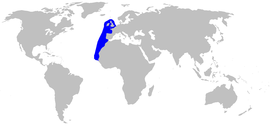
Spiky spiked sharks live in the eastern Atlantic Ocean off the coast of France, Mauritania, Portugal, Senegal, Spain and the UK. These sharks are found on the continental and island slopes at the bottom at a depth of 200 to 1600 m, more often between 550 and 1450 m [6] .
The maximum registered size is 110 cm. The head is tall and thickened. The preoral distance is less than the width of the mouth and almost the distance between the lower symphysis and the first gill slit. The mouth is very wide. Gill slits are elongated, exceed half the length of the eye. The pectoral fins are narrow and leaf-shaped. The caudal fin is asymmetrical, at the edge of a longer upper lobe there is a small notch, the lower lobe is not developed. Caudal stalk short. The first dorsal fin is slightly smaller than the second dorsal fin. The base of the first dorsal fin is located between the bases of the pectoral and ventral fins. Anal fin missing. The ventral fins are wide and large. Coloring in black [3] .
Spiky spiky sharks breed by egg-laying .
The view is not of interest to commercial fishing. Sometimes by- catch is caught in fishing nets. Caught sharks are eaten dried or made from them fishmeal [3] . There is insufficient data to evaluate the conservation status of the species by the International Union for Conservation of Nature [7] .
- ↑ Reshetnikov Yu.S. , Kotlyar A.N. , Russ T.S. , Shatunovsky M.I. The Bilingual Dictionary of Animal Names. Fish. Latin, Russian, English, German, French. / edited by Acad. V. E. Sokolova . - M .: Rus. Yaz., 1989 .-- S. 36 .-- 12,500 copies. - ISBN 5-200-00237-0 .
- ↑ Breder, CM and DE Rosen. Modes of reproduction in fishes. - TFH Publications, Neptune City. - New Jersey, 1966.
- ↑ 1 2 3 Compagno, Leonard JV 1. Hexanchiformes to Lamniformes // FAO species catalog. - Rome: Food and Agricultural Organization of the United Nations, 1984. - Vol. 4. Sharks of the World: An Annotated and Illustrated Catalog of Shark Species Known to Date. - P. 100. - ISBN 92-5-101384-5 .
- ↑ Bocage, JVBdu & De Brito Capello, F. (1864) Sur quelques espèces inédites de Squalidae de la tribu Acanthiana Gray, qui fréquentent les côtes du Portugal. Proceedings of the Zoological Society of London, 1864: 260–263
- ↑ My etymology. A universal etymology dictionary (unopened) (link unavailable) . Date of treatment September 6, 2013. Archived July 31, 2013.
- ↑ Springer, S. Squalidae = Check-list of the fishes of the eastern tropical Atlantic (CLOFETA) / In JC Quero, JC Hureau, C. Karrer, A. Post and L. Saldanha (eds.). - Paris: JNICT, Lisbon; SEI, Paris; and UNESCO, Paris, 1990.- T. 1.
- ↑ Blasdale, T. & Valenti, SV 2009. Scymnodon ringens. In: IUCN 2013. IUCN Red List of Threatened Species. Version 2013.1. <www.iucnredlist.org>. Downloaded on 13 September 2013.

