Bayard type armadillos are a pair of inpatient 2nd rank armadillos built by the French Navy in the 1870-1880s. They were barbet ships, the architecture being a smaller version of the ocean battleship "Amiral Duperré" . They had composite cases with a steel set and wood paneling. Discarded in the 1900s.
| Bayard type battleships | |
|---|---|
| Battleships of the Bayard type | |
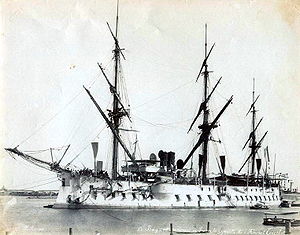 Bayard in Port Said | |
| Project | |
| A country |
|
| Years of construction | 1876 -1882 |
| Years in the ranks | 1882-1901 |
| Scheduled | 2 |
| Built | 2 |
| Scrapped | 2 |
| Service | |
| Named after | |
| Type of sailing weapon | ship |
| Main characteristics | |
| Displacement | 5915 t. |
| Length between perpendiculars | 81 m. |
| Midship Width | 17.45 m. |
| Draft | 7.62-7.67 m. |
| Reservation | main belt - 150-250 mm (iron forged armor); deck - 50 mm; Barbets - 200 mm; |
| Engines | two vertical compounding machines, 8 cylindrical boilers, 4400 hp |
| Speed | 14-14.5 knots |
| Crew | 451 people |
| Armament | |
| Total number of guns | 4 x 240 mm / 19 rifled guns, 1 x 164 mm rifled linear gun, 6 x 140 mm rifled guns, 6 x 3 pound guns 12 x 1 lb. four-barrel revolving Hotchkiss. |
| Mine torpedo armament | Taran, 2 x 356-mm surface TA (on Turen) |

History
By the mid-1870s, the “stationary” armadillos of the Alma type, which formed the basis of the French colonial fleet , began to become obsolete, and no longer fully complied with the war requirements at sea due to their low speed and insufficiently powerful weapons. Armadillos of the La Galissoniere type, which they were building to replace, were delayed on the slipways due to the financial consequences of the Franco-Prussian war, and by the time they were put into operation they were no longer fully modern either.
This state of affairs seemed completely intolerable. France had extensive colonial possessions in Africa, the Caribbean and the Far East, which in the event of a war with Britain (considered at that time as the main enemy) would become attacked. Protecting the colonies, maintaining their ties with France and attacking the British colonial possessions was one of the main tasks of the French fleet.
In the mid-1870s, France decided to build two new small armadillos for service in the Far East. These ships should, on the basis of design requirements, surpass the British armored carriers of the 2nd rank of the Audacious class and armored cruisers of the Nelson and Shannon type . It was assumed that in the event of a war with Britain, they would provide effective protection for the French colonies from attack and would be able to strike at British naval forces in the region.
Design
The Bayard type battleships were a smaller version of the ocean-going battleship Amiral Duperré in design. They had a composite case with a steel set and wood paneling. This decision was made mainly on the basis of maintainability requirements: repairing wooden cladding in colonies was simpler than iron or steel.
The total displacement of these battleships was 5915 tons. They were larger than all previous French "inpatients" and only 2,000 tons inferior to the modern French ocean armadillos. The full length of the ships was 81 meters, width - 17.45 meters, and draft - 7.67 meters.
Like all French ships, Bayard-type battleships had a characteristic strong obstruction inboard: the width of the upper deck was much less than the width of the hull along the waterline. This hull design significantly reduced the upper weight and made it possible to position artillery high.
Armament
The base of the armament of the Bayard series ships was four 240-mm 19-caliber rifled guns of the 1870 model. The guns were placed on the upper deck in the barbet installations. The location of the barbets was repeated by Amiral Dupierre: two barbets were located on the bow side by side, carried out over the edge of the upper deck on the sponsons , one installation was located in the center of the ship's hull, and another stood aft. Due to this arrangement of guns, a powerful linear and retirement fire was provided, since due to a strong blockage of the sides, two bow mounts could shoot along the side directly in the bow or directly in the stern without risk of damage to the hull.
240 mm guns weighed 15.7 tons. The initial velocity of their 144-kilogram projectile was 495 m / s. At the muzzle, such a projectile pierced 356 mm iron armor, and retained the ability to penetrate armor plates of a reasonable thickness up to a distance of 1000-1500 meters. The location of all the guns in the barbettes allowed to increase the angle of vertical guidance and firing range. From above, the guns were covered with thin armor caps resting on the edge of the fixed armored barbet fence, and rotating with the guns. Caps served to protect the calculation from bullets and fragments [1] and had cruciform embrasures in the front part that facilitated accurate guidance.
Auxiliary armaments, traditionally powerful for French ships, consisted of one 164-mm rifled linear gun, standing on the tank and firing through the gun port in the stem, and six (three on board) 140-mm rifled guns on the main deck. These guns were not protected by armor and were intended mainly for firing high-explosive shells at unarmored parts of enemy armadillos and light ships too nimble for the effective use of heavy 240 mm guns against them.
As anti-mine weapons, armadillos were armed with six 3-pound light guns and twelve 1-pound revolving guns of Hotchkiss. The latter had a firing range of up to 3200 meters [2] and issued up to 30 rounds per minute: their projectile was considered powerful at that time to effectively destroy the fragile hulls of wooden or steel destroyers.
As submarine weapons, the ships had a ram. The Turen during construction was equipped with two 356-mm surface torpedo tubes firing at an angle to the diametrical plane.
Armor Protection
The armor protection of the ships has improved significantly compared to the previous "inpatients". This was caused by significant progress in artillery during the 1870s, which made the previous 120-150 mm armor plates vulnerable to new rifled guns. The battleships of the Bayard series carried the classic French full armored waterline belt, made of wrought iron and reaching a maximum thickness of 250 millimeters in the central part of the hull. At the extremities, the belt narrowed: its thickness was only 150 millimeters. The total height of the belt was 3 meters, of which approximately 1.2 were located under water and 1.8 above the waterline. In addition to the bottom, the belt along the entire length tapers to 150 mm.
Horizontal protection was provided by a 50 mm armored deck, held at the waterline level. It was composed of two layers of iron plates and was intended mainly to protect against howitzer shells [3] .
Barbet installations were fixed rings of 200 mm armor, standing on the upper deck. The barbets had an armored bottom, but the elevator feed pipes connecting the units to the cellars were not armored. On top of the barbets were covered thin steel caps rotating with the gun.
Powerplant
The ships were powered by two vertical compound machines, with a total capacity of 4400 hp. Eight cylindrical boilers provided Bayard-class battleships with steam sufficient to reach 14 knots. On the measured mile, the battleships showed 14.5 knots, but because of their service in warm waters, their hulls were very prone to fouling and 14 knots were considered the real maximum speed.
The coal reserve was enough for 6,700 km of an economical 10-knot course. In order to save coal, the battleships carried full sailing equipment.
Service
Project Evaluation
Armadillos of the Bayard type were a definite success of French shipbuilding. Designed for colonial service at remote stations, these battleships were fast, powerfully armed and well protected. A certain drawback was the use of a wooden hull kit, but this anachronism was explained both by considerations of fleet economy for a secondary theater and by pragmatic maintainability considerations: it was much more difficult to repair iron or steel hulls in a weak industrial base of French Caribbean or Far Eastern colonies.
The main drawback of these ships was the large area of the unprotected side. While for the “oceanic” battleships, including the prototype “Amiral Dupierr”, who intended to fight mainly in the Mediterranean Sea or in the English Channel, this drawback was less relevant, for “stationary” battleships forced to fight away from bases, severe damage to the freeboard could lead to death at the transition. In addition, the bases of the barbets and the ammunition supply pipe were not protected by anything - a successfully hit projectile could interrupt the supply of ammunition to the installation or even bring it down.
At the same time, in terms of armament power, belt protection and speed, the Bayard class armadillos were not inferior or superior to the main British “colonial” 2nd class armadillos of the Audacious type. The French ship’s barbette installations made it much easier to maneuver with fire in battle, and the high position of the guns made it possible to conduct a battle effectively in such weather, in which the low-lying casemated guns of the British would be swamped by waves. As a result, Bayard-class battleships significantly strengthened the large French colonial fleet, in the event of a war, forcing the British to either drag armadillos from the Atlantic and the Mediterranean Sea to defend the colonies, or risk a French strike on the colonies.
Links
- ↑ A heavy projectile entering the hood was considered unlikely.
- ↑ Non-sighting.
- ↑ Howitzers were often installed on coastal fortifications, although the probability of getting along a ballistic trajectory into a moving ship was almost zero at that time.
- de Balincourt, Captain; Vincent-Bréchignac, Captain. The French Navy of Yesterday: Ironclad Frigates, Part IV // FPDS Newsletter: journal. - Akron, OH: FPDS, 1975 .-- Vol. III , no. 4 . - P. 26-30 .
- Brassey, Thomas. The Naval Annual 1887 . - Portsmouth, England: J. Griffin, 1888.
- Conway's All the World's Fighting Ships 1860–1905 / Gardiner, Robert. - Greenwich: Conway Maritime Press, 1979. - ISBN 0-8317-0302-4 .
- McCarthy, Justin Huntly. England Under Gladstone, 1880–1884 . - reprint of 1884. - London: Elibron Classics, 2006.
- Sedgwick, Alexander. The Ralliement in French Politics, 1890–1898 . - Cambridge, MA: Harvard University Press, 1965.
- Silverstone, Paul H. Directory of the World's Capital Ships. - New York: Hippocrene Books, 1984. - ISBN 0-88254-979-0 .
- Wilson, HW Ironclads in Action: A Sketch of Naval Warfare From 1855 to 1895. - Boston: Little, Brown, 1896. - Vol. Volume 2.
- Conway's All the World's Fighting Ships 1860–1905 / Gardiner, Robert. - Greenwich: Conway Maritime Press, 1979. - ISBN 0-8317-0302-4 .