Tetraamelia syndrome ( autosomal recessive tetraamelia ; from the Greek. Τετράς 'four', ά 'without', μελος 'term, limb') - a very rare congenital hereditary disease [1] [2] , characterized by the absence of four limbs. Other parts of the body, such as the face, skull, reproductive organs , anus and pelvis, are also prone to malformations . Tetraamelia syndrome is characterized by autosomal recessive inheritance . The disease is associated with a mutation in the WNT3 gene [2] .
| Tetraamelia syndrome | |
|---|---|
| ICD-10-KM | |
| Omim | 273395 |
| Diseasesdb | 34469 |
| Mesh | and |
Content
- 1 Characteristics of the disease
- 2 Reason and heredity
- 2.1 WNT3 gene
- 2.2 Genetics within the family
- 3 Epidemiology
- 4 Famous people with tetraamelia syndrome
- 5 notes
- 6 References
Characteristics of the disease
The syndrome causes serious malformations of various parts of the body, including the face, head, heart, nervous system, skeleton and genitals. In many cases, the lungs are underdeveloped, making breathing difficult or impossible. Children with tetraamelia syndrome often are stillborn or die soon after birth due to multiple malformations. Australian Christian preacher Nick Vuychich and Japanese author and sports journalist Hirotada Ototake are some of the most famous living people with tetraamelia syndrome.
Reason and heredity
WNT3 Gene
The recessive mutation in the WNT3 gene, which is a member of the family of WNT genes that play a critical role in embryonic development, is responsible for the development of the syndrome. In humans, the WNT3 gene is located on the 17th chromosome [1] .
The main function for which the protein produced by the WNT3 gene is responsible is the formation of limbs and other body systems during embryonic development. Mutations in the WNT3 gene disrupt the production of a full-fledged WNT3 protein in the cell, which leads to a disruption in the normal formation of limbs and other serious congenital malformations.
Family Genetics
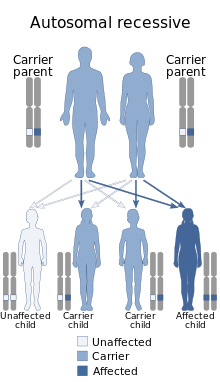
In most families studied, in which there is a case of the birth of a child with tetraamelia syndrome, this disease is inherited by an autosomal recessive mechanism [1] [2] . This means that the gene in which mutations are responsible for the development of the syndrome is on the autosome , and both copies of the gene (one inherited from each parent) must be defective in order to lead to this disease. Thus, both parents of a patient with an autosomal recessive disease are carriers of a gene mutation, but usually they do not have any symptoms or pathological manifestations.
In some families in which children with tetraamelia syndrome appeared, the cause of the disease has not been established. Some researchers believe that the unknown mutations in the WNT3 gene or in other genes involved in the process of limb formation may be responsible for the development of this disease in these cases.
Epidemiology
Only a few cases of the birth of people with tetraamelia syndrome have been registered in the world.
Famous people with tetraamelia syndrome
- Marily Adamsky-Smith
- Christian Arndt
- Violetta
- Prince Randian
- Jovana Yumbo Ruiz
- Piotr Radon
- Nick Vuychich
- Michael Olson
- Maraya Scott
- Hasidi Young ( https://m.lenta.ru/news/2019/07/25/love/ )
Notes
- ↑ 1 2 3 OMIM 273395
- ↑ 1 2 3 Niemann S. , Zhao C. , Pascu F. , Stahl U. , Aulepp U. , Niswander L. , Weber JL , Müller U. Homozygous WNT3 mutation causes tetra-amelia in a large consanguineous family. (English) // American journal of human genetics: journal. - 2004. - Vol. 74 , no. 3 . - P. 558-563 . - DOI : 10.1086 / 382196 . - PMID 14872406 .
Links
- Tetra-amelia syndrome - Genetics Home Reference . US National Library of Medicine. Date of treatment January 9, 2009.
- Tetra-Amelia Syndrome - GeneReviews - NCBI Bookshelf . University of Washington, Seattle. Date of treatment January 9, 2009.
- Tetra-Amelia-Syndrome (Birth defects & disorders) . I-Am-Pregnant. Date of treatment January 9, 2009.
- Tetraamelia multiple malformations - WrongDiagnosis.com . WrongDiagnosis. Date of treatment January 9, 2009.