Clever Geek Handbook
📜 ⬆️ ⬇️

Virtual black hole

A virtual black hole is a hypothetical object of quantum gravity : a black hole resulting from the quantum fluctuations of spacetime [1] . It is one of the examples of the so-called quantum foam and the gravitational analogue of virtual electron-positron pairs in quantum electrodynamics .

The appearance of virtual black holes on the Planck scale is a consequence of the uncertainty relations
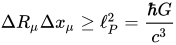
ΔRμΔxμ≥ℓP2=ℏGc3{\ displaystyle \ Delta R _ {\ mu} \ Delta x _ {\ mu} \ geq \ ell _ {P} ^ {2} = {\ frac {\ hbar G} {c ^ {3}}}} \ Delta R _ {{\ mu}} \ Delta x _ {{\ mu}} \ geq \ ell _ {{P}} ^ {2} = {\ frac {\ hbar G} {c ^ {3}}}

WhereRμ {\ displaystyle R _ {\ mu}} R _ {\ mu} - component of the radius of curvature of a small region of space-time;xμ {\ displaystyle x _ {\ mu}} x _ {\ mu} - the coordinate of the small area;ℓP {\ displaystyle \ ell _ {P}} \ ell _ {{P}} - Planck length ;ℏ {\ displaystyle \ hbar} \ hbar - Dirac constant ;G {\ displaystyle G} G - Newton's gravitational constant ;c {\ displaystyle c} c - the speed of light . These uncertainty relations are another form of Heisenberg uncertainty relations applied to the Planck scale.

Justification

Indeed, the indicated uncertainty relations can be obtained from the Einstein equations.
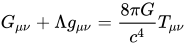
Gμν+Λgμν=eightπGcfourTμν{\ displaystyle G _ {\ mu \ nu} + \ Lambda g _ {\ mu \ nu} = {8 \ pi G \ over c ^ {4}} T _ {\ mu \ nu}} G _ {\ mu \ nu} + \ Lambda g _ {\ mu \ nu} = {8 \ pi G \ over c ^ {4}} T _ {\ mu \ nu}

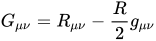
WhereGμν=Rμν-R2gμν {\ displaystyle G _ {\ mu \ nu} = R _ {\ mu \ nu} - {R \ over 2} g _ {\ mu \ nu}} G _ {{\ mu \ nu}} = R _ {{\ mu \ nu}} - {R \ over 2} g _ {{\ mu \ nu}} - Einstein tensor , which combines the Ricci tensor, scalar curvature and metric tensor ,Rμν {\ displaystyle R _ {\ mu \ nu}} R _ {\ mu \ nu} - Ricci tensor resulting from the space-time curvature tensorRabcd {\ displaystyle R_ {abcd}} R_ {abcd} by folding it over a pair of indexes ,R {\ displaystyle R} R - scalar curvature , that is, the rolled Ricci tensor,gμν {\ displaystyle g _ {\ mu \ nu}} g _ {\ mu \ nu} - metric tensor ,Λ {\ displaystyle \ Lambda} \ Lambda - cosmological constant , andTμν {\ displaystyle T _ {\ mu \ nu}} T _ {\ mu \ nu} is the energy-momentum tensor of matter,π {\ displaystyle \ pi} \ pi - pi numberc {\ displaystyle c} c - the speed of light in a vacuum,G {\ displaystyle G} G - Newton's gravitational constant .

In deriving his equations, Einstein suggested that the physical space-time is Riemannian , i.e. crooked. A small area of Riemannian space is close to flat space.

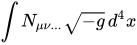
For any tensor fieldNμν... {\ displaystyle N _ {\ mu \ nu ...}} N _ {\ mu \ nu ...} magnitudeNμν...-g {\ displaystyle N _ {\ mu \ nu ...} {\ sqrt {-g}}} N _ {\ mu \ nu ...} {\ sqrt {-g}} can be called tensor density whereg {\ displaystyle g} g - determinant of the metric tensorgμν {\ displaystyle g _ {\ mu \ nu}} g _ {\ mu \ nu} . When the area of ​​integration is small,∫Nμν...-gdfourx {\ displaystyle \ int N _ {\ mu \ nu ...} {\ sqrt {-g}} \, d ^ {4} x} \ int N _ {\ mu \ nu ...} {\ sqrt {-g}} \, d ^ {4} x is a tensor . If the integration domain is not small, then this integral will not be a tensor, since it is a sum of tensors defined at different points and, therefore, is not transformed according to some simple law during coordinate transformations [2] . Only small areas are considered here. The same is true when integrating over a three-dimensional hypersurfaceSν {\ displaystyle S ^ {\ nu}} S ^ {\ nu} .

Thus, Einstein's equations for a small region of pseudo-Riemannian space-time can be integrated over a three-dimensional hypersurfaceSν {\ displaystyle S ^ {\ nu}} S ^ {\ nu} . We have [3]

onefourπ∫(Gμν+Λgμν)-gdSν=2Gcfour∫Tμν-gdSν{\ displaystyle {\ frac {1} {4 \ pi}} \ int \ left (G _ {\ mu \ nu} + \ Lambda g _ {\ mu \ nu} \ right) {\ sqrt {-g}} \, dS ^ {\ nu} = {2G \ over c ^ {4}} \ int T _ {\ mu \ nu} {\ sqrt {-g}} \, dS ^ {\ nu}} \ frac {1} {4 \ pi} \ int \ left (G _ {\ mu \ nu} + \ Lambda g _ {\ mu \ nu} \ right) \ sqrt {-g} \, dS ^ {\ nu} = {2G \ over c ^ 4} \ int T _ {\ mu \ nu} \ sqrt {-g} \, dS ^ {\ nu}

Since the integrable region of space-time is small, we obtain the tensor equation
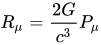
Rμ=2Gc3Pμ{\ displaystyle R _ {\ mu} = {\ frac {2G} {c ^ {3}}} P _ {\ mu}} R _ {\ mu} = {\ frac {2G} {c ^ {3}} P _ {\ mu}

WherePμ=onec∫Tμν-gdSν {\ displaystyle P _ {\ mu} = {\ frac {1} {c}} \ int T _ {\ mu \ nu} {\ sqrt {-g}} \, dS ^ {\ nu}} P _ {\ mu} = {\ frac {1} {c}} \ int T _ {\ mu \ nu} {\ sqrt {-g}} \, dS ^ {\ nu} - 4-pulse,Rμ=onefourπ∫(Gμν+Λgμν)-gdSν {\ displaystyle R _ {\ mu} = {\ frac {1} {4 \ pi}} \ int \ left (G _ {\ mu \ nu} + \ Lambda g _ {\ mu \ nu} \ right) {\ sqrt { -g}} \, dS ^ {\ nu}} R _ {\ mu} = {\ frac {1} {4 \ pi}} \ int \ left (G _ {\ mu \ nu} + \ Lambda g _ {\ mu \ nu} \ right) {\ sqrt {-g} } \, dS ^ {\ nu} - radius of curvature of a small region of space-time.
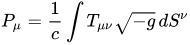
The obtained tensor equation can be rewritten in another form. BecausePμ=mcUμ {\ displaystyle P _ {\ mu} = mc \, U _ {\ mu}} P _ {\ mu} = mc \, U _ {\ mu} that

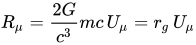
Rμ=2Gc3mcUμ=rgUμ{\ displaystyle R _ {\ mu} = {\ frac {2G} {c ^ {3}}} mc \, U _ {\ mu} = r_ {g} \, U _ {\ mu}} R _ {\ mu} = \ frac {2G} {c ^ 3} mc \, U _ {\ mu} = r_g \, U _ {\ mu}

Whererg {\ displaystyle r_ {g}} r_ {g} - Schwarzschild radius ,Uμ {\ displaystyle U _ {\ mu}} U _ {\ mu} - 4-speed,m {\ displaystyle m} m - gravitational mass. This entry reveals the physical meaning of the values.Rμ {\ displaystyle R _ {\ mu}} R _ {\ mu} as a component of the gravitational radiusrg {\ displaystyle r_ {g}} r_ {g} .

In a small region, space-time is almost flat and this equation can be written in operator form

R^μ=2Gc3P^μ=2Gc3(-iℏ)∂∂xμ=-2iℓP2∂∂xμ{\ displaystyle {\ hat {R}} _ {\ mu} = {\ frac {2G} {c ^ {3}} {{hat {P}} _ {\ mu} = {\ frac {2G} { c ^ {3}}} (- i \ hbar) {\ frac {\ partial} {\ partial x ^ {\ mu}}} = - 2i \, \ ell _ {P} ^ {2} {\ frac { \ partial} {\ partial x ^ {\ mu}}}} {\ displaystyle {\ hat {R}} _ {\ mu} = {\ frac {2G} {c ^ {3}} {{hat {P}} _ {\ mu} = {\ frac {2G} { c ^ {3}}} (- i \ hbar) {\ frac {\ partial} {\ partial x ^ {\ mu}}} = - 2i \, \ ell _ {P} ^ {2} {\ frac { \ partial} {\ partial x ^ {\ mu}}}}

Then the switchboard operatorsR^μ {\ displaystyle {\ hat {R}} _ {\ mu}} {\ hat {R}} _ {\ mu} andx^μ {\ displaystyle {\ hat {x}} _ {\ mu}} {\ hat {x}} _ {\ mu} equals

[R^μ,x^μ]=-2iℓP2{\ displaystyle [{\ hat {R}} _ {\ mu}, {\ hat {x}} _ {\ mu}] = - 2i \ ell _ {P} ^ {2}} [{\ hat {R}} _ {\ mu}, {\ hat {x}} _ {\ mu}] = - 2i \ ell _ {P} ^ {2}

Where do the above uncertainty ratios come from?
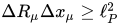
ΔRμΔxμ≥ℓP2{\ displaystyle \ Delta R _ {\ mu} \ Delta x _ {\ mu} \ geq \ ell _ {P} ^ {2}} \ Delta R _ {\ mu} \ Delta x _ {\ mu} \ geq \ ell _ {P} ^ {2}

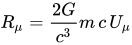
Substituting values ​​hereRμ=2Gc3mcUμ {\ displaystyle R _ {\ mu} = {\ frac {2G} {c ^ {3}}} m \, c \, U _ {\ mu}} R _ {\ mu} = \ frac {2G} {c ^ 3} m \, c \, U _ {\ mu} andℓP2=ℏGc3 {\ displaystyle \ ell _ {P} ^ {2} = {\ frac {\ hbar \, G} {c ^ {3}}} \ ell _ {P} ^ {2} = {\ frac {\ hbar \, G} {c ^ {3}}} and reducing the same symbols on the right and left, we obtain the Heisenberg uncertainty relations .
ΔPμΔxμ=Δ(mcUμ)Δxμ≥ℏ2{\ displaystyle \ Delta P _ {\ mu} \ Delta x _ {\ mu} = \ Delta (mc \, U _ {\ mu}) \ Delta x _ {\ mu} \ geq {\ frac {\ hbar} {2}} } \ Delta P _ {\ mu} \ Delta x _ {\ mu} = \ Delta (mc \, U _ {\ mu}) \ Delta x _ {\ mu} \ ge \ frac {\ hbar} {2}

In the particular case of a static spherically symmetric field and a static distribution of matter, we haveU0=one,Ui=0(i=one,2,3) {\ displaystyle U_ {0} = 1, U_ {i} = 0 \, (i = 1,2,3)} U_ {0} = 1, U_ {i} = 0 \, (i = 1,2,3) and remains

ΔR0Δx0=ΔrgΔr≥ℓP2{\ displaystyle \ Delta R_ {0} \ Delta x_ {0} = \ Delta r_ {g} \ Delta r \ geq \ ell _ {P} ^ {2}} \ Delta R_ {0} \ Delta x_ {0} = \ Delta r_g \ Delta r \ ge \ ell ^ 2_ {P}

Whererg {\ displaystyle r_ {g}} r_ {g} - Schwarzschild radius ,r {\ displaystyle r} r - radial coordinate . HereR0=rg {\ displaystyle R_ {0} = r_ {g}} R_ {0} = r_ {g} , butx0=ct=r {\ displaystyle x_ {0} = c \, t = r} x_ {0} = c \, t = r because at the Planck level matter moves at the speed of light.

The last uncertainty relation allows us to make some estimates of the GR equations with reference to the Planck scale. For example, the expression for the invariant intervaldS {\ displaystyle dS} dS in the Schwarzschild solution has the form

dS2=(one-rgr)c2dt2-dr2one-rg/r-r2(dΩ2+sin2⁡Ωdφ2){\ displaystyle dS ^ {2} = \ left (1 - {\ frac {r_ {g}} {r}} \ right) c ^ {2} dt ^ {2} - {\ frac {dr ^ {2} } {1- {r_ {g}} / {r}}} - r ^ {2} (d \ Omega ^ {2} + \ sin ^ {2} \ Omega d \ varphi ^ {2})} dS ^ {2} = \ left (1 - {\ frac {r_ {g}} {r}} \ right) c ^ {2} dt ^ {2} - {\ frac {dr ^ {2}} {1 - {r_ {g}} / {r}}} - r ^ {2} (d \ Omega ^ {2} + \ sin ^ {2} \ Omega d \ varphi ^ {2})

Substituting here, according to the uncertainty relations, instead ofrg {\ displaystyle r_ {g}} r_ {g} magnituderg≈ℓP2/r {\ displaystyle r_ {g} \ approx \ ell _ {P} ^ {2} / r} r_ {g} \ approx \ ell _ {P} ^ {2} / r will get

dS2≈(one-ℓP2r2)c2dt2-dr2one-ℓP2/r2-r2(dΩ2+sin2⁡Ωdφ2){\ displaystyle dS ^ {2} \ approx \ left (1 - {\ frac {\ ell _ {P} ^ {2}} {r ^ {2}}} \ right) c ^ {2} dt ^ {2 } - {\ frac {dr ^ {2}} {1 - {\ ell _ {P} ^ {2}} / {r ^ {2}}}} - r ^ {2} (d \ Omega ^ {2 } + \ sin ^ {2} \ Omega d \ varphi ^ {2})} {\ displaystyle dS ^ {2} \ approx \ left (1 - {\ frac {\ ell _ {P} ^ {2}} {r ^ {2}}} \ right) c ^ {2} dt ^ {2 } - {\ frac {dr ^ {2}} {1 - {\ ell _ {P} ^ {2}} / {r ^ {2}}}} - r ^ {2} (d \ Omega ^ {2 } + \ sin ^ {2} \ Omega d \ varphi ^ {2})}

It is seen that at the Planck levelr=ℓP {\ displaystyle r = \ ell _ {P}} r = \ ell _ {P} invariant intervaldS {\ displaystyle dS} dS bounded below by the Planck length, division by zero appears on this scale, which means the formation of real and virtual Planck black holes.

Similar estimates can be made for other GR equations.

The above uncertainty relations are valid for any gravitational fields.

According to theoretical physicists [4] , virtual black holes must have a mass of the order of the Planck mass (2.176 · 10 −8 kg), a lifetime of the order of the Planck time (5.39 · 10 −44 seconds), and form with a density of about one on the Planck volume . Moreover, if virtual black holes exist, they can trigger the proton decay mechanism. Since the black hole mass first increases due to the mass falling on the black hole, and then decreases due to Hawking radiation, the emitted elementary particles, in general, are not identical to those falling into the black hole. Thus, if two quarks that make up a proton fall into a virtual black hole, then antiquark and lepton may appear, which violates the law of conservation of the baryon number [4] .

The existence of virtual black holes aggravates the disappearance of information in a black hole , since any physical process can potentially be disrupted as a result of interaction with a virtual black hole [5] .

The formation of a vacuum consisting of virtual Planck black holes ( quantum foam ) is energetically most favorable in three-dimensional space [6] , which, probably, predetermined the 4-dimensionality of the observed space-time.

Notes

  1. ↑ SW Hawking (1995) " Virtual Black Holes "
  2. ↑ P.AM.Dirac General Theory of Relativity, M., Atomizdat , 1978, p.39
  3. ↑ Klymets A.P. Comprehending the universe. LAP LAMBERT Academic Pablishing, Deutschland, 2012, p.79 - 95
  4. 2 1 2 Fred C. Adams, Gordon L. Kane, Manasse Mbonye, ​​and Malcolm J. Perry (2001), Proton Decay, Black Holes, and Large Extra Dimensions , Intern. J. Mod. Phys. A , 16 , 2399.
  5. ↑ The black hole information paradox , Steven B. Giddings, arXiv: hep-th / 9508151v1.
  6. ↑ APKlimets FIZIKA B (Zagreb) 9 (2000) 1, 23 - 42
Source - https://ru.wikipedia.org/w/index.php?title=Virtual_ black_hole&oldid = 87804693


More articles:

  • Vodopadnaya street (Novokuznetsk)
  • Kalevras, Efthimios
  • Krasnov, Ivan Tarasovich
  • Heinald, Layosh
  • Numerical Wind Tunnel
  • Hemiri, Yunas Hassen
  • Cartridges (Town)
  • Apraksina (village)
  • Swimming at the 2000 Summer Olympics 200m backstroke (men)
  • Lopets

All articles

Clever Geek | 2019