
The term Baby Monitor has other meanings - see Baby Monitor .
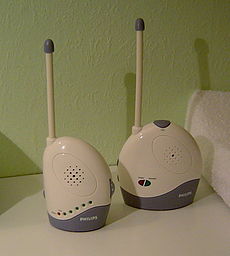
Baby monitor is a radio system for remotely listening to sounds made by a baby . The audio monitor (often referred to as the “baby monitor” ) is a transmitting device equipped with a microphone, which is placed next to the baby. It transmits sounds through radio waves to a receiver with a loudspeaker that is carried or placed by a person who is looking after the child. Some baby monitors provide two-way communication, which allows the caretaker to speak with the child. Some models allow you to play music for the baby. A monitor equipped with a video camera is often called a "baby monitor. "
One of the main purposes of children's monitors is that it allows the caretaker to hear when a child wakes up, being outside the hearing zone. Despite their frequent use, there is no evidence that these monitors prevent sudden infant death syndrome , and many doctors believe that monitors only give a false sense of security. [one]
The first children's monitor was Radio Nurse, created in 1937. [2]
Content
Baby video monitors (baby monitors)
Some baby monitors have a video camera for displaying images on a receiving device that is connected to a TV or equipped with a LCD screen .
Due to the “night vision” function, some baby monitors are able to work at night, at low light levels. Lighting with infrared LEDs located on the front of the camera allows you to see the baby in a dark room. As a rule, video monitors with night vision function automatically switch to this mode when it gets dark.
Monitors with motion sensors
Such monitors are equipped with a touch pad placed under the crib mattress to detect movements. If the movement stops for more than 20 seconds, a beep will sound. [3]
Wired and Wireless
Mostly children's monitors use wireless communication, but there are also models that transmit a signal through wires or through household power lines , for example, according to the X10 standard.
Wireless systems use radio frequencies allocated by governments for non-licensed use. For example, in North America, frequencies in the 49 MHz , 902 MHz, or 2.4 GHz bands are available. Although these frequencies are not intended for high-power television or radio transmitters, interference from other wireless devices such as cordless phones , radio-controlled toys, wireless computer networks , radars , smart meters, and microwave ovens is possible.
Smartphones as baby monitors
Smartphone applications such as "Baby Monitor 3G" or "Baby Monitor & Alarm" allow the user to use a device equipped with a camera, such as another smartphone or tablet , as a baby monitor. An alternative is hardware monitors, such as Withings or BabyPing, which provide Wi-Fi images from their camera to a specialized application on a smartphone or tablet. Such devices, as a rule, have more features and are more reliable.
Other features
Portable, battery- powered receivers can be carried around the house. The transmitter remains next to the crib and is usually plugged into a home electrical outlet. Some baby monitors come with two receivers.
The sound signal on the receivers of children's monitors can be duplicated by a visual signal, which allows you to use them in those places where sound signals are undesirable. Some receivers have a vibration signal mode, which is especially convenient for people with hearing impairments.
Systems with several transmitters can be used to track several rooms in a house at once. [four]
Newer models of baby monitors are often equipped with temperature sensors.
Recording still images on microSD cards is also a new feature introduced in some baby monitors. [five]
Standards
The new voluntary international standard ASTM International F2951 was developed to prevent the possibility of suffocation due to entanglement of babies in the wires of children's monitors. This standard for children's monitors includes the requirements for digital audio, video monitors and monitors with motion sensors [6] .
Notes
- ↑ BUPA ADVICE
- ↑ Onion, Rebecca The World's First Baby Monitor: Zenith's 1937 “Radio Nurse” . (eng.)
- ↑ Mommy Review - BabySense V monitor
- ↑ Baby Safety Monitors . ChildProofingTips.com . (eng.)
- ↑ Review of Lorex LIVE snap . pnmag.com . (eng.)
- ↑ Baby Monitors Safety Standards SGS Consumer Testing Services, Retrieved 07/07/2013