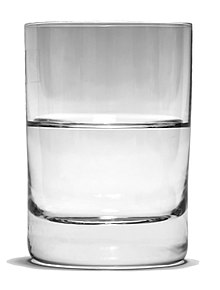
A glass is half empty or half full - a commonly used expression used as a rhetorical question that allows one to determine a person’s worldview as a whole, or his attitude to a particular situation as pessimistic (the glass is half empty) or optimistic (the glass is half full) [1] [2] .
This idiom is used to explain how people perceive events and objects. The worldview of each person is unique and represents only one of the interpretations of reality [3] .
This expression in English ( Eng. Is the glass half empty or half full ) also served as the basis for characterizing a person who adheres to one or another point of view on the world [4] . So, the expressions “a person for whom the glass is half empty” ( English glass half-empty person ), describing the pessimist, and “a person for whom the glass is half full” ( English glass half-full person ), characterizing the optimist are widespread.
See also
- The effect of "less is better"
Notes
- ↑ Encyclopedia of dslov.ru
- ↑ Stephanie Stokes Oliver. Seven Soulful Secrets for Finding Your Purpose and Minding Your Mission . - Crown Publishing Group , 2001-11-27. - P. 106–. - “I love that proverbial question,“ Do you see the glass as half empty or half full? ”It's like the litmus test for how you see the world. Optimists have a tendency to hope for the best. That doesn't mean they hope for the best sometimes. It means that ... ". - ISBN 978-0-385-48767-2 .
- ↑ Terry Bookman. A Soul's Journey: Meditations on the Five Stages of Spiritual Growth . - iUniverse 2004-12. - P. 157–. - "When is the glass half empty for you? Half full? What prevents you from seeing it (at least) as half full all the time? Fill a glass halfway with water. Look at it for a few moments. Is the glass half empty or half full? This classic question is not an ... ". - ISBN 978-0-595-77439-5 .
- ↑ Christine Ammer. The American Heritage® Dictionary of Idioms . Houghton Mifflin Harcourt Publishing Company (1997, 2003). Date of treatment September 9, 2013.