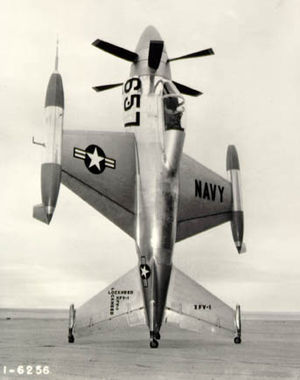
XFV-1 - an experimental turboprop aircraft - a vertical take-off and landing fighter created in the early 1950s by Lockheed .
| Lockheed XFV-1 | |
|---|---|
 | |
| Type of | experimental turboprop aircraft - vertical takeoff and landing fighter |
| Manufacturer | Lockheed |
| The first flight | June 16, 1954 |
| Operators |  US Navy US Navy |
| Years of production | 1954 |
| Units produced | 2 |
Content
- 1 History of creation
- 2 Flight performance
- 3 See also
- 4 notes
Creation History
In 1950, the U.S. Navy issued terms of reference for a vertical take-off and landing fighter capable of being deployed on conventional ships (not aircraft carriers) in order to defend naval convoys from air attacks. Two firms: Convair and Lockheed developed the XFY-1 and XFV-1 aircraft, respectively, to meet this TK. Both aircraft were equipped with one turboprop engine and had to take off and land, turning their longitudinal axis to a vertical position, that is, to the tail (see figure). Tests of the XFV-1 began in March 1954. At the initial stage of the tests, it was decided to take off and land in the traditional way for an airplane, for which purpose the landing gear supports were docked. Later, a series of successful vertical take-offs with a transition to horizontal flight and landings were performed. However, the US Navy closed the program, and serial production of the aircraft never started [1] .
Flight performance
Data Source: RAF Flying Review. Vol. XVII, No 9.
- Specifications
- Crew : 1
- Length : 11.43 m
- Wing span : 8.35 m
- Height :
- Wing Area: 22.88 m²
- Empty weight: 5266 kg
- Maximum take-off weight : 7364 kg
- Powerplant : 1 × TVD
- Flight characteristics
- Maximum speed: 933 km / h (calculated)
- Practical ceiling : 13,200 m (calculated)
- Rate of climb : 55 m / s (calculated)
- Armament
- Shooting gun: 2 × 20 mm
See also
- Convair XFY-1
- Focke-wulf triebflügel
- Heinkel lerche
- Ryan X-13 Vertijet
Notes
- ↑ RAF Flying Review. Vol. XVII, No 9.