Islam in Hungary has a long history that dates back to the 12th century. In the days of the Ottoman Hungary, the influence of Muslims increased. In the Old Hungarian language, Muslims called bezormen. This term has been preserved both as a surname and as part of the name of the city of Haidubosermen [1] .
| Islam in Hungary | |
|---|---|
 | |
| Number of muslims | from 3,000 to 20,000 |
| Islamic states | Ottoman Hungary (1541–1699) |
| Wikimedia Commons | Islam in Hungary |
Early Middle Ages
The first Islamic author to mention the Muslim community of Hungary was Yakut al-Hamavi (1179–1229), who wrote about a Hungarian student who studied in Aleppo. According to the student, there were 30 Muslim villages in Hungary [2] . The Spanish traveler Abu Hamid al-Garnati wrote about two Muslim communities in Hungary: the Beserman and the Volga Bulgars .
In the 11th century, discriminatory laws were introduced that led to the disappearance of the community [3] .
Ottoman Hungary
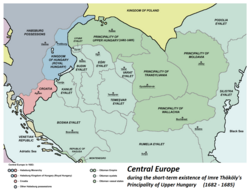
After the defeat of the combined Hungarian-Czech-Croatian army at the Battle of Mojac on August 29, 1526, most of the Hungarian lands fell under the rule of the Ottoman Empire. From 1541 the Turks began to control Central Hungary, where they organized five missions ( Buda , Kanizha, Temesvár , Eger, Varad ).
In place of the Hungarian lands conquered by the Ottomans, a new region was formed - Ottoman Hungary, which existed in the years 1526-1699. The Hungarian peasantry of the south-east of the country regarded the arrival of the Turks as an exemption from the dominance of the local feudal lords , who besieged them with excessive dues. In an effort to attract the Hungarian peasants to their side, the Turks liberalized many areas of the life of the Hungarian peasantry. In contrast to the bloody feuds between Catholics and Protestants of Europe at that time, the Turks did not prohibit any of the religions, although the conversion to Islam was strongly encouraged.
Taking advantage of the chaos of the post-war years and the birth of a new Muslim community, many ordinary Hungarians, who converted to Islam ( Magyarabs ), managed to climb the career ladder of the Ottoman military classes. Residents of the northern Hungarian lands put more resistance to the Turks, creating groups of haidus . Many also fled to the neighboring Slovak lands to the north. After the failed siege of Vienna, the Austrian Germans set about more decisive actions against the Turks, and a gradual “ reconquest ” of the Balkan Peninsula begins. After the battle of Mohach, the European nations began to attempt to unite in order to counter the threat of the Islamization of Europe. This strategy brought the first success in the battle of Lepanto in 1571. In addition, despite its initial success, it was in Hungary that the Turks first encountered the Western European socio-political structure, which had a strong German influence and was already significantly different from the Orientalized Greco-Slavic states of the Balkan region, so easily conquered by the Turks.
Due to the remoteness of Hungary, the Turkish occupation did not lead to a radical change in the national, religious and linguistic composition of the population, but over time a number of changes in religious terms became tangible. Muslims , about 80 thousand people, mostly military mercenaries of South Slavic origin, settled mainly in the major cities of Hungary, under the protection of the fortress walls. Each city had both a Muslim quarter adjoining a mosque and a Christian district adjoining a church. Christianity was not forbidden and not persecuted, because the Turks did not want to arouse the anger of the local population, but the Christian church was left without a livelihood. It was deprived of the financial support of the state, and the Christian subjects of the empire ( paradise ) were obliged to pay a special tax ( jizya ), taking away the funds previously provided to the church tithe . Many large city churches were converted into mosques, and minarets attached to them. Since the Muslims formed the basis of the new ruling class and possessed considerable property, they feared attacks from the Haidus, they moved from city to city only under the protection of military convoys. The rural regions of Hungary, as well as the entire agriculture (primarily crop production) in the Balkans, declined under the Turks because of migration processes, hostilities, guerrilla activity and the extreme inefficiency of local government suffering from chronic bribery. Transhumance, which the ancient Hungarians took over from the Turks before coming to Central Europe, on the contrary, was revived. But large urban settlements at the same time received an incentive for development, becoming a concentration of new eastern influences. In the 17th century, 165 main ( mektepy ) and 77 secondary and higher theological schools ( madrasas ) appeared in the Ottoman Hungary in 39 urban settlements of Hungary. The schools taught writing, arithmetic, reading the Koran and prayer. The Turks also built Turkish baths , mosques and fountains. Most of them were destroyed by the Austrian Habsburgs during the Balkan "reconquest". Only a few monuments have survived.
Due to the death or migration of a significant part of the Hungarian nobility and large landowners, a number of ordinary Hungarians took advantage of new opportunities provided by the Turkish military-administrative apparatus, converted to Islam , entered the service of the Sultan and received significant opportunities for local self-government. Some of them ( Magyarabs ) moved or were resettled in other areas of the empire, becoming part of the Turkish ethnic group. Many captured Hungarians were sold into slavery in Rumelia and Anatolia .
Modernity
According to the 2001 census, 3201 Muslims lived in Hungary, which was 0.03% of the population [4] . The leader of the Islamic community of Hungary, Zoltan Bolek, estimated the number of Muslims in 2004 at about 20,000 (0.2% of the total population) [5] .
In 2011, the Law “On the Right to Religious Freedom and Conscience, on the Legal Status of Churches, Religious Denominations and Religious Organizations” was adopted, which legally recognized only 14 Churches and religious communities. For religious communities that have not yet received any recognition, the new law regulated a special procedure for obtaining full legal status. At the end of February 2013, the Constitutional Court of Hungary abolished certain provisions of the law on granting official status to churches and ordered the Hungarian parliament to work out new rules for registering religious organizations [6] .
In May 2013, an exhibition of the Hungarian painter Tsegledi Lajos, dedicated to the pillars of the Islamic faith, was held at the Hassan Pasha Mosque in Pécs [7] .
Notes
- ↑ Hajduboszormeny | HajduPorta (inaccessible link)
- "The Islamic Review", London, February 1950, 38th vol., No.2
- ↑ Ladislaus I law
- ↑ nepszamlalas.hu
- ↑ Hungarian terror group received Saudi funding Archive dated June 5, 2009 at Wayback Machine jihadwatch.org
- Венг The Hungarian Constitutional Court repealed the controversial articles of the law on the registration of churches . Institute of Religious Freedom (March 12, 2013). The appeal date is September 7, 2013.
- ↑ An exhibition dedicated to the pillars of the Islamic faith . islam-today.ru (May 14, 2013). The appeal date is September 7, 2013.
Links
- Nasyrov, Ilshat "Bashkirdy" in Pannonia . islamdag.ru (June 24, 2009). The appeal date is September 7, 2013.