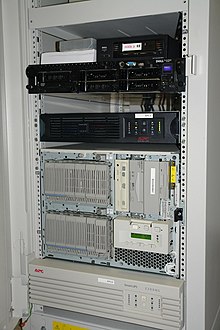
A source (system [1] , unit [2] ) of uninterruptible power supply (UPS) , UPS ( Uninterruptible Power Supply (Source, Systems) ) is a power source that provides power supply during short-term shutdown of the main source, as well as protection against interference in main source network. The UPS is a secondary power source [3] [4] Both the quality of electrical energy and the parameters of electrical energy (voltage, frequency) can undergo conversion. [five]
Uninterruptible power supplies developed in parallel with computers and other high-tech devices for reliable power supply of this equipment, which standard power supply networks cannot provide. [6] The most widely used designs are as a standalone device, including a battery and a DC / AC converter. Also, flywheels and fuel cells can be used as a backup source. Currently, the UPS power is in the range of 100 W ... 1000 kW (or more), various values of output voltages are possible. [6]
Reasons to use
Short-term disturbances in the normal operation of the electrical network are inevitable. Most short-term power outages are caused by short circuits. It is almost impossible to completely protect the electric network from them, or, in any case, it would be very expensive. [7] Short-term power outages occur much more often than long-term interruptions. A long power outage can be avoided by using automatic reserve transfer (ATS) . At the same time, short-term power interruptions will occur not only with a short circuit on any of the ATS supply lines, but also on the lines supplying neighboring consumers. [7]
Uninterruptible from guaranteed power supply differs in that in the case of guaranteed power supply, a break is allowed for the duration of putting the backup source into operation. In the event of uninterrupted power supply, “instantaneous” commissioning of the backup source is required. This important requirement limits the range of backup sources suitable for uninterruptible power supply. In practice, usually only one such source can be used - the battery. [eight]
The main function of the UPS is to provide continuous power through the use of an alternative energy source. In addition, the UPS improves the quality of the power supply by stabilizing its parameters within specified limits. In a UPS, chemical current sources are usually used as an energy storage device. In addition to them, other drives can be used. [4] As the primary source, power supplied from the mains or generator may be used. [4]
Industry
Sophisticated technological equipment of modern industrial production cannot function normally if the power supply is not uninterrupted. For many industrial enterprises, a power outage of a few seconds or even tenths of a second leads to disruption of the continuous process and to a halt in production. [7]
If the permissible time of a power interruption is less than 0.2 s, only the use of uninterruptible power supplies is possible, protection by circuit breakers with a short circuit to reduce the time of a power interruption in this case is impossible or ineffective. If the permissible time is more than 0.2 s, it is possible to use power protection or use uninterruptible power supplies. With a permissible time of 5 ... 20 s, it is possible to refuse uninterruptible power supplies and use ABP. [7]
For electric motors, voltage drops in the 0.4 kV network with a duration of 0.3 ... 0.5 s can lead to the fact that the vectors of the residual EMF of the electric motors can be out of phase with the network voltage vectors. As a result, when power is restored, the electromagnetic releases of the circuit breakers will trip and the motors will be permanently disconnected. At the same time, voltage dips with a duration of less than 0.3 s are not dangerous, therefore, for electric motors, the struggle with voltage dips is usually aimed at preventing contactors from disconnecting in the 0.4 kV main power circuit. One of these measures is to power the contactor control circuits from an uninterruptible power supply. [9]
The susceptibility of industrial controllers on logic circuits to voltage dips is similar to the susceptibility of computers. [6]
Violation of the operation of contactors and relays can occur when the voltage is interrupted 5 ... 10 ms and 80 ... 120 ms. The difference in the operation of the same device occurs due to the difference in the instantaneous value of the AC voltage when the voltage dip has begun. With the passage of voltage through zero, the stability is more than 10 times greater. [6]
In households and offices
The most common application in everyday life and in offices is turning off the computer without data loss during a power outage. With voltage dips of 0.2 s duration, the computer read / write procedures are stopped; 0.25 c - blocking the operating system; 0.4 s - reboot. [6]
Emergency
The power sources that are used in the event of a power outage are divided into backup and power sources for security systems. [ten]
Regulation
The International Electrotechnical Commission adopted a group of standards:
- IEC 62040-1 Continuous Energy Systems (UPS). Part 1. General provisions and safety requirements for UPS; [eleven]
- IEC 62040-2 Uninterruptible Power Systems (UPS). Part 2. Requirements for electromagnetic compatibility; [12]
- IEC 62040-3 Continuous energy systems. Part 3. Method for determining operational and testing requirements; [13]
- IEC 62040-4 Uninterruptible Power Systems (UPS). Part 4. Environmental aspects. Requirements and presentation of information [14]
- IEC 62040-5-3 Uninterruptible Power Systems (UPS). Part 5-3. UPS DC. Performance and Test Requirements [15]
UPS International Classification
The following UPS classification is introduced by IEC 62040-3:
UPS Type Designation Example: VFI SS 111
The 1st group of characters is the dependence of the output signal of the UPS on the input (network).
- Class VFI (Voltage and Frequency Independent) - the voltage and frequency at the output of the UPS are independent of the input network.
- Class VI (Voltage Independent) - the UPS output depends on the input frequency, but the voltage is maintained within the specified limits by passive or active regulation.
- Class VFD (Voltage and Frequency Dependent) - the voltage and frequency at the output of the UPS depend on the input network.
2nd group of characters - UPS output signal form.
- SS is the sinusoidal shape of the output signal ( harmonic distortion coefficient K gi <8%) with linear and non-linear load.
- XX - non-sinusoidal output waveform with non-linear load (sinusoidal with linear).
- YY is a non-sinusoidal waveform at any load.
3rd group of characters - dynamic characteristics of the UPS. Ensuring the stability of the output voltage of the UPS during three types of transients (1 - class 1, excellent; 2 - class 2, good; etc.):
- 1st digit: normal mode -> offline mode -> bypass mode,
- 2nd digit: 100% change in linear load in normal or offline mode (worst case),
- 3rd digit: 100% change in non-linear load in normal or offline mode (worst case).
AC UPS
Initially, AC UPSs consisted of a diesel engine, an electric motor, a flywheel, and an electric generator . When turning off the power coming from the mains, due to the inertia of the flywheel, the generator continued to work until the diesel engine started. [6]
The history of electronic AC UPSs begins with the invention of thyristors in 1957. In 1964 ... 1967 UPSs with redundancy up to 500 kVA were created. To date, the main design change is to replace thyristors with IGBT transistors. [6]
Redundant Scheme
Redundant circuit ( Off-Line, Standby ) - in normal mode, the connected load is supplied directly from the primary electrical network, which the UPS filters (high-voltage pulses and electromagnetic interference) with passive filters. When the power supply goes beyond the normalized voltage values (or its disappearance), the load is automatically reconnected to the power from the circuit, which receives electric energy from its own batteries using a simple inverter . When voltage appears within normal limits, it again switches the load to the power supply from the primary network.
Advantages:
- due to the efficiency of about 99% (in the presence of mains voltage) they are almost silent and have minimal heat emission;
- low cost of the UPS as a whole.
Disadvantages:
- relatively long switching time [16] (about 6..10 ms) to battery power;
- the inability to adjust either voltage or frequency (VFD according to IEC classification).
- non-sinusoidal form of the output voltage when operating on battery power (approximated sinusoid, quasi-sinusoid);
Most often, UPS built according to this scheme is used to power personal computers or workstations of entry-level local area networks , for which timely shutdown in case of a network failure is not critical. Almost all inexpensive low-power UPSs offered on the domestic market are built according to this scheme.
Interactive Scheme
Interactive scheme ( English Line-Interactive ) - the device is similar to the previous scheme; In addition, a step-by-step voltage stabilizer based on an autotransformer is present at the input, allowing one to obtain an adjustable output voltage. (VI according to IEC classification). When operating in normal mode, such UPSs do not adjust the frequency, passive filters filter the incoming AC voltage. In the event of a power failure, the UPS transfers to power from the inverter, similar to the previous one.
Inverters of some models of linear-interactive UPS give voltage as a rectangular or trapezoidal shape, as in the previous version, and a sinusoidal shape. The switching time is shorter than in the previous version, since the inverter is synchronized with the input voltage. The efficiency is as high as that of the backup ones [17] .
Disadvantages: in the "on-line" mode it does not perform the function of filtering peaks, and provides only extremely primitive voltage stabilization (usually 2-3 autotransformer stages, relay-switched, the function is called "AVR").
In the battery mode, some, especially cheap, circuits give the load a frequency much higher than 50 Hz, and an AC waveform that has little in common with a sine wave. This is due to the use of a classic large-sized transformer in a circuit (instead of an inverter on semiconductor switches). Due to the fact that a transformer of this size has (due to the occurrence of hysteresis in the core) a limit on the transmitted power, which increases linearly with frequency, this transformer (occupies 1/3 of the total volume of the UPS) is enough to power the battery charging circuit at 50 Hz in the "network" mode. But, in the “on battery” mode, hundreds of watts of power must be passed through this transformer, which is possible only by increasing the frequency.
This leads to the inability to power devices using, for example, induction motors (almost all household appliances , including heating systems).
In fact, from such a UPS you can only power devices that are undemanding to the quality of power, that is, for example, all devices with pulse power supplies, where the supply voltage is immediately rectified and filtered. That is, computers and a significant part of modern consumer electronics. You can also power the lighting and heating appliances.
Double Conversion Scheme
Double conversion mode [18] ( Eng. Online , double-conversion, online) - is used to power loaded servers (for example, file ), high-performance workstations of local area networks, as well as any other equipment with high demands on the quality of network power. The principle of operation is double conversion of the current type. First, the input alternating current is converted to direct current, then back to alternating current using an inverter . If the input voltage fails, switching the load to the battery power is not required, since the batteries are constantly connected to the circuit (the so-called buffer mode of the battery) and for these UPSs the “switching time” parameter does not make sense. For marketing purposes, the phrase "switching time is 0" can be used, correctly reflecting the main advantage of this type of UPS: the absence of a period of time between the loss of external voltage and the beginning of battery power. Double conversion UPSs have low efficiency (from 80 to 96.5%) in the on-line mode, which is why they differ in increased heat generation and noise level. However, modern UPSs of medium and high capacities of leading manufacturers have a variety of intelligent modes that automatically adjust the operating mode to increase efficiency up to 99%. Unlike the two previous schemes, they are able to correct not only the voltage, but also the frequency (VFI according to IEC classification).
Advantages:
- lack of time to switch to battery power;
- sinusoidal shape of the output voltage, that is, the ability to power any load, including heating systems (in which there are asynchronous motors).
- the ability to adjust both voltage and frequency (moreover, such a device is at the same time the best possible voltage stabilizer).
Disadvantages:
- Low efficiency (80-94%), increased noise and heat dissipation. Almost always, the device contains a computer-type fan, and therefore it is not noiseless (unlike line-interactive UPS).
- High price. About two to three times higher than line-interactive.
“Standby” UPS construction scheme “Interactive” UPS construction scheme Double conversion UPS design
DC UPS
A DC UPS differs from other circuits in the absence of an inverter.
UPS Specifications
- output power measured in volt-amperes (VA) or watts (W). It is worth paying attention that equipment containing powerful electric motors (refrigerator, submersible pumps of autonomous water supply systems and irrigation systems) has “starting currents”. This means that at the time of starting the engine, the device briefly consumes power, 5-7 times higher than the nameplate. The UPS must be selected with this in mind. The same applies to laser printers, which are generally generally forbidden to connect to the UPS;
- output voltage, measured in volts , V;
- switching time [16] , that is, the time the UPS switches to battery power (measured in milliseconds, ms);
- battery life is determined by the capacity of the batteries and the power of the equipment connected to the UPS (measured in minutes, min.), for most office UPSs it is 4-15 minutes ; (usually 40-45 minutes with fresh batteries and an unloaded computer).
- the width of the input (mains) voltage range at which the UPS is able to stabilize power without switching to rechargeable batteries (measured in volts, V);
- battery life (measured over the years , usually lead-acid batteries significantly lose their capacity after 2-3 years. It depends heavily on the quality, and therefore the price of the UPS, specifically on the degree of primitiveness of its battery charging circuit).
Design
Power Storage Devices
Chemicals
The implementation of the main function is achieved by operating the device from the batteries installed in the UPS case, under the control of the electrical circuit, therefore, any UPS except the control circuit includes a charger that charges the batteries when there is voltage in the network, thereby ensuring constant readiness for UPS operation offline. To increase the battery life, you can equip the UPS with an additional (external) battery.
In uninterruptible power supplies can be used chemical current sources (HIT):
- emergency battery - a HIT battery that supplies the necessary electric energy to the circuit during interruptions in the operation of a normal energy source;
- buffer battery - a HIT battery connected in parallel to a constant current source to reduce the effect of energy fluctuations on the source. [nineteen]
An electric battery is a secondary chemical current source. [20]
Dynamic
Capacitors
The main difference between capacitors and batteries is that capacitors directly store electrical charge, and batteries convert electrical energy into chemical energy, store it, and then reverse conversion occurs. However, the capacitance of electrolytic capacitors is insufficient for use in long-running uninterruptible power supplies. Ionistors have a much larger capacity. [21]
When using DC ATS using a relay circuit, a large capacitor can be used to exclude power interruptions during the switching time. [9]
Bypass
Bypass is one of the components of a UPS unit. Bypass mode ( English Bypass , “bypass”) - power supply to the load by filtered mains voltage bypassing the main UPS circuit. Switching to Bypass mode is performed automatically or manually (manual switching is provided in case of carrying out preventive maintenance of the UPS or replacing its components without disconnecting the load). Can do so-called. pheasant (through zero). It is used in online circuits, moreover, turned off by the OFF button online UPS remains in bypass mode, the same thing happens when the power components of the circuit are destroyed, determined by the control circuits, as well as when the circuit breaks when the output is overloaded. In line-interactive UPS, the network mode is bypass.
AC voltage regulator
Used in UPSs that operate in an interactive manner. Often, the UPS is equipped with only a boosting booster , which has only one or several steps of boosting, but there are models that are equipped with a universal regulator that works to boost and reduce voltage buck. The use of stabilizers allows you to create a UPS circuit that can withstand long deep "subsurfacing" and "subsidence" of the input mains voltage (one of the most common problems of domestic power grids) without switching to rechargeable batteries, which can significantly increase the battery life.
Inverter
An inverter is a device that converts the kind of voltage from direct to alternating (similarly, alternating to direct). The main types of inverters:
- inverters that generate rectangular voltage;
- inverters with step-by-step approximation;
- pulse width modulated inverter (PWM) .
- pulse density modulation converter (IPM, eng. Pulse-density modulation )
An indicator that characterizes the degree to which the voltage or current waveform differs from the ideal sinusoidal waveform is the Total Harmonic Distortion (THD ). Typical Values:
- 0% - the waveform fully corresponds to the sinusoid;
- about 3% - a form close to sinusoidal;
- about 5% - a waveform close to sinusoidal;
- up to 21% - the signal has a trapezoidal or stepped shape (modified sine or meander);
- 43% and above is a square wave signal (meander).
To reduce the effect on the shape of the voltage in the supply network (if the input node of the UPS constructed according to the double conversion circuit is a thyristor rectifier, the element is non-linear and consumes a large pulsed current, such a UPS causes higher-order harmonics) a special THD is installed in the input circuit of the UPS filter . When using transistor rectifiers, the harmonic distortion coefficient ( Total Harmonic Distortion, THD ) is about 3%, and filters are not used.
Transformer
Galvanic isolation between the input and output (as a rule, this is not done in the UPS at all for the fundamental reasons of passing “through zero” to the load, that is, the absence of any switching of the neutral wire from the UPS input to its output) is carried out by the UPS installed in the input circuit (between the mains and rectifier) input isolation transformer . Accordingly, in the output circuit of the UPS between the converter and the load there is an output isolation transformer that provides galvanic isolation between the input from the UPS circuit and the output to the connected load.
Interface
For advanced monitoring of the status of the UPS itself (for example, battery charge level, parameters of the electric current at the output), various interfaces are used: for connecting to a computer - serial ( COM ) port or USB , while the UPS manufacturer delivers proprietary software that allows, after analyzing the situation , determine the operating time and give the operator the opportunity to safely turn off the computer, completing all programs. To monitor the status of uninterruptible power supplies and other equipment through the local area network , the SNMP protocol and specialized software are used.
In order to increase the reliability of the entire system as a whole, redundancy is used - a circuit that consists of two or more UPSs.
Manufacturers
Распределение продаж ИБП по производителям (2017 г., «IT Research»):
| Поставщик | млн долл. | % | Comment |
|---|---|---|---|
| Schneider Electric | 128,1 | 39,6 % | Ранее бренд APC, сейчас поглощен гигантом Schneider Electric [22] |
| Ippon | 28.0 | 8,7 % | Бренд представлен только в РФ, данные не проверяются по сайту производителя [23] и держателя бренда [24] |
| Eaton | 25.7 | 8 % | Общая прибыль 770 млн.долл. ( [25] ), пропорция взята из более ранних отчетов |
| Delta | 19,0 | 5,9 % | Имеется в виду Delta Energy Systems [26] , не имеющая отношения к бренду батарей Delta в РФ |
| Powercom | 18.0 | 5,6 % | Ошибочно указана доля на рынке РФ, а не мировом [27] |
| Данные не подтверждены документально | |||
| Cyberpower | 9,4 | 2,9 % | На международном сайте не указана информация позволяющая отделить прибыль по основному сегменту ИБП от прибыли с продажи сопутствующих товаров и услуг [28] |
| Vertiv Liebert | 8,3 | 2,6 % | |
| GE Digital Energy | 7.8 | 2,4 % | |
| Huawei | 7.5 | 2,3 % | |
| Legrand | 7.3 | 2,3 % | |
| ABB | 7.3 | 2,2 % | |
| ELTENA (Inelt до 2018 года [29] ) | 6.8 | 2,1 % | |
| Makelsan | 5.7 | 1,7 % | |
| Riello | 4.9 | 1,5 % | |
| Powerman | 4.6 | 1,4 % | |
| Socomec UPS | 4.2 | 1,4 % | |
| Benning | 2,8 | 0.9% | |
| FSP | 2,4 | 0,7 % | |
| Dexp | 2.2 | 0,7 % | |
| 3Cott | 1.9 | 0.6 % | |
| Tripp Lite | 0.4 | 0,4 % | |
| Irbis | 0.6 | 0,2 % | |
| Sven | 0.5 | 0,2 % | |
| Total | 323,2 | 100,00 % |
Notes
- ↑ ГОСТ 27699-88 Системы бесперебойного питания приемников переменного тока. Общие технические условия
- ↑ ГОСТ МЭК 62040-3-2009 Системы гарантированного электроснабжения. Агрегаты бесперебойного питания. Часть 3. Общие технические требования. Методы испытаний
- ↑ ГОСТ Р 53560-2009 Системы тревожной сигнализации. Источники электропитания. Классификация. General technical requirements. Методы испытаний.
- ↑ 1 2 3 ГОСТ IEC 62040-1-2013 Системы бесперебойного энергоснабжения (UPS). Часть 1. Общие требования и требования безопасности к UPS
- ↑ ГОСТ 18311-80 Изделия электротехнические. Термины и определения основных понятий п.4
- ↑ 1 2 3 4 5 6 7 Куско А., Томпсон М. Сети электроснабжения. Методы и средства обеспечения качества энергии —Саратов: Профобразование, 2017
- ↑ 1 2 3 4 Гуревич Ю. Е., Кабиков К. В. Особенности электроснабжения, ориентированного на бесперебойную работу промышленного потребителя —М.: Элекс-КМ, 2005.
- ↑ Бушуев В. М. Электропитание устройств связи —М.: Радио и связь, 1986. С. 122
- ↑ 1 2 Гуревич В. И. Устройства электропитания релейной защиты. Проблемы и решения —М.: Инфра-Инженерия, 2013
- ↑ ГОСТ 30331.1-2013 (IEC 60364-1:2005) Электроустановки низковольтные. Часть 1. Основные положения, оценка общих характеристик, термины и определения пп.20.55, 20.101
- ↑ IEC 62040-1(2008) | Электронный магазин стандартов
- ↑ IEC 62040-2(2005) | Электронный магазин стандартов
- ↑ IEC 62040-3(1999) | Электронный магазин стандартов
- ↑ IEC 62040-4(2013) | Электронный магазин стандартов
- ↑ IEC 62040-5-3(2016) | Электронный магазин стандартов
- ↑ 1 2 Важно знать : нагрузка обесточивается на время переключения ИБП на питание от аккумуляторных батарей и обратно! Поэтому ИБП интерактивного и offline-типа (независимо от уровня его собственной надёжности) не может считаться высоконадёжным источником бесперебойного питания для персонального компьютера: персональный компьютер может в момент переключения успеть уйти на перезагрузку, потому что типичное время переключения ИБП и время, которое может выдержать компьютер в обесточенном состоянии без перезагрузки, — одного порядка (зависит от различных факторов, в частности схемотехнических параметров и возраста его блока питания , текущего уровня энергопотребления процессора и видеокарты).
- ↑ Различные типы систем ИБП http://www.apc.com/salestools/SADE-5TNM3Y/SADE-5TNM3Y_R7_RU.pdf
- ↑ Граф Ш., Гессель М. 1. Введение // Схемы поиска неисправностей = Fehlererkennungsschaltungen. — М. : Энергоатомиздат, 1989. — С. 6. — 144 с. — 80 000 экз. — ISBN 5-283-02462-8 .
- ↑ ГОСТ Р МЭК 60050-482-2011 Источники тока химические. Термины и определения
- ↑ ГОСТ 15596-82 Источники тока химические. Термины и определения
- ↑ Elec.ru Конденсатор вместо аккумулятора
- ↑ American Power Conversion (рус.) // Википедия. — 2019-02-18.
- ↑ Ippon, Источники бесперебойного питания . ippon.ru. Date of treatment July 18, 2019.
- ↑ PRODUCTS . nipponklick.com. Date of treatment July 18, 2019.
- ↑ Eaton. Annual report .
- ↑ Delta Energy Systems - Delta Energy Systems . www.deltaenergysystems.com. Date of treatment July 18, 2019.
- ↑ Powercom (Russian) // Wikipedia. - 2018-07-11.
- ↑ News | Press Releases CyberPower - the Power Supply Industry News (Eng.) (Neoprene). ? . CyberPower Date of treatment July 18, 2019.
- ↑ Intelligent Power. Rebranding uninterruptible power supplies . ELTENA .
Links
- Uninterruptible Power Supply in the Open Directory Project Link Directory (dmoz)