The white-eyed shark of Auston [1] ( lat. Centroscymnus owstoni ) is a species of the genus of the white-eyed sharks of the somnius shark family of the cataract - like order . It is widespread in all oceans except the Arctic Ocean at a depth of up to 1500 m. The maximum recorded size is 120 cm. Slightly protruding tiny spikes are visible at the base of the dorsal fins. Coloring is black or black-brown [2] .
| Auston's White-Eyed Shark |
 |
| Scientific classification |
|---|
| No rank : | Bilateral symmetrical |
| View: | Auston's White-Eyed Shark |
|
| International scientific name |
|---|
Centroscymnus owstoni ( Garman , 1906) |
| Area |
|---|
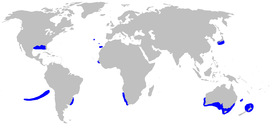
|
| Security status |
|---|
Least ConcernedIUCN 3.1 Least Concern : 41749 |
|
Content
The first scientific description of white-eyed spiny sharks was given in 1906 [3] . The holotype is an individual 79 cm long, caught off the coast of Japan [2] .
Auston’s white-eyed sharks live in the west-central Atlantic, in the eastern Indian Ocean and in the north- and southwest Pacific Ocean off the coast of Japan, Australia, New Zealand, and probably in the Gulf of Mexico. They are found in the upper and middle parts of the continental slope at a depth of 250 to 1500 m, usually deeper than 500 m [4] .
Auston's white-eyed sharks have a stocky, cylindrical body that tapers slightly toward the tail. The snout is quite long, the preoral distance is approximately equal to the distance between the mouth and the first gill slit, as well as the width of the mouth. The lips are quite thick and fleshy. The upper labial groove is very short. The lower teeth are blade-shaped and equipped with short tips. The upper teeth are in the form of lancets. The second dorsal fin is significantly higher than the first. At the base of the dorsal fins, there are slightly protruding tiny spikes. The first dorsal fin protrudes forward in the form of a crest, its base is located above the bases of the pectoral fins. The length of the base of the second dorsal fin far exceeds the distance between it and the base of the upper lobe of the caudal fin. The pectoral fins are quite large. Oval eyes are elongated horizontally, behind there are splashes. The body is covered with large and smooth oval-shaped placoid flakes. Color is black or brown-black [2] . The maximum registered size is 120 cm [4] .
Males and females of short-nosed white-eyed sharks reach puberty with a length of 70–79 cm and 82–105 cm, respectively. These sharks breed by egg-production, the length of newborns is 25-30 cm [4] .
Not subject to commercial fishing. Sometimes by-catch is caught in commercial networks. The International Union for Conservation of Nature has assigned this species a conservation status of “Least Concerns” [4] .
- ↑ Reshetnikov Yu.S. , Kotlyar A.N. , Russ T.S. , Shatunovsky M.I. The Bilingual Dictionary of Animal Names. Fish. Latin, Russian, English, German, French. / edited by Acad. V. E. Sokolova . - M .: Rus. Yaz., 1989 .-- S. 35 .-- 12,500 copies. - ISBN 5-200-00237-0 .
- ↑ 1 2 3 Compagno, Leonard JV 1. Hexanchiformes to Lamniformes // FAO species catalog. - Rome: Food and Agricultural Organization of the United Nations, 1984. - Vol. 4. Sharks of the World: An Annotated and Illustrated Catalog of Shark Species Known to Date. - P. 59. - ISBN 92-5-101384-5 .
- ↑ Garman, S. (1906) New Plagiostoma. Bulletin of the Museum of Comparative Zoology at Harvard College, 46 (11): 203—208
- ↑ 1 2 3 4 Paul, L. (SSG Australia & Oceania Regional Workshop, March 2003) 2003. Centroscymnus owstonii. In: IUCN 2013. IUCN Red List of Threatened Species. Version 2013.1. <www.iucnredlist.org>. Downloaded on 02 September 2013.