Amegilla dawsoni (lat.) - a species of large earthen bees from the tribe Anthophorini of the family Apidae . Endemic to Australia [3] [4] .
| Amegilla dawsoni | |||||||||||||||||||||||||||||||||||||||||||||||
|---|---|---|---|---|---|---|---|---|---|---|---|---|---|---|---|---|---|---|---|---|---|---|---|---|---|---|---|---|---|---|---|---|---|---|---|---|---|---|---|---|---|---|---|---|---|---|---|
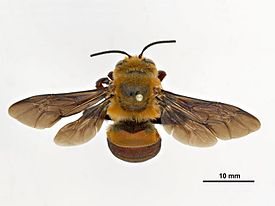 Bee Amegilla dawsoni | |||||||||||||||||||||||||||||||||||||||||||||||
| Scientific classification | |||||||||||||||||||||||||||||||||||||||||||||||
| |||||||||||||||||||||||||||||||||||||||||||||||
| International scientific name | |||||||||||||||||||||||||||||||||||||||||||||||
Amegilla dawsoni (Rayment, 1951) [1] | |||||||||||||||||||||||||||||||||||||||||||||||
| Synonyms | |||||||||||||||||||||||||||||||||||||||||||||||
Anthophora dawsoni Rayment, 1951 [2] | |||||||||||||||||||||||||||||||||||||||||||||||
Content
- 1 Distribution
- 2 Description
- 3 notes
- 4 Literature
- 5 Links
Distribution
Western Australia [3] [4] .
Description
Large bees (about 2 cm) nesting in dense clay soil in large colonies of up to 10,000 nests [5] , the weight of an individual is 0.5-0.7 g [6] . Females dig minks at a depth of 15 to 35 cm. At the end of the course, they make a brood cell for the larva with a supply of pollen and nectar [7] . Fore wings with three almost equal-sized radio-medial cells. Males of two types are found: large (major) with a head width of about 6.7 mm and small (minor) with a head width of about 5.5 mm (males of an intermediate size are rare) [8] . Fatal battles of males (drones) for mating with the future uterus are observed. At the same time, small males appear earlier [9] and watch the females on flowers, while large males wait near the entrances to their earthen nests. As a rule, most females (90%) are fertilized by large males, immediately after they exit. As a result, almost all males die in fights, and until the next year the populations consist only of females [3] [10] [9] . In the pre-pupal stage, diapause under unfavorable conditions can last several years (up to 10 years) [11] . They are visited by flowers Cassia ( Cesalpinia ), Eremophila ( Myoporaceae ), Solanum ( nightshade ) and Trichodesma ( Borage ) [12] .
Notes
- ↑ Rayment, T. 1951. A critical revision of species in the genus Asaropoda by new characters. Memoirs of the National Museum of Victoria, Melbourne 17: 65-80 [77].
- ↑ Amegilla dawsoni (Rayment, 1951)
- ↑ 1 2 3 Matt Walker . Bees fight to death over females , BBC News (November 12, 2009).
- ↑ 1 2 Dawson's Burrowing Bee ( Amegilla dawsoni ) . Australian Native Bee Research Center. Date of treatment March 24, 2014.
- ↑ Which Native Bees are in Your Area? 6. Teddy Bear Bees (Amegilla (Asaropoda)) (English) . Australian Native Bee Research Center . Australian Native Bee Research Center (2013). Date of treatment September 1, 2013 ..
- ↑ Joseph L. Tomkins; Leigh W. Simmons; John Alcock 2001. Brood-provisioning strategies in Dawson's burrowing bee, Amegilla dawsoni (Hymenoptera Anthophorini). Behav. Ecol. Sociobiol. (2001). 50: 81-89. DOI 10.1007 / s002650100331
- ↑ Alcock, J. 1999. The nesting behavior of Dawson's burrowing bee, Amegilla dawsoni (Hymenoptera: Anthophorini), and the production of offspring of different sizes. Journal of insect behavior, Journal of Insect Behavior, Vol. 12, No. 3, 1999. 363–384.
- ↑ Alcock, J. Competition from large males and the alternative mating tactics of small males of Dawson's burrowing bees (Amegilla dawsoni) (Apidae, Apinae, Anthophorini) // Journal of Insect Behavior. - 1997. - Vol. 10, No. 1 . - P. 99-113 ..
- ↑ 1 2 Alcock, J. 1997. Small males emerge earlier than large males in Dawson's burrowing bee (Amegilla dawsoni) (Hymenoptera: Anthophorini). // Journal of Zoology, London. - 1997. - Vol. 242: 453-462 [453].
- ↑ Deadly Battle of Drones
- ↑ Michener CD . (2000). The Bees of the World, Johns Hopkins University Press. P.7.
- ↑ Amegilla (Asaropoda) dawsoni (Rayment, 1951 ) . Australian Faunal Directory . Environment.gov.au (September 20, 2012). Date of treatment September 1, 2013. (unavailable link) .
Literature
- Alcock, J. Male size and survival: the effects of male combat and bird predation in Dawson's burrowing bees, Amegilla dawsoni // Ecological Entomology. - 1996. - Vol. 21, No. 4 . - P. 309-316 ..
- Alcock, J. Competition from large males and the alternative mating tactics of small males of Dawson's burrowing bees (Amegilla dawsoni) (Apidae, Apinae, Anthophorini) // Journal of Insect Behavior. - 1997. - Vol. 10, No. 1 . - P. 99-113 ..
- Houston, TF Ecology and behavior of the bee Amegilla (Asaropoda) dawsoni (Rayment) with notes on a related species (Hymenoptera: Anthophoridae) // Records of the Western Australian Museum. - 1991. - Vol. 15. - P. 535–553 ..
Links
- Matt Walker Bees fight to death over females , BBC News (November 12, 2009).
- Amegilla (Asaropoda) dawsoni (Rayment, 1951 ) . Australian Faunal Directory . Environment.gov.au (September 20, 2012). Date of appeal September 1, 2013. (unavailable link)
- Dawson's Burrowing Bee ( Amegilla dawsoni ) . Australian Native Bee Research Center. Date of treatment May 5, 2010.
- Amegilla at www.discoverlife.org
- Amegilla at www.aussiebee.com.au
- Amegilla dawsoni (Rayment, 1951) on BioLib