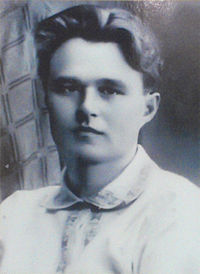
Sergey Grigorievich Grushevsky (June 24, 1892 - November 3, 1937) - candidate member of the 1st State Duma of the Russian Empire and the All-Russian Constituent Assembly , professor of history of the Taras Shevchenko Luhansk National University in 1925–1930, deputy director of the institute for scientific work, nephew Ukrainian historian and public figure Michael Hrushevsky . Russian nationalist , reforged in the Ukrainian nationalist [1] .
| Sergey G. Grushevsky | |
|---|---|
| ukr Sergiy Grigorovich Grushevsky | |
 | |
| Date of Birth | June 24, 1892 |
| Place of Birth | Kamenka |
| Date of death | November 3, 1937 (45 years) |
| Place of death | Sandarmoh |
| Citizenship |  the USSR the USSR |
| Allegiance |  Russian empire Russian empire |
| Occupation | |
| Father | Grigory Hrushevsky |
| Mother | Olga Rantsova |
| Spouse | Olga Levitskaya |
Father - Gregory of Hrushevsky, a priest in Cherkassy . In 1921, he came under the jurisdiction of the Ukrainian Autocephalous Orthodox Church . After his arrest in 1937, Grushevsky served his sentence in Siberian camps, where he died. Mother - Olga Hrushevskaya (maiden name - Rantsova) came from St. Petersburg intelligent literary family. Grigory and Olga got married in Kiev. In the marriage had three sons Sergey, Vasily, Leo and daughter Irina. During World War II, Irina, who was married to an ethnic German, took the mother to Germany, where she died in 1945. Sergey's godfather was the Ukrainian historian Mikhail Hrushevsky.
Sergey Grushevsky graduated with a gold medal gymnasium in Zlatopol , where V. Vinnichenko, M. Zerov, B. Lyatoshinsky, P. Filipovich studied or taught. In 1909 he entered the Faculty of History and Philology of Kiev University. He was a member of the Two-Headed Eagle youth society , which conducted anti-Ukrainian and anti-Semitic actions, in particular, prevented the celebration of Taras Shevchenko’s centenary. In 1916, Sergey Hrushevsky married Olga Levitskaya, the daughter of a priest. In the summer of 1917, during the elections to the Kyiv City Duma, the “out-of-party bloc of Russian voters” was included in the first five created by V. Shulgin by this election. According to the results of the voting he was elected a public Duma [2] .
In 1921 he became the founder and director of the Institute of Public Education named after the III International in Zlatopol, into which the Zlatopol gymnasium was reorganized [1] . After the revolution, he withdrew from Russian nationalism and merged Ukrainian nationalism . Then in 1923-25 he worked as an inspector of the Poltava provincial education department and a history teacher at the Poltava Institute of Public Education (INO), whose dean was R.V. Kutepov.
In the 1920s, he was accused of “Ukrainian bourgeois nationalism” and sent with his first husband, his sister R. Kutepov, to Lugansk . There, in the years 1925-1930, he took an active part in Ukrainization and in the development of the Donetsk Institute of Public Education . He was a professor and dean of this university. Author of several articles on the history of the Revolution in the local press.
In 1930 he moved to the Kuban and was actively involved in the politics of Ukrainization in the Kuban Institute of Public Education named after Skrypnyk. In 1930, Grushevsky supported the repression of the NKVD in the case of the Union for the Liberation of Ukraine . During the process, he gathered for a rally of scientists and students who "angrily condemned the enemies of the people" [3] . However, he himself soon became a victim of repression as a person of “ non-proletarian origin ”, mixed at the same time with the “Black Hundreds” and “Ukrainian bourgeois nationalism.” On January 13, 1933, professors were arrested as a member of the nationalist organization Union of Kuban and Ukraine, created in the depths of the NKVD [1] . In August 1933, the OGPU College sentenced him to 10 years in prison, which he served in the Solovki Special Purpose Camp. On November 3, 1937, Sergei Hrushevsky was shot at Sandarmokh in Karelia. Rehabilitated posthumously on August 8, 1960.
Notes
- ↑ 1 2 3 Kucheruk O. Sergiy from the Hrushevsky family // “Radio Svoboda”, 10.01.2013.
- ↑ DI Babkov. Political activities and views of V. V. Shulgin in 1917-1939. : Diss. Cand. ist sciences. Specialty 07.00.02. - National history. - 2008.
- ↑ Right Bilokin S. “Spilki vvvovennya Ukrainy” and the prospect of the next vivchennya Archival copy of September 23, 2015 on the Wayback Machine .
Works
- German occupation in Lugansk // Luganskaya Pravda №244, October 23, 1927.
- Lugansk Council of Workers' Deputies in the October Days // Luganskaya Pravda №№248-249, October 28-29, 1927.
- Archive fondi m.Luganskogo // Radyanska school, 1930.
Links
- A. Kucheruk, historian, director of the Museum of the Ukrainian Revolution of 1917-1921. Sergey from the Grushevsky family / / Radio Liberty. - 2013. - 10.01.
- Remember. Honor! Martyrology of those shot under Sandarmokh / / Historical truth. - 2010. - 27.10.
- Belokon S. Solovki .
- "Sandarmohu List". Ukraine Incognita. History and "I", 2012.
- Lines of our history . Site of the Institute of History, International Relations and Socio-Political Sciences Luhansk Taras Shevchenko National University.
- Scientists of Cherkasy region