
The historical center of Lugansk (or the Old Town ) is the oldest part of the city around which Lugansk grew up in the late XVIII - early XX centuries . The old city was formed on the territory between the turn of the Lugan River in the north, st. Forest (Kotsyubinsky) in the south, st. Petersburg and the first line in the west and the sixteenth line in the east.
Historical Review

The history of the city begins with the foundation in 1795 near the breech village Kamenny Brod of an iron foundry . The village was called Yekaterinoslavsky, and in 1797 the Lugansk plant . At the plant for the first time in the Russian Empire , smelted iron on coal coke was launched and the production of guns and cores was launched. These products were intended for arming the Black Sea Fleet . As of 1859, there were 49 trading shops, 70 forges , 9 salotopes, 7 candle factories , 5 brick factories (which produced more than a million bricks annually), 12 mills , 5 bath houses , 2 crew houses. Consolidated hospitable courtyard with 12 rooms, 1012 houses, three churches, a school, a weather station and a hospital. Twice a year, on May 9 and August 26, fairs and weekly bazaars were held . [one]
In the second half of the XIX century, the village of Lugansk Plant underwent rapid development. This was facilitated by the construction of the railway . In 1877, the Lugansk - Debaltseve railway line was laid. In 1884, the construction of the Catherine Railway, which connected the Donbass with Kryvyi Rih, was completed . Finally, on September 3, 1882, a regulation of the Committee of Ministers on the establishment of the district city of Lugansk on the basis of the villages of the Lugansk Plant and Kamenny Brod was approved by royal decree. In 1883, the first mayor, Nikolai Kholodilin , was elected. [2]
In 1895, the workshops of the former foundry were transferred to the Treasury cartridge plant. The following year, the German industrialist Gustav Hartmann founded the Lugansk Locomotive Plant . [3] Factories and the road played the role of major city-forming factors. By the end of the 19th century, Lugansk turned into a large industrial center.
The local population consisted mainly of Orthodox Russians and Ukrainians. About 10% of Luhansk belonged to the Jewish community. The rest are Poles , Armenians , Germans and others.
Old Town
A visual representation of the historical center of Lugansk gives the "Plan of the village of Lugansk" in 1879. The map clearly describes the planning structure of the city, which took shape in the 19th century.
Lugansk was built up according to a system of mutually perpendicular streets, which was common in the Russian Empire in the first third of the 19th century, taking into account the urban landscape . However, while in the first half of the 19th century central construction was carried out in Lugansk, at the turn of the 19th – 20th centuries there was a spontaneous division of the city into industrial, transport, storage and residential areas.
At the beginning of the 19th century, the center of the village was Angliyskaya Street and Starobazarnaya (Bazarnaya, Uspenskaya) Square.
With the construction of St. Nicholas Cathedral in 1841, the central Cathedral Square and the main St. Petersburg Street were formed. Second> O> O> Kazanskaya street became significant. The center was built up with two-three-story houses. The first building with four floors (Vasnev House) appeared at the beginning of the XX century. On the outskirts of the streets, one-story marl houses prevailed. One of the oldest structures that has survived to this day is the house of a hydropathic institution , an architectural monument of the beginning of the 19th century (7 Dalya St.). In the second half of the 19th century, roads in the streets are built up with paving stones . With the advent of the city power station in 1912, the central streets were electrified.
Streets and squares
| Urbanonym | Description | Picture |
|---|---|---|
| English (Young Spartak, V. Dahl) | The first houses in the city appeared on the street. English. It was inhabited by British engineers , who had come along with Karl Gascoigne to work at foundries. On the street there is an architectural monument of the beginning of the 19th century (Dahl St., 7) and the V. Dahl House-Museum ( Dahl St., 12). House number 7 with a garden, known as the House of hydropathic, built after 1809 . The central part is decorated with a four-column ionic portico with a balcony. It housed the leadership of the Lugansk mountain district, the factory library , which consisted of more than 3,000 volumes of special literature and fiction of different languages, the mineralogical museum (the first museum in Lugansk, founded by the efforts of the head of the Lugansk foundry Gustav Hess de Calve and mining engineer Evgraf Kovalevsky in the first half XIX century), and since 1926 - hydropathic . [four] The Treasury building (now the Office of the Regional Judicial Administration) was erected opposite the hydropathic house. According to legend, Vladimir Dal (1801-1872), the author of the four-volume Explanatory Dictionary of the Living Great Russian Language and Proverbs of the Russian People , was born in house No. 12, where the museum is located. True, according to the old map, the house of his father, the factory doctor-Danish Johann Christian von Dahl, was in a different place and still has not been preserved. In 1926, the street was renamed in honor of the pioneer organization of Young Spartak, whose Lugansk center was founded in house number 7. Since 1976, the street bears the name of Vladimir Dal. | English street |
| Postal | The street is so named because it housed the first post office in Lugansk. It differed from the usual one in that it did not have a permanent postman staff. The messenger was handled by a messenger who worked temporarily; sometimes the townspeople themselves took the letters. The postmaster lived with his family in the post office building. Little space was reserved for mail in the building, and the rest was used by the family. After checking the premises, the postmaster was dismissed. The vacated place was taken by mail. At the end of the XIX century, one of the quarters belonged to the rich David Venderovich. David Venderovich - owner of factories, shops and warehouses. He also served as the head of the synagogue , which appeared in 1860 . Soon, with his money, the Lugansk Art Museum was built on the site of his house At the beginning of the 20th century, a state gymnasium (now the House of Children's Creativity) was located on a postal street, where girls from various classes studied. In 1913, on the street Pochtovaya, 22 opened a postal and telegraph office Near the post office was a wooden circus - a big top , which was demolished in 1914 in order to expand the Lugansk cartridge factory . During the Great Patriotic War, the office building was badly damaged, but was later restored and now there is a post office | House of Venderovich |
| Petersburg (Petrograd, Lenin) | It arose at the end of the 18th century . It was built up by barracks for workers of a foundry. After their demolition in the second half of the 19th century, it turned into a business and commercial center of the city. Two-story houses are being built on it. The ground floors housed numerous establishments: the newspaper "Uyezdnye Vesti", the police station, the district military chief, shops , hotels , restaurants , barbers, pastry shops , a dental office, jewelry and watch shops, and kiosks . At Petersburg was the studio of the photographer Lev Matusovsky, one of whose sons, Mikhail Matusovsky , later became a famous Soviet songwriter. Renamed in 1914 on the street. Petrograd, and in 1922 - st. Lenin . | Hotel "Russia" |
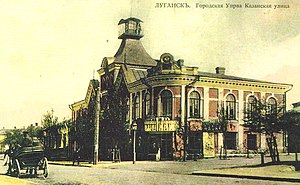
| Kazan | Formed in the second half of the XIX century . Named after the Kazan Church , built in 1864 . [5] Art Nouveau dominated the architecture . On the street was the city government (now the Museum of the History and Culture of Lugansk). In the courtyard of the house was a fire station. The first floor was occupied by the Braslavsky shop, which traded bicycles and gramophones . The building of the Azov-Don Bank is still preserved. On the street, some buildings belonged to Jews. In one of them there was an outpatient clinic for public assistance to poor Jews. The newspaper "Southern Israel" was published. On Kazan contained gastronomic and sausage shops, salons and various shops. Renamed to st. K. Marx in 1922 . | Kazanskaya street (Karl Marx) City government (now a museum of the city), Azov-Don Bank. Closes the perspective of the Kazan Church |
| Pushkinskaya | Pushkinskaya Street appeared in the second half of the 1880s on the site of the filled Olkhovsky Canal, which was supplied with water to the factory headquarters. It was built up with one-and two-story residential premises, as well as shops of local merchants. After granting Lugansk the status of a county town, street development begins. In 1887, the canal was filled up, and Pushkinskaya Street was planned in its place. Residential houses, shops of local merchants, a mining and commercial club and a circus appear on it. In 1912, the street was electrified. In the first years of Soviet power, the building of the KPU regional committee was erected here. Buildings were badly damaged during World War II . In 1944 - 1952, the Oktyabr Hotel was built with the Ukraine Restaurant, which has become the dominant street and one of the main decorations of the city. The architectural institutes Giproshakht (1944) and the new building of the mining and commercial club (later the House of Culture of Railway Workers) also belong to architectural monuments. In 1949, the building of the Ukrainian Music and Drama Theater was erected on the site of the destroyed mining and commercial club (since 1963 - the Regional Drama Theater, since 1970 - the Palace of Culture of Railway Workers, since 2002 - the Lugansk Regional Palace of Culture). In 1996, a monument was opened to the first head of the city, Nikolai Kholodilin . | Pushkinskaya street. Lugansk |
| Banking (Romanovskaya, Democratic, Taras Shevchenko) | On the street there was a firewall (fire brigade), a house of arrest ( Mayakovsky club) and, finally, the first four-story building, which housed a female commercial school and a male gymnasium (Vasnev House). Renamed to st. T. Shevchenko in 1922 . | Vasnev House |
| Forest (Kotsyubynsky) | In the second half of the XIX century st. Lesnaya was a small outskirts street in the south of the city between the street. Konyushennoy (now Lunacharsky) and the city cemetery . At the beginning of the XX century it stretched to the fourteenth line (B. Shevchenko St.). In 1905, the Resurrection Church was erected on a street near the cemetery. | |
| Square | Cathedral (since 1922 - Red), on which in 1841 the main temple of the city was built St. Nicholas Cathedral. Starobazarnaya (Assumption, from 1922 - Revolution) with the Assumption chapel. The two-story building housed the Slavianoserbsk Zemstvo Government (now school No. 2). The former Novobazar (Bazarnaya) square occupied the territory between the modern Square for the Fighters of the Revolution and the Drama Theater. The fairground has disappeared between the Square of Heroes of the Second World War and ul. Demekhina. | Assumption (Starobazar) square. Right - Assumption Chapel |
Lines
The first terrace streets (Petersburg, Kazan, Bankovskaya) crossed the so-called "lines" that went up the slope of the right bank of Lugani . [6] These small streets were numbered. Opposite sides of the street were different lines. The city was divided by 48 lines. Since this confused the townspeople, each line received only one number.
Currently, there are 23 of them, in the Old Town - 16. However, some of them have been renamed, the other has disappeared from the map of the city. So, the second line became part of the street. Soviet. The 8th line has disappeared. The 3rd is renamed St. Etienne, the 4th is named after M. Yakovenko, the 10th is M. Polsky, the 11th is A. Sheremet, the 12th is A. Demekhin, the 13th is V. Titova, 14 1st - V. Shevchenko.
| Line | Picture | Line | Picture |
|---|---|---|---|
| 2nd line | |||
| 6th line | |||
| 8th line | does not exist | ||
| 10th line | |||
| 11th line (vul.Sheremeta) | (Demekhina street) | ||
| (vul.Titova) | 14th lіnіya (Shevchenko St.) | ||
Old Town Objects
Ruined Sacred Structures
| Title | Description | Date of destruction | Picture |
|---|---|---|---|
| Trinity Monastery | It was founded in 1912 on the corner of ul. Sadovaya (K. Liebnecht) and Natalievsky Lane. The Bolsheviks confiscated the monastery property in 1922 . Only the first floor of the monastic cells remained from the monastery buildings. | 1922 year | The remains of the Trinity Monastery in Lugansk (early XX century) (only the first floor has been preserved). |
| Assumption Prayer | The first church of Lugansk. It was erected in 1821 on Starobazarnaya (Uspenskaya) square. Burned down in 1830 . During the years 1840-1854 a stone chapel was built. In the 1910s, the construction of a new church was planned, but with the establishment of Soviet power, the project was not implemented | 1924 year | Assumption Church and square. The church was destroyed in 1924. Now the square of the Revolution (Lugansk). |
| St. Nicholas Cathedral | The cathedral was built during 1840 - 1841 [7] . In 1935, the cathedral was destroyed by the Bolsheviks. Later, in 1953, the building of the House of Technology was built near the location of the cathedral. | 1935 year | St. Nicholas Cathedral |
| Kazan church | On October 9, 1861, a report was received from the mining director of the Lugansk plant Apollo Miviyus to the Department of Mining and Salt Affairs that the union of merchants and townspeople of the village, at their own expense, wants to build a stone church . The construction of the temple began in the same year and ended in 1864 . Kazan Church was the only five-baptized church in the then Lugansk. In 1909, by decision of the City Council, 500 rubles were allocated for the construction of the bell tower, an honorary citizen of the city, Ivan Pivovarov, allocated funds for the casting of bells . In 1935 the church was closed. November 6 , on the eve of the anniversary of the October Revolution , crosses were removed from it and red flags were set. In 1937 the temple was destroyed. However, in 1942, the Kazan Orthodox community was revived and adapted a private house under a chapel. In 1961, the parish was again closed. | 1937 year | Kazan Church and the panorama of Lugansk. |
| Ascension Church | The church was built in 1905 on the street. Forest at the entrance to the city cemetery. In 1935, the presidium of the city executive committee closed the temple, the premises of which were planned to be adapted for the club of the Artyom plant. | 1935 year | Ascension Church (Lugansk). |
| Church in the name of the Nativity of Christ | Catholics founded the community in 1902 . The church was built in 1904 in Natalievsky Lane. The Bolsheviks closed it in 1929 . The building has been significantly converted. Only a part of the ground floor and the decor of the ceiling remained. | 1929 year | Fragment of the decor of the rebuilt church in Lugansk (beginning ... XX century) |
| Synagogues | At the turn of the XIX - XX centuries, three synagogues were built in the city: Choral (main), Lithuanian on the street. Banking and Handicraft on the street. Konyushennoy (now Lunacharsky). All synagogues are currently destroyed. Only the building of the former heder (Jewish religious elementary school) on the 11th line (Sheremet Street) has survived. [five] | 1930s | Choral Synagogue. Former street Banking (T. Shevchenko). Lugansk |
Monuments
In the historical center, only the House of the Hydropathic (Dalia St., 7) is registered with architectural monuments of national importance, the rest of the buildings are monuments of local importance.
| Streets | Monuments | Images | Streets | Monuments | Images |
|---|---|---|---|---|---|
| Dalya | Residential building, mid- 19th century (No. 1), Treasury , late 19th century (No. 10), Dahl Museum, 1881 (No. 12), mansion , the turn of the XIX — XX centuries. (No. 5) | Treasury Department | Postal | Art School (No. 24), administrative building, late 19th century (No. 27), factory management, the turn of the XIX — XX centuries. (No. 1a), post office , 1911 (No. 22) | Art school |
| K.Marx | Azov-Don Commercial Bank, 1889 (No. 36), mansions (No. 34, 38a, 54), residential buildings (No. 46, 53, 61, 66, 77), a complex of facilities for the former laundry (No. 55), late XIX Art., city zemstvo government (No. 30), residential building (No. 42), the turn of the 19th — 20th centuries, residential building with a store (No. 6), institution (No. 26), beginning of the 20th century, residential buildings with a store, 1920s (No. 14) and 1940-1950s (No. 43), residential building, 1950s (No. 1), complex of mine rescue structures, 1940-1950s (No. 45), office building, 1950 (No. 3), Zhilstroy plant, 1953-1956 (No. 7) | Azov-Don Bank | Lenin | Houses (No. 49, 54, 105a), city estates (No. 56, 59), residential buildings (No. 32, 44 with a store), late 19th century , Residential buildings (No. 40 and 42 with a store, 47), border XIX -XX centuries, pharmacy (No. 1), residential building (No. 36), cinema (No. 37), office building (No. 50), beginning of the 20th century, residential buildings with a shop (No. 29 115), residential buildings, 1950 years (No. 21, 68a), administrative buildings, 1930-1950s. (No. 26, 38) | Mansion, house number 54 |
| Shevchenko | Residential buildings, end of XIX century (No. 7, 15), Vasnev House, the turn of the XIX — XX centuries. (No. 41), institution , beginning of the 20th century. (No. 35) | Vasnev House | Sheremet | Городская коммунально-спасательная служба в здании бывшего хедера , рубеж XIX -XX вв. (№ 11) | Бывший хедер |
| Pushkin | Проектный институт «Гипрошахт», 1944 г. (№ 1), горно-коммерческий клуб , 1949 г. (№ 2), Гостиница «Октябрь» , 1944—1951 гг. | Отель «Украина» в Луганске | пл. Красная | Дом Техники ( 1953 ), построенный на месте разрушенного Николаевского собора | Луганский дом техники. |
| К.Либкнехта | Особняк (№ 52), жилые дома, начало XX в. (№ 51, 60), проектный институт , 1950-е годы (№ 71) | Дом на улице Либкнехта, 51 (начало 20 века). | Натальевский переулок | Особняк, начало XX в. (№ 2), дом Сергея Ильенко (№ 9), бывший костел (№ 5) | Дом Сергея Ильенко |
Музеи и театры
- Луганский областной краеведческий музей
- Музей истории и культуры города Луганска
- Луганский областной художественный музей
- Литературный музей Владимира Даля
- Луганский академический областной русский драматический театр
- Луганский академический областной театр кукол
Скверы и парки
- Сквер имени Героев Великой Отечественной войны (Луганск)
- Сквер Молодой гвардии
Памятники
- Владимиру Далю
- Трофейные английские танки Mark V .
- Мемориал «Памятник Борцам Революции» .
- Труженику Луганщины .
- Клименту Ворошилову .
- Героям- чернобыльцам и часовня Георгия Победоносца .
- Первому главе города Николаю Холодилину .
Старые карты Луганска
Карта «села Луганского», 1879 | Карта Луганска 1910 года | Карта Луганска 1912 года |
See also
- Центр Луганска
- Список православных храмов Луганска
- Старый город (Киев)
- Старый город (Каменец-Подольский)
Sources
- Документальний фільм про Луганськ, 1930-ті роки . Youtube
- Ворошиловград. Voroshilovgrad: фотоальбом. — К.: Мистецтво, 1983.
- История Луганского края: Учебное пособие/ Ефремов А. С., Курило В. С., Бровченко И. Ю., Климов А. А., Красильников К. И., Семистяга В. Ф. , Подов В. И. — Луганск: Альма-Матер, 2003. — 432 с., 16 ил.
- Костин В. И. Ворошиловград. Архитектурно-исторический очерк. — К.: Будивельник, 1987. — 223 с.
- Подов В. И. История Донбасса: В трёх томах. — Луганск: Альма-Матер, 2004.
- Подов В. И. К тайнам истории: Заметки краеведа. — Луганськ: Світлиця, 1996. — 104 с.
- Подов В. И. Мемориальный музей К. Е. Ворошилова : Путеводитель. — Донецк: Донбасс, 1986. — 24 с.
- Форостюк О. Д. Луганщина релігійна. — Луганськ: Світлиця, 2004. — 212 с.
- Форостюк О. Д. Прогулянки Старим містом // Довідник куратора студентських груп. — Луганськ, 2011.
- Злинько Ю. Є. Топонімія старого Луганська (недоступная ссылка) // Лінгвістика. Збірник наукових праць. — Луганськ, 2011. — № 1. — Ч.1. — С. 209—213. (pdf)
Notes
- ↑ Обозрение Луганского Завода// Новороссийский литературный сборник. — 1859 (недоступная ссылка)
- ↑ Намдаров Г. М. Луганск: исторический очерк// Паспорт Луганска: справочно-картографическое издание. — К., 2002.
- ↑ Город революционной и трудовой славы. Сайт Луганської міської ради
- ↑ Луганська фізіотерапевтична поліклініка ім. професора О. Є. Щербака (недоступная ссылка) . Дата обращения 27 августа 2013. Архивировано 22 февраля 2012 года.
- ↑ 1 2 Форостюк О. Д. Луганщина релігійна. — Луганськ: Світлиця, 2004. — C. 89-93, 101—102.
- ↑ Луганские улицы: от Романовской до имени Шевченко // Реальная газета «Ижица». — 2007. — 8 лютого
- ↑ http://hotel-slavyanskiy.lg.ua/index.php?do=static&page=pam_lugansk Памятные места Луганска (рус.)