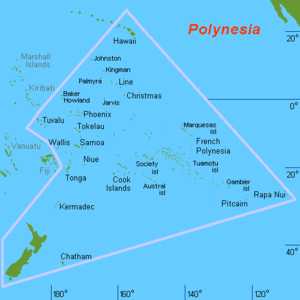
The date of the beginning of the settlement of the Polynesian islands is difficult to establish - most likely the settlement of the numerous islands of Polynesia by the Polynesians began from the middle of the first millennium BC and stretched for almost 2 millennia. The ancestral home of the Polynesians, according to representatives of many sciences, was Asia . The Polynesians themselves call their legendary ancestral home of Hawaii, with this word possibly associated with such names as Hawaii, Sawaii, Khiva, Java . In 1846, Horatio Hale suggested that the Proto-Polynesians lived in the area of the Moluccas .
Content
Settlement
In the settlement of Oceania, an important role was played by the Australoids, who about 40 thousand years ago inhabited southeastern China and large territories, which made up a single land area with continental Southeast Asia, before the ocean level rose 100 meters at the end of the ice age and turned them to the islands. It was from Asia that the Australoids began their journey to Australia and to the nearby islands - New Guinea , Melanesia . [one]
After the Australoids, the ancestors of the Polynesians appear in the history of Oceania, whose physical data were the result of a mixture of the Mongoloid, Australoid, and possibly Caucasoid nations of Asia. The racial appearance of the Polynesian formed in Southeast Asia and only then spread to the islands of Oceania. About 4000 years ago, the ancestors of the Polynesians were forced to leave Southeast Asia due to the movement of Mongoloid groups from Central Asia. [2] Ocean level rose with the end of the ice age, having absorbed part of the land, forming the Indonesian (Malay) archipelago. Around 1500 BC, the Protopolynesians reached the islands of Sumatra and Java, and a little later traces of their presence are also found in Sulawesi .
Lapitoid ceramics, first found by archaeologists in New Caledonia in Lapita, is considered evidence of the presence of the ancestors of the Polynesians. Lapitoid ceramics is found throughout Melanesia, Western Polynesia, Tonga and Samoa . [3] The oldest finds of lapitoid ceramics on the islands of Tonga date back to the 13th century BC. In Samoa, ceramics of this kind appeared three centuries later. In Eastern Polynesia, the most ancient finds date back to the 2nd century BC on the Marquises . [4] Hawaii was inhabited in the 3rd century, Tonga in the 6th century, Easter Island in the 7th century, and Cook Islands in the 9th century. Seafarers from the tribes of South America and Asia reached the Marquesas Islands , where the cradle of the Maori civilization is located, and then mastered the nearby archipelagos .
In the 1940s, the Norwegian explorer Thor Heyerdahl was hypothesized that Polynesia was populated from South America, to prove which he and 5 of his comrades Eric Hesselberg , Herman Watzinger , Knut Haugland , Thorstein Robu and Bengt Danielsson crossed the Pacific Ocean on a balsa raft in 1947 .
The Appearance of Europeans
The first European to reach Polynesia is Fernand Magellan . In 1521, he reached one of the islands in the Tuamotu group and named it San Pablo. When these islands were discovered by Europeans, Polynesian culture was extended to them for more than 800 years. Contacts with Europeans were before that, but they did not have a big impact on local customs .
The Tonga Islands were discovered in 1616 by Jacob Lehmer and Willem Schauten , and in 1643 by Abel Tasman . Варlvaro Mendagna discovered the Marquesas Islands in 1595. Jacob Roggeven discovered some of the islands of Samoa in 1722. Tasman discovered New Zealand in 1642, James Cook - Cook Islands and Niue Island , 1767 - the official opening of Tahiti by Captain Semuel Wallace . An important contribution to the study of Polynesia was made by French and Russian sailors: Louis Antoine de Bougainville , Jean Francois de Laperouz , Ivan Fedorovich Kruzenshtern , Yuri Fedorovich Lisyansky , Otto Evstafievich Kotzebue , Mikhail Petrovich Lazarev .
The first contact of the Hawaiians with the Europeans took place in 1778, with the expedition of James Cook . The natives took him for their god Lono, who, according to legend, was supposed to return on a floating island. But on a second visit, in 1779, Cook was killed by the natives after he tried to forcefully return the stolen whaleboat . However, this incident did not affect the peaceful attitude towards other sailors. [five]
The expedition of 1789 is most famous for its purpose, which was to collect seedlings of breadfruit, which serves as food for colonists and black slaves on Caribbean plantations. The scene of the most famous ship riot in history was the Bounty sailing ship, commanded by Captain William Bly . Assistant Captain Christian Fletcher and his associates left the ship in a boat and settled on Pitcairn Island (between Mangarev Island and Easter Island) to avoid the gallows. [6]
In the XVIII century the word "Polynesia" appeared, denoting the numerous islands discovered in the southern seas by European sailors. In the process of a long search for a large “Southern continent”, which, according to scientists of that era, was supposed to “balance the world”, only small islands that did not possess special wealth were encountered by sailors.
In 1797, Christian missionaries from the London Missionary Society began their activities on the islands of Polynesia, seeking to convert natives from paganism to Christianity . [7] Since 1836, a new stage begins in the history of Polynesia - French missionary Catholics appear on the islands. During the 19th century, a struggle was waged between the European powers for the possession of the colonies. Western Samoa belonged to Germany , the remaining territories were divided between Great Britain and France . The largest possessions are French Polynesia , still remaining the possession of France and New Zealand, captured by the British in 1840, is now an independent state within the Commonwealth of Nations (in 1907 received the status of dominion). At the end of the XIX century, part of the islands fell under the protectorate of the United States . In 1959, the USA declared Hawaiian Islands its state.
In the 2nd half of the 20th century, some islands achieved independence.
Literature
- M. Stingl . Mysterious Polynesia. Ed. "Science", M. - 1991.
- Myths, traditions and tales of Western Polynesia. M. - 1986.
- Bellwood P. Man's Conquest of the Pacific. - M .: Science, 1986. ( cit. Bellwood )
- B. Danielsson. Polynesia is land in the ocean. M. - 1970.
- T. Heyerdahl . Travel to Kon-Tiki. - 1948.
- Handbook "Countries of the World", M. - 1989.
- Puchkov P.I. Ethnic situation in Oceania. - M .: Nauka, 1983. ( cit. Puchkov )
- A. Kondrashov. Directory of necessary knowledge, M. - 2001.
- TSB, Volume 19, M. - 1975.