The battle at the New Market ( Eng. The Battle of New Market ) occurred May 15, 1864 during the campaign in the Shenandoah Valley (1864) of the American Civil War . The small Confederate army under John Breckinridge was able to stop the army of Federal General Franz Siegel and forced him to retreat from the Shenandoah Valley .
| The Battle of New Market | |||
|---|---|---|---|
| Main Conflict: US Civil War | |||
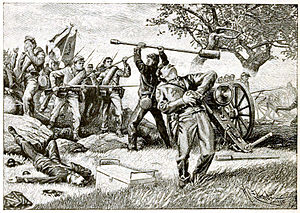 New Market Cadet Attack | |||
| date of | May 15, 1864 | ||
| A place | Shenandoah County, Virginia. | ||
| Total | KSA victory | ||
| Opponents | |||
| |||
| Commanders | |||
| |||
| Forces of the parties | |||
| |||
| Losses | |||
| |||


Content
- 1 Background
- 2 Forces of the parties
- 3 Shootout May 14
- 4 battle
- 5 Consequences
- 6 At the cinema
- 7 notes
- 8 Literature
- 9 References
Background
In the spring of 1864, Commander-in-Chief of the Federal Army General Grant began planning an attack on Richmond, and in these plans much attention was paid to control of the Shenandoah Valley. Grant intended to advance with the main forces on the position of General Lee’s army in eastern Virginia, and Franz Siegel was instructed to lead an army of 10,000, occupy the valley and threaten the left flank of Lee’s army. Siegel launched an attack on Stoughton to join George Crook's detachment, which was advancing from West Virginia, seeking to destroy the Virginia-Tennessee Railroad. Siegel's forces totaled 9,000 people and 28 guns. They consisted of the infantry division of Jeremiah Sullivan and the cavalry division of Major General Julius Steyhl. During the campaign, Siegel had to send part of his forces to other places, and as a result, by the beginning of the battle, he had 6,300 people [1] .
Hearing about Siegel's appearance, Confederate Major General John Breckinridge brought together all available forces to stop the invasion. He managed to assemble two infantry brigades: John Echols and Gabriel Warton and the cavalry brigade of John Imboden . The detachment was also reinforced by the cadet corps of students of the Virginia Military Institute (WWI), commanded by Lieutenant Colonel Scott Ship. This detachment consisted of 247 cadets and two guns. Breckinridge stationed his unit in Stouton, and Imboden's cavalry slowed Siegel's advance in the valley. On the morning of May 13, Breckinridge decided to go north and attack Siegel, instead of waiting for him at Stoughton. By the evening of that day, Siegel's advance detachments approached the New Market village, and Breckinridge detachments approached the Lacy Springs 8 miles from New Market. Southerners launched an offensive at one in the morning of May 15, hoping to catch the enemy by surprise and defeat [2] .
The forces of the parties
The federal forces consisted of two divisions under the general command of Franz Siegel [3] .
Jeremiah Sullivan's Infantry Division
- Colonel Augustus Moore's Brigade
- 18th Connecticut Regiment; Major Henry Pael
- 28th Ohio Regiment; Lt. Col. Gottfried Becker
- 116th Ogai Regiment; Colonel James Wasburn
- 123rd Ohio Regiment, Major Horace Kellogg
- Colonel Joseph Tobern's Brigade
- 34th Massachusetts; Colonel George Wells
- 54th Pennsylvania Colonel Jacob Campbell
- 1st West Virginia; Lt. Col. Jacob Weddle
- 12th West Virginia; Colonel William Curtis
Cavalry Division of Julius Steyhl
- William Tibbits Brigade
- John Winkup Brigade
Confederate forces consisted of an infantry division and several additional units under the general command of Breckinridge.
- John Echols Brigade
- 22nd Virgin Regiment ; Colonel George Patton
- 23rd Virginian Battalion; Lt. Col. Clarence Derrick
- 26th Virgin Battalion; Lt. Col. George Edgar
- Gabriel Wharton Brigade
May 14 shootout
On the morning of June 14, Colonel Moore received an order from Brigadier General Sullivan to take three infantry regiments, a cavalry brigade and six artillery barrels, and go to Mont Jackson and probe Imboden's positions on Rud Hill. At 11 a.m., Moore left the camp near Woodstock, taking with him the 1st Virginia, 34th Connecticut regiments and part of the battery of the Maryland artillery regiment. Colonel Winkup (300 horsemen) joined him. In Edenberg, the 123rd Ohio Regiment joined Moore [4] .
At 15:00, the cavalry detachment of Colonel Quinn entered into a firefight with the enemy. The 1st New York Cavalry Regiment attacked Imboden's 18th Virgin Regiment and forced him to retreat to New Market. Imboden took up a position south of New Market, where his 18th Virginia and 23rd Virginia regiments dismounted and occupied the defensive line. The northerners attacked Imboden twice, but both times were repulsed. At night, Imboden retreated south [5] .
Battle
In the morning, three Moore regiments stood near New Market. At 03:00, intelligence reported that Imboden had left his position. Moore sent patrols in search of the enemy and at 07:00 they informed him that the southerners were advancing again and were now 4 miles from New Market. When the southerners came a mile away, Moore ordered his artillery (batteries of Snow and Eving) to open fire.
Breckinridge deployed the Uarton brigade on the left flank west of Valley Tenpike, and the Echols brigade on the right flank directly on the road. Echols was sick that morning, so Colonel George Patton commanded his team. The cadet battalion was kept in reserve, and Imboen's cavalry was east of the road. Breckinridge tried to provoke the feds to attack, but Moore remained in his position. Around 11:00, Breckinridge decided to launch an infantry attack, and Imboden's cavalry crossed Smith Creek east of New Market, moved north and there again crossed the river to the rear of the northerly army. At this time, federal general Steichel arrived, and Siegel himself followed.
At about noon, Breckinridge launched an attack and gradually pushed Moore's infantry brigade with Manor Hill, and then further north, toward the rest of Siegel’s army, which was deployed on a hill north of Jacob Bashong’s farm, now known as Bashong Hill.
At this time, the southerners, passing the New Market, stopped to restore order in the ranks and tighten artillery. At 14:00, Breckinridge repeated the attack. Under heavy enemy fire, the center of the Southerners' line was disorganized, the right flank of the 51st Virgin Regiment and the 30th Virgin Battalion retreated. In this situation, Breckinridge reluctantly ordered the cadets of the Virginia Academy to close the gap. The battalion was sent to the Bashong Garden, where Lieutenant Colonel Ship was wounded. He was replaced by Captain Henry Wise. Siegel launched two counterattacks at this time. On the left flank, Steichel sent cavalry into the attack, but was repelled. Three infantry regiments attacked on the right flank, but was also repelled.
Reflecting the attack of the northerners, Breckinridge resumed the offensive at about 15:00. During this attack, many academy cadets lost their shoes in the mud on the field, which has since become known as the “Field of Lost Shoes”. When the southerners came too close to the federal artillery, the northerners were forced to withdraw. In this case, 5 guns were lost, of which one was captured by the cadets. At this time, a battery arrived at the battlefield in the 5th artillery regiment of the federal army and two infantry regiments. These units managed to stop the advance of the southerners.
... the offensive continued until we passed Bashong’s house, about a mile beyond the New Market, still on the left side of the road. Enemy artillery opened fire on us with buckshot at a distance of 250 or 300 yards, and at the same time their long infantry chains connected to the battle. The fire was sizzling. It seemed impossible for a living creature to be saved. Here we suffered the most severe losses, many were wounded or knocked to the ground, moaning and temporarily powerless. Here I was out of order, and the command passed to Captain G. A. Wise, from Company A. He bravely continued the attack. At this time, we were at the forefront. We took a position behind the hedge. A fierce firefight ensued. A shot, a jerk - and the day was ours. The enemy retreated in disarray, leaving the dead, wounded, artillery and prisoners in our hands.
Original text- The advance was thus continued until having passed Bushong's house, a mile or more beyond New Market, and still to the left of the main road, the enemy's batteries, at 250 or 300 yards, opened upon us with canister and case-shot, and their long lines of infantry were put into action at the same time. The fire was withering. It seemed impossible that any living creature could escape; and here we sustained our heaviest loss, a great many being wounded and numbers knocked down, stunned, and temporarily disabled. I was here disabled for a time, and the command devolved upon Captain HA Wise, Company A. He gallantly pressed onward. We had before this gotten into the front line. Our line took a position behind a line of fence. A brisk fusillade ensued; a shout, a rush, and the day was won. The enemy fled in confusion, leaving killed, wounded, artillery. and prisoners in our hands.
Breckinridge paused the offensive to tighten the wagons and replenish ammunition. When the infantry dismantled the ammunition, Imboden arrived and said that the river was too full to allow it to cross. Sullivan arrived to the northerners with 28 and 116 Ogai regiments. Siegel decided to place a rearguard on Ruds Hill, placing Sullivan east of the highway, Steichl's cavalry to the west, and artillery behind the lines. Deciding that his people were exhausted and wasted supplies, Siegel decided to retreat behind Shenandoah. They managed to cross the river and burn bridges before the southerners captured them.
| Bashong Farm (view from the west) | Bashong Garden Fence | The garden fence and the "field of lost shoes" | Von Kleiser's Battery Memorial Cannon |
Consequences
Breckinridge’s report on the progress of the battle was brief, only two lines of text: “This morning, two miles from the New Market, my detachment met the enemy under the command of Franz Siegel, advancing in the valley, and defeated him, inflicting heavy losses. Events took place near the Shenandoah River. The enemy fled for the northern arm of Shenandoah and burned bridges behind him ” [6] .
In the movie
In 2014, Sin McNamara directed the film Field of Lost Shoes.
Notes
- ↑ Davis, pp. 18-20, 24.
- ↑ Knight, S. 89, 100, 117.
- ↑ Composition of the Union forces
- ↑ Moore Report
- ↑ Battle of New Market
- ↑ Breckinridge Report
Literature
- Davis, William C. The Battle of New Market. Garden City, New York: Doubleday & Company, Inc., 1975.
- Knight, Charles, Valley Thunder: The Battle of New Market, New York: Savas Beatie, 2010, ISBN 978-1-932714-80-7 .