The green spiny shark [1] , or the Caribbean etmopterus [2] ( lat. Etmopterus virens ) is a species of the genus of black spiny sharks of the family Etmopteridae of the cataract - like order . Distributed in the west-central Atlantic Ocean at a depth of over 350 m. The maximum recorded size is 26 cm. The body is slim, elongated, dark brown or gray, the belly is black. There are spikes at the base of both dorsal fins. Anal fin missing. These sharks breed by egg-laying [3] . Most likely, these sharks are kept in packs and massively attack squid and octopus, which are superior in size. They do not represent commercial value [4] .
| Spiny green shark |
 |
| Scientific classification |
|---|
| No rank : | Bilateral symmetrical |
| Gender: | Black Spiky Sharks |
|
| International scientific name |
|---|
Etmopterus virens ( Bigelow , Schroeder & S. Springer , 1953 ) |
| Area |
|---|
|
| Security status |
|---|
Least ConcernedIUCN 3.1 Least Concern : 60245 |
|
Content
The species was first described in 1953. The holotype is a male 20.3 cm long, caught at a depth of 403 m in the Gulf of Mexico [4] [5] . Species epithet comes from the word lat. virere - "green" [6] .
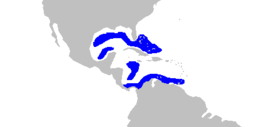
Thorny green sharks live in the central western Atlantic Ocean in the Gulf of Mexico from Texas to Florida and Cuba , as well as off the coast of the Yucatan Peninsula . In the Caribbean, these sharks are common off the coast of Honduras and Nicaragua , as well as from Panama to Venezuela and probably Brazil [7] . They are found at the bottom in the upper part of the continental slope at depths from 196 to 915 m, but mostly fall deeper than 350 m [8] [9] .
Black marks on the ventral side of the shark carry photophores that emit light.
The maximum recorded size is 26 cm. The body is rather slender, elongated, with a long tail. The distance from the beginning of the base of the ventral fins to the vertical drawn through the base of the lower lobe of the caudal fin is equal to the length of the head and the distance between the bases of the pectoral and ventral fins and is 1.4 times greater than the distance between the dorsal fins. In adult sharks, the distance between the bases of the pectoral and ventral fins is relatively large and slightly shorter than the head. The distance from the tip of the snout to the spine at the base of the first dorsal fin is approximately equal to the distance between these spines and the base of the second dorsal fin. The width of the head is equal to the distance from the tip of the snout to the mouth. The distance from the snout tip to the sprayer is approximately equal to the distance between the sprayers and the base of the pectoral fins. The gill slits are short, comparable in width to sprinklers and are 1/3 or less of the length of the eye. The base of the first dorsal fin begins at the level of an imaginary vertical line drawn along the inner edge of the pectoral fins, it is located closer to the pectoral fins than to the ventral fins. The distance between the base of the second dorsal fin and the upper lobe of the caudal fin is 1.4 times the distance between the dorsal fins. The caudal fin is rather long and equal in length to the head. Upper teeth with three teeth. The lower teeth in the form of a blade have one tip and are interlinked. On the upper and lower jaws there are 29–34 and 24–32 dentitions
Large oval eyes are elongated horizontally. Behind the eyes are tiny splatter . The nostrils are placed on the tip of the snout. Spikes are located at the base of both dorsal fins. The second dorsal fin and spine are much larger than the first. The pectoral fins are small and rounded. The upper lobe of the caudal fin is elongated. The skin is tightly and chaotically covered with small placoidal scales in the form of short hooks. The lower edges of the fins are devoid of scales. The color is dark brown or gray-black, the belly and bottom of the head are black. Above and behind the bases of the ventral fins there are wide black markings of the mark. There are also elongated marks at the base of the caudal fin and along the caudal stem [4] . These marks carry light-emitting photophores .
A newborn green spiny shark next to an adult.
Photophores located on the belly and underside of the head, emitting light, can mask the silhouette of the shark from potential predators. Like other sharks with the property of bioluminescence, on the pineal gland of green prickly sharks there is a yellow spot that functions as a “window” that allows you to determine the level of illumination of the environment. [10] . As by-catch, these sharks are found irregularly, but in large quantities, which suggests that they travel in packs [4] . In this case, photophores allow members of the pack to keep in sight and coordinate their actions with relatives [10] .
Thorny green sharks prey mainly on squid and octopus [8] . Often in their stomachs they find eyes and beaks of cephalopods of such a size that sharks would have to stretch their jaws to swallow [10] . It is not known how such tiny sharks manage to catch and defeat such a large victim for them. Stuart Springer hypothesized that these sharks attack in packs, as if swarming around an octopus and squid and biting off their flesh piece by piece [7] . Like other black prickly sharks, green prickly sharks breed by egg-production. In the litter from one to three newborns with a length of about 9 cm [9] . Males and females reach puberty with a length of 18.3-23.6 and 22-22.7 cm, respectively [7] .
The view has no commercial value. As by-catch, green prickly sharks are often found in commercial fisheries. The International Union for Conservation of Nature has assigned this species a conservation status of “Least Concern” [7] .
- ↑ Reshetnikov Yu.S. , Kotlyar A.N. , Russ T.S. , Shatunovsky M.I. The Bilingual Dictionary of Animal Names. Fish. Latin, Russian, English, German, French. / edited by Acad. V. E. Sokolova . - M .: Rus. Yaz., 1989 .-- S. 36 .-- 12,500 copies. - ISBN 5-200-00237-0 .
- ↑ Gubanov E.P., Kondyurin V.V., Myagkov N.A. Sharks of the World Ocean: A Guide-Guide. - M .: Agropromizdat, 1986. - S. 203. - 272 p.
- ↑ Breder, CM and DE Rosen. Modes of reproduction in fishes. - TFH Publications, Neptune City. - New Jersey, 1966 .-- S. 941.
- ↑ 1 2 3 4 Compagno, Leonard JV 1. Hexanchiformes to Lamniformes // FAO species catalog. - Rome: Food and Agricultural Organization of the United Nations, 1984. - Vol. 4. Sharks of the World: An Annotated and Illustrated Catalog of Shark Species Known to Date. - P. 88. - ISBN 92-5-101384-5 .
- ↑ Bigelow, HB, WC Schroeder, and S. Springer (July 1953). "New and little known sharks from the Atlantic and from the Gulf of Mexico." Bulletin of the Museum of Comparative Zoology at Harvard University 109 (3): 213-276.
- ↑ My etymology. A universal etymology dictionary (unopened) (link unavailable) . Date of treatment March 21, 2013. Archived July 31, 2013.
- ↑ 1 2 3 4 Horodysky, AZ and GH Burgess (2006). Etmopterus virens. In: IUCN 2008. IUCN Red List of Threatened Species.
- ↑ 1 2 McEachran, JD; Fechhelm, JD Fishes of the Gulf of Mexico: Myxinformes to Gasterosteiformes .. - University of Texas Press., 1998. - S. 119. - ISBN 0-292-75206-7.
- ↑ 1 2 Compagno, Leonard JV, Dando, M .; Fowler, S. Sharks of the World. - Princeton: Princeton University Press, 2005 .-- S. 110. - ISBN 978-0-691-12072-0 .
- ↑ 1 2 3 Ellis, R. Deep Atlantic: Life, Death, and Exploration in the Abyss. Alfred A. Knopf. - 1996. - P. 195—197. - ISBN 1-55821-663-4 .