The Bengal eagle owl reaches a size of 50–56 cm with a wing length of 36–39 cm in males and 37–42 cm in females. The body weight of an adult bird is about 1100 g. It has a light, yellow-brown plumage with black spots. On the chest there are many dark longitudinal stripes. The eyes are orange-red in color [2] .
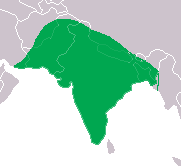
The range occupies most of the Indian subcontinent to the western foothills of the Himalayas and includes Pakistan , India , Nepal and Burma . It lives in rocky and rocky semi-deserts with sparse vegetation, often settles in mango plantations near people. As a rule, it avoids moist evergreen forests and extremely arid areas. Altitude range reaches approximately 5000 m above sea level.
They hunt at night, often flying close to the ground in search of prey. The diet consists mainly of small mammals and birds, less often reptiles, crustaceans and large insects. The breeding season lasts from February to April. Nests on the ground, in a shallow pit among rocks or under bushes. Lays three or four eggs. Chicks hatch after about 35 days and depend on their parents for another six months. When strangers approach the nest, the birds open their wings to appear larger or fly around a potential predator (including humans), hissing loudly and clicking with their beaks. Sometimes, in order to divert the attention of an intruder to themselves, adult birds pretend to be a wing injury. The behavior of a Bengal eagle owl is the cause of many superstitions. Usually the appearance of these birds (as well as other owls) is considered a bad omen. Owls sitting on the roof of houses, according to some legends, portend the death of one of the tenants. Cases of catching, torturing and killing birds for ritual purposes have been recorded to attract wealth, good luck or predict the future. All this attracts poachers. Hunting for the Bengal eagle owl in India is prohibited and its population today is not in danger [3] [4] .