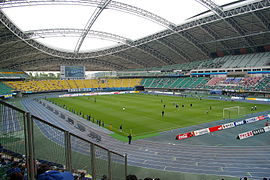
Oita Bank Home [1] is a multi-purpose stadium in Oita City in Oita Prefecture on Kyushu Island in Japan .
| Oita Bank Dome | |
|---|---|
 | |
| Location | Oita , Japan |
| Open | 2001 |
| Architect | |
| Owner | |
| Developer | |
| Capacity | 43,254 places |
| Home team | Oita Trinita |
| Field dimensions | 105 x 68 m |
The stadium is now called Ōita Bank Dome ( Jap. 大分 銀行 ド ー ム o: ita ginko: do: mu ) , or Daigin Dome ( jap. 大 銀 ド ー ム daigin do: mu ) . It was also called the Kyushu Oil Dome Kyushu Oil Dome ( 九州 石油 ド ー ム kyu: syu: sekiyu do: moo ) while it was funded by Kyushu Oil Co. until the beginning of 2010 . Mostly the stadium is used for football purposes, being the home arena for Oita Trinity's J. League club . The stadium was built by architect Kisho Kurokawa , which was implemented by KT Group, Takenaka Corporation .
Content
History
The Oita Stadium opened in May 2001 and initially accommodated 43,000 spectators.
The stadium hosted 3 matches in the framework of the World Cup 2002 ;
Group Stage Matches:
- June 10: Tunisia 1 - 1 Belgium
- June 13: Mexico 1 - 1 Italy
1/8 finals
- June 16: Sweden 1 - 2 Senegal (additional time)
Features
The stadium has a retractable domed roof.
Other features of the stadium:
- Area of construction: 51 830 m²
- Total area: 92 882 m²
- Covered Area: 29,000 m²
See also
Other domed stadiums in Japan :
- Sapporo Dome in Sapporo , Hokkaido Prefecture
- Kobe Wing in Kobe , Hyogo Prefecture
One of the episodes of the television series Engineering Miracles was dedicated to the stadium.
Notes
- ↑ Oita Bank Dome // Big Russian Encyclopedia : [in 35 vols.] / Ch. ed. Yu.S. Osipov . - M .: Great Russian Encyclopedia, 2004—2017.
Links
- (jap.) Official site