The desert phylin , or pharaohs phylin [1] ( lat. Bubo ascalaphus ) [2] is a species of bird of the genus Eagle Owl of the family of owls , living in North Africa and the Middle East . The scientific name ascalaphus received the name of one of the demons of Greek mythology , Ascalaphus .
| Desert Eagle Owl |
 |
| Scientific classification |
|---|
| No rank : | Bilateral symmetrical |
|
| International scientific name |
|---|
Bubo ascalaphus ( Savigny , 1809 ) |
| Security status |
|---|
Least ConcernedIUCN 3.1 Least Concern : 22688938 |
|
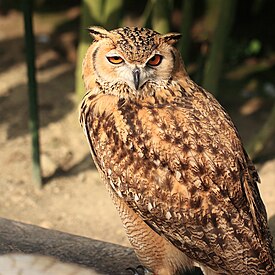
The adult pharaoh eagle owl is a bird 46–50 cm in size and weighing 1900–2300 g. The total color of plumage varies from pale red to sand, with black spots. The front disc is framed by a narrow dark rim. The beak is black. It has small feather "ears" and yellowish-orange eyes. The range includes most of Northwest Africa, the Sahara desert and the Arabian Peninsula . Two subspecies are known that inhabit the northern and southern parts of the range, respectively [3] :
- Bubo ascalaphus ascalaphus
- Bubo ascalaphus desertorum - is smaller and paler in color.
Desert eagle owl prefers rocky deserts and semi-deserts, mountain slopes, gorges and rocks. It hunts small mammals , reptiles and birds at night and at dusk, and also eats beetles and scorpions . As a rule, they form monogamous pairs for life. The female lays two to four eggs in February - March. The incubation period is from 31 to 36 days. Chicks leave the nest at the age of 20 to 35 days, but remain in the family group for about another 20–26 weeks. In the second year of life, they become capable of reproduction [4] .