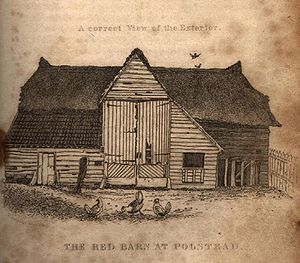
Murder in the Red Barn is a high -profile crime committed in 1827 in Polstead ( Suffolk County). A young woman, Maria Marten, was shot dead by her lover, William Corder. They were planning to flee to Ipswich , where they planned to make a secret marriage, and agreed to meet in the Red Barn. After that, Mary disappeared; Corder went on the run. Although he sent letters to the Martin family stating that she was in good health, her body was found buried in a barn after her adoptive mother said she saw the murder in a dream.
Corder was tracked down in London, where he married and began a new life. He was escorted back to Suffolk; the lawsuit received great publicity. Corder was found guilty and in 1828 publicly hanged in the city of Bury St Edmunds .
History has received great publicity; In addition to newspaper descriptions, songs appeared on the topic of the atrocities in the Red Barn, and even theatrical plays. The village in which the crime occurred became a tourist attraction. The plays and ballads about the event remained popular for a century and still continue to be performed [1] .
Content
Murder
Maria Marten was born on July 24, 1801 . She was the daughter of Thomas Marten [2] , a mole catcher from Polstead, Suffolk County [3] . In March 1826, at the age of 24, she entered into a relationship with 22-year-old William Corder (born in 1803). Maria Marten was an attractive woman and, as a result of relations with her neighbors, had already managed to give birth to two children. One of them, the son of Thomas, William's elder brother, died in infancy, the other named Thomas Henry was alive by then. Although Thomas’s father, Henry, did not want to communicate with Mary after the birth of a child, he occasionally sent money to support him [3] .
William Corder was the son of a local farmer and had a reputation as a con man and womanizer. At school, for his craftiness, he received the nickname "Fox." Corder fraudulently sold pigs belonging to his father, and although his father settled the case without government intervention, his son did not change his behavior. He later received 93 pounds on a fake check and helped local thief Samuel “Handsome” Smith steal a pig from a neighboring village. When the local constable interrogated Smith about the theft, he allowed himself a statement about Corder, which turned out to be prophetic: "Damn me if they don't hang him one day." ( English I'll be damned if he will not be hung some of these days ). Following the fraudulent sale of pigs, Corder was shamefully sent to London. William was called back to Polsted after his brother Thomas drowned while trying to cross a frozen pond, and he needed someone to replace the deceased [4] . Corder's father and three brothers died one after the other for 18 months, and William and his mother remained to run the farm.
Although Corder wanted to keep her relationship with Mary a secret, in 1827, at the age of 25, she gave birth to a child. Maria believed that she and Corder should get married. The child died (later in the documents it was suggested that he was killed), but apparently Corder was still going to marry Maria. In the summer, in the presence of stepmother Maria Ann Marten, he suggested that Mary meet him in the Red Barn, from where they should go to Ipswich . Corder said he heard rumors that parish officials were about to start prosecuting Mary for her illegitimate children. At first he offered to run on Wednesday evening, but later decided to stay until Thursday evening. He was delayed again on Thursday, some sources mention that his brother’s illness was the cause, although most sources claim that all his brothers had died by this time. The next day, on Friday , May 18, 1827, he came to the Marten cottage and, according to Ann Marten, told Mary that they should flee immediately, because he heard that the local constable James Balam had received a warrant to persecute her. Balam later stated that he had never spoken to Corder about warrants [2] . It remains unknown: Corder lied or was simply mistaken.
Maria was worried that she could not run in broad daylight, but Corder ordered her to change into men's clothes so as not to arouse suspicion, while he would take her things to the barn, where she would meet him and change clothes, after which they would go to Ipswich [ 2] .
After Corder left, Maria went to the Red Barn, located on Barnfield Hill, half a mile from the Marten Cottage. No one else saw her alive. Corder also disappeared, but later returned and stated that Mary was in Ipswich or Great Yarmouth , or elsewhere nearby. He cannot bring her back, since she became his wife, which can cause the anger of her relatives and friends. As a result, Corder had to leave due to pressure from society. Corder wrote letters to the Martin family stating that they were married and live on the Isle of Wight . He apologized that she did not write anything. Corder gave various explanations for this: she was ill, injured her hand, or that her letters were lost [3] .
Suspicions continued to grow, Mary's stepmother began to talk about her dreams, in which she saw that Mary was killed and buried in the Red Barn. On April 18, 1828, she persuaded her husband to go to the Red Barn and dig out one of the grain storage bins. He discovered the remains of his daughter, packed in a bag. The body was badly decomposed, but was still recognizable. The inquest was held in the Kok tavern (which has survived to this day) in Polsted, where the body of Mary was officially recognized by her sister Ann. Maria’s hair and some details of her clothes were still recognizable, but the victim’s well-known special sign - the missing tooth, disappeared along with the jawbone. Evidence of Corder’s involvement was found: his green scarf was wrapped around the neck of the deceased [3] .
Capture
Corder found quite easily. Mr. Ayres, a constable from Polstead, received his old address from a friend and, with the help of Lambert Street Police Officer James Lee (Lee later led the investigation of Jack Spring on his heels ), tracked down Corder, who was in Brentford 's boarding school [4] . Korder ran the boarding school with his new wife Mary Moore, whom he met through an ad in The Times (more than a hundred people responded to the ad) [5] [6] [K 1] . Lee entered the boarding school on the pretext that he wanted to put his daughter here and took Corder by surprise in his office. The English novelist Thomas Hardy described his capture in a report written for the Dorset County Chronicle [7] :
... he was sitting in an office (where four ladies had breakfast) dressed in a bathrobe; in front of him lay a clock on which he detected the boiling time of eggs.
Original text... in parlor with 4 ladies at breakfast, in dressing gown & had a watch before him by which he was 'minuting' the boiling of some eggs.
Lee took Corder aside and stated that he was seriously charged and could consider himself arrested. To the officer’s further questions, Corder replied that he did not know Mary at all and that he did not know anything about the crime [2] . During a search of the house, a pair of pistols were found, which were supposedly bought on the day of the murder, letters from Mr. Gardener, which could contain warnings that the crime was discovered, and a passport received from the French ambassador. This served as evidence that Corder could prepare for flight [3] .
Court
Corder was taken back to Suffolk County. His trial took place in Bury St Edmunds in the county government building. The court was adjourned for several days due to the general interest caused by the case. The process began on August 7, 1828. City hotels began to fill already on July 21. Due to the large number of people wishing to attend the hearings, they were allowed to go to court only by tickets. Despite this, in order to get into the courtroom, the judge and judicial officials each time had to make their way through the crowd gathering at the door of the courtroom.
The Chief Justice of the Treasury Court, Chief Baron Alexander, expressed dissatisfaction with the press coverage of the case, "causing obvious damage to the defendant" ( English to the manifest detriment of the prisoner at the bar ) [8] . Nevertheless, The Times thanked the public for its common sense, expressed in the unanimous recognition of Corder as the killer Marten [9] .
At the trial, Corder pleaded not guilty. The exact cause of Marten's death could not be established. It was believed that the victim’s eye socket was pierced with a sharp object - perhaps a short sword or Corder’s dagger - but the same wound could have been inflicted by Marten’s spade when removing the body from the ground. Corder’s handkerchief wrapped around Martin’s neck didn’t exclude the possibility of strangulation , and in addition to the resulting confusion, the nature of the wounds on the victim’s body suggested that she was shot. The indictment accused Corder of "... murdering Maria Marten by feloniously and wilfully shooting her with a pistol through the body, and likewise stabbing her with a dagger and intentionally shooting her body with a dagger." her with a dagger ) [2] . In order to avoid a judge ordering a “wrong trial” [K 2], Corder was charged on nine counts at once, including forgery of securities. (According to John Smith - on ten articles [2] .)
Anne Marten was summoned to court to testify about the events of the day Maria disappeared and to talk about her further dreams. Then Thomas Marten told the court how he dug up the body of his daughter. Maria's 10-year-old brother said that he saw Corder with a loaded gun before the alleged murder, and later noticed how he walked from the barn with a pickaxe. Officer Lee testified about the arrest of Corder and the objects found during a search of his house [10] . The prosecution stated that Corder never wanted to marry Maria, but she knew about some of his criminal transactions, which gave her power over him and there was friction between them, since he had previously stole the money that her child’s father sent Maria [11] .
Corder told his version of events. He admitted that he was in the barn with Maria, but stated that he had left the barn after talking with her. He said that when he left the barn he heard a pistol shot and, having run into the barn, he found the murdered Maria, one of his pistols lay next to her body. He asked the jury to interpret the doubts in his favor, but after conferring only 35 minutes, they returned with a guilty verdict [10] . Judge Alexander sentenced Corder to hanging and subsequent dissection .
You will be taken back to the prison from where you were brought, next Monday you will be taken out of there, [taken] to the place of execution and there you will be hanged by the neck and [will hang] until you die, then your body will be opened and anatomized and let the all-merciful God in his infinite kindness will have mercy on your soul!
Original textThat you be taken back to the prison from whence you came, and that you be taken from thence, on Monday next, to a place of Execution, and that you there be hanged by the Neck until you are Dead; and that your body shall afterwards be dissected and anatomized; and may the Lord God Almighty, of his infinite goodness, have mercy on your soul!
The next three days, Corder spent in prison, tormented by the question of whether to confess to the crime and sincerely repent of his sins before God. After several meetings with the prison chaplain, the requests of his wife and the calls of his jailer and the head of the prison, John Otridge, he confessed to the crime [12] . Corder strongly denied that he had stabbed Mary and claimed that he accidentally shot her in the eye when she took off her disguise [3] .
Execution
On August 11, 1828, Corder was taken to the gallows of the city of Bury St Edmunds , he was apparently too weak to stand without assistance [13] . Shortly before noon, Corder was hanged in front of a huge crowd. According to the statement of one of the newspapers, 7 thousand spectators were present, another was estimated to be 20 thousand. [14] At the insistence of the head of the prison, before putting a cap on his head, he said in a weak voice: “I consider myself guilty, my punishment rightly, I have earned my fate and may God have mercy on my soul. ” [15] ( English I am guilty; my sentence is just; I deserve my fate; and, may God have mercy on my soul )
An hour later, his body was removed from the gallows by the executioner John Foxton . According to his rights, he demanded the pants and stockings of the executed. The body was carried back to the courtroom in the city administration building, where it was opened along the abdominal cavity to expose the muscles. People were allowed to stay in the courtroom until the doors closed at six o’clock. According to the Norwich and Bury Post , over 5,000 people stood in line to look at the body. [sixteen]
The next day, an autopsy and dissection of the body was performed in the presence of doctors and students of Cambridge . To demonstrate muscle contraction, a battery was connected to Corder's limbs. The sternum was opened and the internal organs examined. There was a controversy over whether strangulation became the cause of death - according to reports, Corder's chest continued to rise and fall for several minutes after hanging, so compression of the spinal cord was suggested as the probable cause of death. Since Corder’s skeleton had to be assembled after an autopsy, it was impossible to examine the brain; instead, surgeons agreed to conduct a phrenological examination of the skull. Researchers claimed that Corder’s skull was highly developed in the areas of “stealth, money-grubbing, destructive, fertility, and imitation” with some evidence of “goodwill or veneration.” A bust of Corder, made by Child from Bangui , Suffolk, was placed in the Moyse's Hall Museum in Bury St Edmunds as a phrenological study aid. The skeleton was assembled and used as a teaching aid at West Suffolk Hospital [17] . Several posthumous masks were made, a copy of one of them is in the Moyse's Hall Museum [18] . The museum also houses court items and some of Corder’s personal items. Corder’s skin was hollowed out by surgeon George Creed and used as material for binding the murder report [K 3] .
Corder’s skeleton was on display at the Hunter Museum of the Royal College of Surgery near the skeleton of Jonathan Wilde . In 2004, Corder's bones were removed from the exhibition and cremated [19] .
Rumors
After the trial, doubts were expressed about the veracity of the story, the dreams of the stepmother, the fate of the child Mary and William. The stepmother was only a year older than Maria, and there were rumors that Anne Marten and Corder were in touch, and they planned to kill Maria to continue to meet without obstacles. It was said that the stepmother's jealousy became the motive for discovering the body and her vision was simply a hoax, as she began to dream only a few days after Corder married Maria [3] .
There were rumors about the death of the child of Corder and Mary. Both of them said that they had buried the deceased child in the town of Sudburi in Suffolk County, but no records and traces of the child’s grave were found [3] . In his written confession, Corder indicated that on the day of Mary’s murder, they argued whether the burial site would be discovered.
In the 20th century, after the researcher and writer Donald McCormick released the book The Red Barn Mystery, a new wave of rumors arose. The author mentioned some interesting facts, including a hitherto unknown acquaintance between Corder and Thomas Griffiths , a counterfeiter and a poisoner, while Corder was in London and that actress Caroline Palmer, who often played in a melodrama, set based on this case and The investigation concluded that perhaps Corder did not kill Mary, and the murderer could have been a local gypsy. However, McCormick's studies of other police and criminal stories remain open to question, and this conclusion has not been accepted by most researchers.
Public Interest
В деле об убийстве Марии Мартен присутствовали все составляющие, необходимые для возбуждения пристального интереса общества: преступный помещик и несчастная девушка, живописное место убийства, сверхъестественный элемент в виде вещих снов мачехи убитой, работа детективов Эйрса и Ли (который стал прототипом детектива Фароса Ли — собирательного образа из анонимной пьесы «Мария Мартен, или Убийство в Красном амбаре»), новая жизнь Кордера, начавшаяся с объявления о поисках спутницы жизни. Ажиотаж вокруг преступления породил целую небольшую промышленность по производству сувениров и бульварных сочинений, так или иначе связанных с историей убийства.
Пьесы уже ставились, когда Кордер ожидал суда. После казни неизвестный автор опубликовал мелодраму по мотивам убийства (ставшую предшественницей сборника Newgate novels . Мелодрама быстро стала бестселлером. Тема убийства в красном амбаре вместе с рассказами о Джеке Шеппарде и о других разбойниках с большой дороги, ворах и убийцах стала популярным сюжетом дешёвых пьес исполняемых для развлечения низших классов в пропитанных джином задних комнатах трактиров [20] . После казни издатель Джеймс Катнач продал свыше миллиона экземпляров газет-листовок [21] [К 4] . Катнач описал детали признания Кордера и казни и включил в газету сентиментальную балладу предположительно написанную самим Кордером. Более вероятно, что автором баллады был сам Катнач или кто-то из его служащих [23] [24] . Во время казни появилось по меньшей мере пять баллад [25] .
Благодаря атмосфере волнения в ходе судебного процесса и общественного спроса на произведения, созданные по мотивам убийства, были написаны и распространены множество произведений содержащих различные версии убийства, что создало сложности при разделении действительно имевших место фактов и мелодраматических украшений для читателей того времени. На основе официальных документов были созданы хорошие судебные отчёты. Лучшим судебным отчётом признаётся работа журналиста Джеймса Кёртиса , который провел время с Кордером и две недели прожил в Полстеде, опрашивая жителей, которых коснулось это убийство [3] . Свою книгу «The Mysterious Murder of Maria Marten» он опубликовал сразу после окончания судебного процесса [3] . Кёртис по-видимому уже настолько ассоциировался с делом, что художник одной из газет выполняя требование нарисовать обвиняемого изобразил его больше похожим на Кёртиса чем на Кордера [26] .
Куски верёвки, на которой был повешен Кордер, продавались по гинее за штуку [27] . Кусок скальпа Кордера вместе с ухом был выставлен в магазине на Оксфорд-стрит . Прядь волос Марии была продана за две гинеи. Полстед стал туристической достопримечательностью, туристы приезжали даже из Ирландии [28] . По оценке Кёртиса только в 1828 году Полстед посетили 200 тыс. чел. [3] особый интерес вызывали Красный амбар и коттедж Мартен [28] . Амбар был ободран на сувениры, со стен были содраны доски, которые были проданы на зубочистки [29] . Амбар планировалось снести после суда, однако он простоял до 1842 пока не сгорел дотла [3] [К 5] . Даже могильный камень Марии на кладбище церкви Св. Марии был в итоге совершенно разбит и уничтожен охотниками за сувенирами. Продавались керамические модели и наброски. Сочинялись песни, одна из них была исполнена в операх Ральфа Воан-Уильямса Hugh the Drover и Five Variants of Dives and Lazarus .
Скелет Кордера был выставлен на обозрение в стеклянном шкафу в West Suffolk Hospital и снабжён особым механизмом: когда кто-либо подходил достаточно близко, скелет указывал на коробочку для сборов. Череп позднее забрал доктор Килнер, желавший добавить его к своей обширной коллекции памятных вещей события в Красном амбаре. После постигшей его серии несчастий Килнер пришёл к убеждению, что над черепом тяготеет проклятие и передал его своему другу Хопкинсу. Тем не менее, несчастья продолжали преследовать обоих друзей и в итоге они оплатили погребение черепа по христианским обычаям в надежде избегнуть предполагаемого проклятия [31] .
In popular culture
Интерес общества к делу не угасал ещё долго. Пьеса «Мария Мартен, или Убийство в Красном амбаре» ( англ. Maria Marten; or The Murder in the Red Barn ), существовавшая в различных анонимных версиях, стала сенсацией в середине XIX столетия и была возможно наиболее часто исполняемой пьесой в то время. Чтобы справиться с возросшим спросом хозяевам пип-шоу существовавших в викторианскую эпоху пришлось снабдить свои ящики, демонстрирующие сцены убийства дополнительными отверстиями, [4] . В пьесах викторианской эпохи наблюдается тенденция изображения Кордера в виде хладнокровного чудовища, охотившегося за Марией и другими невинными жертвами, её собственная репутация, как и репутация её детей от других отцов, была очищена [32] . Кордер изображался стариком [33] . Чарльз Диккенс опубликовал отчёт об убийстве в своём журнале « Круглый год » ( англ. All the Year Round ), хотя сначала он ответил отказом, полагая, что история приобрела слишком большую известность, а рассказ мачехи о её снах скорее выдуман [34] .
В XX веке история несколько утратила популярность; тем не менее, по её мотивам было снято пять фильмов. Среди них можно отметить фильм « Мария Мартен, или Убийство в Красном амбаре » ( англ. Maria Marten or Murder in the Red Barn ; 1935) [33] с в роли Кордера. Фильм был показан в США в несколько урезанном виде [К 6] , и фильм-драму канала Би-би-си «Мария Мартен» ( англ. Maria Marten ) с в главной роли. В 1953 рассказ в художественной обработке был включён в радиосериал Crime Classics канала CBS [36] . В 1991 году британский драматург написал мелодраматическую сценическую версию с элементами политики и народной сказки.
В конце 2013 года [37] театральная аудиокомпания Wireless Theatre Company выпустила радиоспектакль The Legend Of Springheel'd Jack , [38] основой сценария послужил оригинальный диалог взятый из мелодраматического рассказа викторианской эры «The Murder in the Red Barn». Текст прочитали актёры Мэтью Вудкок ( англ. Matthew Woodcock ) и Нейл Фрост ( англ. Neil Frost ).
Преступление послужило источником вдохновения для создания таких произведений как альбом группы (1971), содержащий народную песню «Murder of Maria Martin»; более современную песню Тома Уэйтса «Murder in the Red Barn» (написанную вместе с женой Кэтлин Бреннан ), включённую в альбом 1992 года Bone Machine [39] , и песню Кэтрин Робертс и Шона Лейкмана «The Red Barn», вошедшую в альбом 2004 года. Во втором альбоме упоминается об убийстве. Песня «Maria Martin» из альбома народной музыки White Swans Black Ravens была записана вживую в Moyse's Hall Museum . В декабре 2011 года фолк-группа из Эссекса The Owl Service создала песню «Red Barn» [40] .
События убийства стали темой второй серии сериала телеканала BBC One A Very British Murder: A National Obsession (2013), представленной Люси Уорсли [41] Также была опубликована сопроводительная книга [42] .
Comments
- ↑ Иногда указывалось другое имя: Мария Мур однако надпись в журнале Кордера и последовавшие отчёты подтвердили тот факт, что её звали Мэри. В первых газетных заметках сообщалось, что она увидела объявление Кордера в витрине кондитерской. Неизвестно, является ли это правдой, однако не вызывает сомнений тот факт, что Кордер получал ответы на объявление в газете «Таймс», экземпляр которой содержится в отчёте Кёртиса по делу.
- ↑ Судья может аннулировать судебный процесс до вынесения вердикта, на юридическом языке это называется неправильным судебным разбирательством Судья может объявить о неправильном судебном разбирательстве по следующим причинам:
- Суд определяет, что данное дело не попадает под его юрисдикцию
- Доказательства представлены не по правилам
- Должностное преступление совершённое одной из сторон процесса, присяжным или посторонним лицом если это препятствует надлежащей правовой процедуре.
- Коллегия присяжных не может вынести вердикт с требуемой степенью единодушия
- Дисквалификация присяжного заседателя если нет дополнительного присяжного и истцы не согласны чтобы процесс продолжался с оставшимися присяжными.
Original textA judge may cancel a trial prior to the return of a verdict; legal parlance designates this as a mistrial.
A judge may declare a mistrial due to:
- The court determining that it lacks jurisdiction over a case,
- Evidence being admitted improperly,
- Misconduct by a party, juror,[1] or an outside actor, if it prevents due process,
- A hung jury which cannot reach a verdict with the required degree of unanimity
- Disqualification of a juror after the jury is impaneled, if no alternate juror is available and the litigants do not agree to proceed with the remaining jurors.
A declaration of a mistrial generally means that a court must hold a retrial on the same subject.
- ↑ На внутренней стороне обложки отчёта по делу сделанной из выдубленной кожи Кордера, написана от руки острота: в ночь казни в театре Друри-Лейн ставили « Макбета ». После строки «Казнён ли Кавдор?» мужчина с галёрки выкрикнул: «Да! Он был повешен утром в Бери».
- ↑ Источники указывают различные количества проданных экземпляров. Чаще упоминаются числа в 1 160 000 или 1 600 000 экземпляров. По утверждению Катнача было продано свыше 1 650 000 экземпляров [22] .
- ↑ В ноябре 2007 года на первой странице издания «Ист-Англиан Дейли Таймс» появилось сообщение о пожаре, который едва не уничтожил коттедж Мартен. Очевидцы заметили в дымоходе здания огонь, угрожавший «знаковому суффолкскому коттеджу», ныне используемому в качестве мини-гостиницы . Впрочем, пожарные сумели спасти около 80 % соломенной крыши [30] .
- ↑ В Британии сценарий прошёл через фильтр Совета киноцензоров , который был готов утвердить его лишь при условии исключения сцены казни. Сцена всё же была снята, однако члены совета настояли на её удалении до показа фильма [33] . В американской версии были вырезаны сцены, акцентировавшие внимание на беременности Мэри, а также эпизоды, в которых употреблялись слова «шлюха» ( англ. slut ) и «девка» ( англ. wench ). Была укорочена и сцена её погребения. В штатах Виргиния и Огайо в версиях фильма, разрешённых к распространению были удалены ещё некоторые сцены [35] .
Notes
- ↑ Maria Martin . The Crushed Tragedian. Дата обращения 17 августа 2013.
- ↑ 1 2 3 4 5 6 Smith, John Hay. Celebrated Trials of All Countries, and Remarkable Cases of Criminal Jurisprudence . — J. Harding, 1847.
- ↑ 1 2 3 4 5 6 7 8 9 10 11 12 The Red Barn Murder . St Edmundsbury Council. Дата обращения 17 августа 2013.
- ↑ 1 2 3 Donaldson, 2004 , pp. 168-169.
- ↑ Maclaren, 1997 , p. 250.
- ↑ Urban, Sylvanus. Obituary // The Gentleman's Magazine. — L. : John Henry and James Parker, 1857. — Vol. 3, № 203.
- ↑ Hardy, 2004 , p. 131, Note 85.b.
- ↑ The Times. - 1828. - August 9. - P. 3. - Cit. in: Wiener, 2004 , p. 138.
- ↑ The Times. - 1828. - August 12. - P. 3. - Cit. in: Wiener, 2004 , p. 138.
- ↑ 1 2 Urban, Sylvanus. Domestic Occurrences // The Gentleman's Magazine. - L .: JB Nichols, 1828. - Vol. 98, No. 21.
- ↑ Cairns, 1999 , p. 40.
- ↑ Langbein, 2003 , p. 270.
- ↑ Gatrell, 1996 , p. 13.
- ↑ Gatrell, 1996 , p. 32.
- ↑ Cairns, 1999 , p. 18.
- ↑ Curtis, 1828 , p. 210.
- ↑ Gatrell, 1996 , pp. 256-257.
- ↑ Local History of Moyse's Hall . St. Edmundsbury Borough Council. Date of treatment August 17, 2013.
- ↑ Killer cremated after 180 years . BBC News (August 17, 2004). Date of treatment August 17, 2013.
- ↑ Picard, 2006 , p. 198.
- ↑ Gatrell, 1996 , p. 159.
- ↑ Broadside Ballads and the Oral Tradition . University of Glasgow. Date of treatment August 17, 2013. Archived October 10, 2006.
- ↑ Neuburg, 1977 , p. 138.
- ↑ Hindley, 1969 , p. 79.
- ↑ Pettitt, Tom. The Murdered Sweetheart: Child of Print and Panic? (PDF). Massachusetts Institute of Technology (May 2005). Date of treatment August 17, 2013.
- ↑ Caulfield, 2005 , p. 55.
- ↑ Gatrell, 1996 , p. 258.
- ↑ 1 2 Mackay, 1995 , p. 700.
- ↑ Gatrell, 1996 , p. 43.
- ↑ Claydon, Russell. Blaze at home of famous murder victim . East Anglian Daily Times (November 27, 2007). Date of treatment August 17, 2013.
- ↑ Storey, 1980 , p. 118.
- ↑ Wiener, 2004 , pp. 138-139.
- ↑ 1 2 3 The Unknown 1930s, 2001 , p. 136.
- ↑ The Letters of Charles Dickens, 1999 , p. 371.
- ↑ Slide, 1998 , p. 103.
- ↑ Premier Collections: Crime Classics . First Generation Radio Archives (2007). Date of treatment August 17, 2013.
- ↑ The Springheel Saga: The Legend of Springheel'd Jack - The Terror of London . Yes Wireless Theater Company. Date of treatment March 16, 2014.
- ↑ Woodcock, Matthew SPRINGHEEL'D JACK AND THE RED BARN MURDER . Yes Matthew Woodcock Blog. Date of treatment March 16, 2014.
- ↑ ask lyrics (inaccessible link) . asklyrics.com (2008). Date of treatment August 17, 2013. Archived February 27, 2006.
- ↑ The Owl Service: All Things Being Silent . normanrecords.com. Date of treatment August 17, 2013.
- ↑ A Very British Murder, BBC Four, review . Telegraph. Date of treatment June 11, 2014.
- ↑ History Book Reviews. A Very British Murder by Lucy Worsley, review . Telegraph. Date of treatment June 11, 2014.
Literature
- Cairns, David. Advocacy and the Making of the Adversarial Criminal Trial 1800–1865. - Clarendon Press , 1999 .-- 230 p. - (Oxford Studies in Modern Legal History). - ISBN 0-19-826284-1 .
- Caulfield, Catherine. The Man Who Ate Bluebottles: And Other Great British Eccentrics. - Icon Books Ltd., 2005. - 224 p. - ISBN 1-84046-697-9 .
- Church, Robert. More murders in East Anglia. - Robert Hale , 1990 .-- P. 11-28. - ISBN 0-7090-4031-8 .
- Curtis, James. The Mysterious Murder of Maria Marten. - L .: William Clowes , 1828.
- Donaldson, Willie. Brewer's Rogues, Villains and Eccentrics: An A – Z of Roguish Britons Through the Ages. - Phoenix House , 2004 .-- 686 p. - ISBN 0-7538-1791-8 .
- Gatrell, VAC The Hanging Tree: Execution and the English People, 1770–1868. - Oxford Paperbacks , 1996 .-- 654 p. - ISBN 0-19-285332-5 .
- Hardy, Thomas. Thomas Hardy's 'Facts' Notebook / William Greenslade. - Ashgate Publishing, Ltd., 2004 .-- 365 p. - ISBN 1-84014-235-9 .
- Hindley, Charles. The History of the Catnach Press. - Detroit: Singing Tree Press , 1969. - Orig. ed. 1869.
- Langbein, John H. The Origins of Adversary Criminal Trial (Oxford Studies in Modern Legal History). - Oxford University Press , 2003 .-- 376 p. - ISBN 0-19-925888-0 .
- Mackay, Charles. Extraordinary Popular Delusions and the Madness of Crowds. - Wordsworth Editions Ltd., 1995. - 748 p. - ISBN 1-85326-349-4 .
- Maclaren, Angus. The Trials of Masculinity: policing sexual boundaries, 1870–1930. - University of Chicago Press , 1997 .-- 307 p. - ISBN 0-226-50067-5 .
- McCormick, Donald. The Red Barn Mystery: some new evidence on an old murder. - AS Barnes and Co., 1968. - 206 p.
- Neuburg, Victor E. Popular Literature: A History and Guide. - Routledge, 1977 .-- 302 p. - ISBN 0-7130-0158-5 .
- Picard, Liza. Victorian London: The Tale of a City 1840–1870. - St. Martin's Press, 2006 .-- 384 p. - ISBN 0-312-32567-3 .
- Slide, Anthony. Banned in the USA: British Films in the United States and their Censorship, 1933–1966. - IB Tauris , 1998 .-- 232 p. - ISBN 1-86064-254-3 .
- Storey, Neil R. A Grim Almanac of Suffolk. - Sutton Publishing, 1980 .-- 192 p. - ISBN 0-7509-3498-0 .
- Wiener, Martin J. Men of Blood: Violence, Manliness, and Criminal Justice in Victorian England. - Cambridge University Press , 2004 .-- 312 p. - ISBN 0-521-83198-9 .
- The Letters of Charles Dickens: 1865–1867 / Graham Storey, Margaret Brown, Kathleen Tillotson (eds.). - Clarendon Press , 1999. - Vol. 11. - 598 p. - ISBN 0-19-812295-0 .
- The Unknown 1930s: An Alternative History of the British Cinema 1929–1939 / Jeffrey Richards (ed.). - IB Tauris & Co Ltd., 2001. - 287 p. - ISBN 1-86064-628-X .
Links
- The Red Barn Murder . St Edmundsbury Council. Date of treatment August 17, 2013.
- Victorian Murder at the Red Barn - Polstead - Suffolk . Suffolk Coast. Date of treatment August 17, 2013.