Horned black shark [1] ( lat. Etmopterus sentosus ) is a species of the black thorny shark genus of the family Etmopteridae of the cataract- like order . It is widespread in the western part of the Indian Ocean at depths of up to 500 m. The maximum recorded size is 27 cm. The body is slim, elongated, gray-black, and the belly is black. There are spikes at the base of both dorsal fins. Anal fin missing. These sharks breed by egg-laying [2] . They do not represent commercial value [3] .
| Horned black shark |
|---|
|
| No rank : | Bilateral symmetrical |
| Gender: | Black Spiky Sharks |
|
|
Etmopterus sentosus ( Bass , D'Aubrey & Kistnasamy , 1976) |
|
|
|
Least ConcernedIUCN 3.1 Least Concern : 60244 |
|
The species was first described in 1976 [4] . The holotype is an immature male 27 cm long, caught in 1967 off the coast of southern Mozambique ( Bazaruto Island ). Paratype: immature female 24 cm long, caught 18 km from Durban [5] .
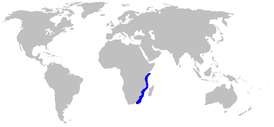
Horned black sharks are common in the western Indian Ocean from Kenya to South Africa , including the island of Madagascar . These sharks are found at the bottom and in the upper part of the continental slope at depths from 200 to 500 m [3] .
The maximum recorded size is 27 cm. The body is slim, elongated, with a rather long tail. The distance from the beginning of the base of the ventral fins to the vertical drawn through the base of the lower lobe of the caudal fin is equal to the length of the head and the distance between the bases of the pectoral and ventral fins and between the dorsal fins. In adult sharks, the distance between the bases of the pectoral and ventral fins is relatively large and equal to the length of the head. The distance from the tip of the snout to the spine at the base of the first dorsal fin is approximately equal to the distance between these spines and the base of the second dorsal fin. The width of the head is slightly larger than the distance from the tip of the snout to the mouth. The distance from the snout tip to the sprayer is approximately equal to the distance between the sprayers and the base of the pectoral fins. The gill slits are quite long, wider than the sprinkler and make up 1/3 of the length of the eye. The base of the first dorsal fin begins at the level of an imaginary vertical line drawn along the inner edge of the pectoral fins. The distance between the base of the second dorsal fin and the upper lobe of the caudal fin is 1.5 times the distance between the dorsal fins. Upper teeth with three teeth. The lower teeth in the form of a blade have one tip and are interlinked.
Large oval eyes are elongated horizontally. Behind the eyes are tiny splatter . The nostrils are placed on the tip of the snout. Spikes are located at the base of both dorsal fins. The second dorsal fin and spine are much larger than the first. The pectoral fins are small and rounded. The upper lobe of the caudal fin is elongated. The skin is loosely and randomly covered with narrow placoid scales. Over the pectoral fins lies 2 rows of large skin denticles. The lower edges of the fins are devoid of scales. The color is gray-black, the belly and bottom of the head are black. In front of, above and behind the bases of the ventral fins there are wide black markings of the mark. There are also elongated marks at the base of the caudal fin and along the caudal stem [3] .
Sharks less than 27 cm are immature. The size of the found embryo was 5.7 cm [6] .
The view has no commercial value. In the area, deep-sea fishing is practically not carried out. The International Union for Conservation of Nature has assigned this species a conservation status of “Least Concerns” [6] .