| Hexagonal mosaic | |
|---|---|
 | |
| Type of | Right mosaic |
| Vertex figure | 6.6.6 (6 3 ) |
| Shlefly symbol | {6.3} t {3,6} |
| 3 | 6 2 2 6 | 3 3 3 3 | | |
| Coxeter Chart |       |
| Symmetry group | , [6.3], (* 632) |
| Rotational symmetry | , [6.3] + , (632) |
| Dual mosaic | Triangular mosaic |
| The properties | Vertically transitive , |
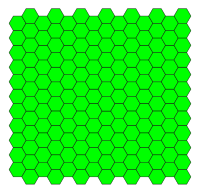
Hexagonal parquet ( hexagonal parquet [1] ) or hexagonal mosaic - tiling of a plane with equal regular hexagons located side to side.
A hexagonal mosaic is a dual triangular mosaic - if you connect the centers of adjacent hexagons, then the drawn segments will give a triangular mosaic [1] [2] . The Shlefli symbol of hexagonal parquet is {6,3} (which means that three hexagons converge at each vertex of the parquet), or t {3,6} if the mosaic is considered as truncated triangular.
The English mathematician Conway called the mosaic hextille (six-parquet).

The internal angle of the hexagon is 120 degrees, so three hexagons at one vertex together give 360 degrees. This is one of the three regular mosaics of the plane . The other two mosaics are triangular parquet and square parquet .
Content
- 1 Applications
- 2 Homogeneous coloring
- 2.1 Hexagonal mosaic with chamfer
- 3 Related Mosaics
- 3.1 Symmetry options
- 4 Building Withoff from hexagonal and triangular mosaics
- 5 Monohedral convex hexagonal mosaics
- 6 Topologically equivalent mosaics
- 7 Packing circles
- 8 Associated regular complex infinite angles
- 9 See also
- 10 notes
- 11 Literature
- 12 Links
Applications
Tiling the plane with regular hexagons is the basis for hex , hexagonal chess and other games on the checkered field , polyhexes , variants of the Life model and other two-dimensional cellular automata , ring flexagons , etc.
Hexagonal mosaic is the most dense way of packing circles in two-dimensional space. states that a hexagonal mosaic is the best way to divide a surface into areas of equal area with the smallest total perimeter. The optimal three-dimensional structure for honeycombs (rather, soap bubbles) was investigated by Lord Kelvin , who believed that (or the body-centered cubic lattice) was optimal. However, the less regular slightly better.
This structure exists in nature in the form of graphite , where each layer of graphene resembles a wire mesh, where strong covalent bonds play the role of a wire. Tubular sheets of graphene were synthesized; they are known as carbon nanotubes . They have many potential applications due to their high tensile strength and electrical properties. Silicene is similar to graphene .
The densest packing of circles has a structure similar to a hexagonal mosaic
Chicken net
Graphene
Carbon nanotubes can be considered as a hexagonal mosaic on a cylindrical surface
Hexagonal mosaic appears in many crystals. In three-dimensional space, a face - centered cubic structure and a hexagonal close-packed structure are often found in crystals. They are the most dense spheres in three-dimensional space. Structurally, they consist of parallel layers of a hexagonal mosaic similar to the structure of graphite. They differ in how the levels are shifted relative to each other, while the face-centered cubic structure is more correct. Pure copper , among other materials, forms a face-centered cubic lattice.
Homogeneous Coloring
There are three different hexagonal mosaic, all obtained from the mirror symmetry of the Withoff constructions . The notation ( h , k ) represents the periodic repetition of a colored tile with hexagonal distances h and k .
| k-homogeneous | 1- homogeneous | 2- homogeneous | 3- homogeneous | ||||
|---|---|---|---|---|---|---|---|
| Symmetry | p6m, (* 632) | p3m1, (* 333) | p6m, (* 632) | p6, (632) | |||
| Picture | |||||||
| Colors | one | 2 | 3 | 2 | four | 2 | 7 |
| (h, k) | (1,0) | (1,1) | (2.0) | (2.1) | |||
| Loafs | {6.3} | t {3,6} | t {3 [3] } | ||||
| 3 | 6 2 | 2 6 | 3 | 3 3 3 | | |||||
| Coxeter | |||||||
| H | tΔ | cH | |||||
A 3-color mosaic is formed by a permutation polyhedron of order 3.
Chamfered Hexagonal Mosaic
Chamfering a hexagonal mosaic replaces the edges with new hexagons and converts it to another hexagonal mosaic. In the limit, the original faces disappear, and the new hexagons are converted into rhombuses, turning the mosaic into a rhombic one .
| Hexagons (H) | Chamfered hexagons (cH) | Rhombi (daH) | ||
|---|---|---|---|---|
Related Mosaics
Hexagons can be divided into 6 triangles. This leads to two 2-homogeneous mosaics , and a triangular mosaic :
| Right mosaic | Breaking up | 2 homogeneous mosaics | Right mosaic | |
|---|---|---|---|---|
| Source | | broken 1/3 hexagons | broken 2/3 hexagons | full partition |
The hexagonal mosaic can be considered an elongated rhombic mosaic , in which each vertex of the rhombic mosaic is “stretched” with the formation of a new edge. This is similar to the connection between the tilings of the rhombododecahedron and the in three-dimensional space.
| Rhombic mosaic | Hexagonal mosaic | A grid showing this relationship |
You can also split the proto-tiles of some hexagonal mosaics into two, three, four, or nine identical pentagons:
| A pentagonal mosaic of the 1st type with overlapping regular hexagons (each hexagon consists of 2 pentagons). | A pentagonal mosaic of the 3rd type with overlapping regular hexagons (each hexagon consists of 3 pentagons). | A pentagonal mosaic of the 4th type with overlapping semi-regular hexagons (each hexagon consists of 4 pentagons). | A pentagonal mosaic of the 3rd type with overlapping regular hexagons of two sizes (hexagons consists of 3 and 9 pentagons). |
Symmetry Options
This mosaic is topologically related to a sequence of regular mosaics with hexagonal faces that begins with a hexagonal mosaic. Mosaics of infinite sequence have the Schleafly symbol {6, n} and the Coxeter diagram .
| * n 62 symmetry options for regular mosaics: {6, n } | ||||||||
|---|---|---|---|---|---|---|---|---|
| Spherical | Euclidean | Hyperbolic mosaics | ||||||
| {6,2} | {6.3} | {6.4} | {6.5} | {6.6} | {6.7} | {6.8} | ... | {6, ∞} |
The hexagonal mosaic is topologically connected (as part of the sequence) with regular polyhedra with vertex figure n 3 .
| Spherical | Euclidean | Compact hyperbolic. | Paracom pacty. | Noncompact hyperbolic. | |||||||
|---|---|---|---|---|---|---|---|---|---|---|---|
| {2,3} | {3,3} | {4.3} | {5,3} | {6.3} | {7.3} | {8.3} | {∞, 3} | {12i, 3} | {9i, 3} | {6i, 3} | {3i, 3} |
Similarly, the mosaic is connected with homogeneous truncated polyhedra with the vertex figure n .6.6.
| * n 32 mutations of symmetries of truncated mosaics: n .6.6 | ||||||||||||
|---|---|---|---|---|---|---|---|---|---|---|---|---|
| Symmetry * n 32 [n, 3] | Spherical | Euclidean | Compact hyperbolic | Paracompact. | Noncompact hyperbolic | |||||||
| * 232 [2,3] | * 332 [3.3] | * 432 [4.3] | * 532 [5.3] | * 632 [6.3] | * 732 [7.3] | * 832 [8.3] ... | * ∞32 [∞, 3] | [12i, 3] | [9i, 3] | [6i, 3] | ||
| Truncated figures | ||||||||||||
| Conf. | 2.6.6 | 3.6.6 | 4.6.6 | 5.6.6 | 6.6.6 | 7.6.6 | 8.6.6 | ∞.6.6 | 12i.6.6 | 9i.6.6 | 6i.6.6 | |
| n-kitty figures | ||||||||||||
| Conf. | V2.6.6 | V3.6.6 | V4.6.6 | V5.6.6 | V6.6.6 | V7.6.6 | V8.6.6 | V∞.6.6 | V12i.6.6 | V9i.6.6 | V6i.6.6 | |
Mosaic is also part of truncated rhombic polyhedra and mosaics with symmetry of the Coxeter group [n, 3]. A cube can be considered as a rhombic hexagon, in which all rhombuses are squares. Truncated shapes have regular n-gons in place of truncated vertices and irregular hexagonal faces.
| Spherical | Euclidean | Hyperbolic | |||||
|---|---|---|---|---|---|---|---|
| * n32 | * 332 | * 432 | * 532 | * 632 | * 732 | * 832 ... | * ∞32 |
| Mosaic | |||||||
| Conf. | V (3.3) 2 | V (3.4) 2 | V (3.5) 2 | V (3.6) 2 | V (3.7) 2 | V (3.8) 2 | V (3.∞) 2 |
Building Withoff from hexagonal and triangular mosaics
Like there are eight homogeneous mosaics based on regular hexagonal mosaics (or dual triangular mosaics ).
If you draw tiles of the original faces in red, the original vertices (the polygons obtained in their place) are yellow, and the original edges (the polygons obtained in their place) are blue, there are 8 shapes, 7 of which are topologically different. (A truncated triangular mosaic is topologically identical to a hexagonal mosaic.)
| Homogeneous hexagonal / triangular mosaics | ||||||||
|---|---|---|---|---|---|---|---|---|
| Fundamental domains | Symmetry : [6.3], (* 632) | [6.3] + , (632) | ||||||
| {6.3} | t {6,3} | r {6,3} | t {3,6} | {3,6} | rr {6.3} | tr {6,3} | sr {6,3} | |
| Config. | 6 3 | 12/3/12 | (6.3) 2 | 6.6.6 | 3 6 | 3.4.6.4 | 4.6.12 | 3.3.3.3.6 |
Monohedral Convex Hexagonal Mosaics
There are 3 types of monohedral [3] convex hexagonal mosaics [4] . All of them are isohedral . Each has parametric options with fixed symmetry. Type 2 contains moving symmetries and keeps chiral pairs different.
| one | 2 | 3 | |
|---|---|---|---|
| p2, 2222 | pgg, 22 × | p2, 2222 | p3, 333 |
| b = e B + C + D = 360 ° | b = e, d = f B + C + E = 360 ° | a = f, b = c, d = e B = D = F = 120 ° | |
| two-tile grid | four-tile grid | three-tile grid | |
Topologically equivalent mosaics
Hexagonal mosaics can be identical to the {6.3} topology of a regular mosaic (3 hexagons at each vertex). There are 13 options for hexagonal mosaics with isohedral faces. From the point of view of symmetry, all faces have the same color, the coloring in the figures represents the position in the grid [5] . One-color (1-tile) grids consist of hexagonal parallelogons .
| pg (×^) | p2 (2222) | p3 (333) | pmg (22 *) | |||
|---|---|---|---|---|---|---|
| pgg (22 ×) | p31m (3 * 3) | p2 (2222) | cmm (2 * 22) | p6m (* 632) | ||
Other topologically isohedral hexagonal mosaics look like quadrangular and pentagonal, not touching side-to-side, but whose polygons can be considered as having collinear adjacent sides:
| pmg (22 *) | pgg (22 ×) | cmm (2 * 22) | p2 (2222) | |||
|---|---|---|---|---|---|---|
| Parallelogram | Trapezoid | Parallelogram | Rectangle | Parallelogram | Rectangle | Rectangle |
| p2 (2222) | pgg (22 ×) | p3 (333) |
|---|---|---|
2-homogeneous and 3-homogeneous tilings have a rotational degree of freedom that bends 2/3 of the hexagons, including the case of collinearity of the sides, which can be seen as mosaics of hexagons and large triangles with non-matching sides (not side-to-side) [6] .
Mosaic can be curved to chiral 4-color interlaced in three directions patterns, with the transformation of some hexagons into parallelograms . Interlaced patterns with 2 colored faces have a rotational symmetry of 632 (p6) .
| Right | Rotated | Right | Intertwined |
|---|---|---|---|
| p6m, (* 632) | p6, (632) | p6m (* 632) | p6 (632) |
| p3m1, (* 333) | p3, (333) | p6m (*632) | p2 (2222) |
Упаковка кругов
Шестиугольную мозаику можно использовать для упаковки кругов , разместив круги одинакового радиуса с центрами в вершинах мозаики. Каждый круг соприкасается с 3 другими кругами упаковки ( контактное число ) [7] . Круги можно закрасить двумя цветами. Пространство внутри каждого шестиугольника позволяет поместить один круг, создавая наиболее плотную упаковку треугольной мозаики , в которой каждый круг соприкасается с максимально возможным числом кругов (6).
Связанные правильные комплексные бесконечноугольники
Существует 2 , имеющиx те же вершины шестиугольной мозаики. Рёбра правильных комплексных апейрогонов могут содержать 2 и более вершин. Правильные апейрогоны p { q } r имеют ограничение: 1/ p + 2/ q + 1/ r = 1. Рёбра имеют p вершин и вершинные фигуры являются r -угольниками [8] .
Первый апейрогон состоит из 2-рёбер, по три вокруг каждой вершины, второй имеет шестиугольные рёбра, по три вокруг каждой вершины. Третий комплексный апейрогон, имеющий те же самые вершины, квазиправилен и в нём чередуются 2-рёбра и 6-рёбра.
| 2{12}3 or | 6{4}3 or |
|---|
See also
- Шестиугольная решётка
- Треугольные призматические соты
- Мозаики из выпуклых правильных многоугольников на евклидовой плоскости
- Список правильных многомерных многогранников и соединений
Notes
- ↑ 1 2 Голомб, 1975 , с. 147.
- ↑ Weisstein, Eric W. Dual Tessellation (англ.) на сайте Wolfram MathWorld .
- ↑ Мозаика называется моноэдральной, если она состоит из конгруэнтных плиток .
- ↑ Grünbaum, Shephard, 1987 , с. Sec. 9.3 Other Monohedral tilings by convex polygons.
- ↑ Grünbaum, Shephard, 1987 , с. 473–481, list of 107 isohedral tilings.
- ↑ Grünbaum, Shephard, 1987 , с. uniform tilings that are not edge-to-edge.
- ↑ Critchlow, 1987 , с. 74–75, pattern 2.
- ↑ Coxeter, 1991 , с. 111-112, 136.
Literature
- С.В. Голомб. Полимино = Polyominoes / Пер. с англ. В. Фирсова. Предисл. и ред. И. Яглома. — М. : Мир, 1975. — С. 147. — 207 с.
- HSM Coxeter . Regular Complex Polytopes. — 2ed. — New York, Port Chester, Melbourne, Sydney: Cambridge University Press, 1991. — ISBN 0-521-39490-2 .
- HSM Coxeter . Table II: Regular honeycombs // . — 3rd. — Dover, 1973. — С. 296. — ISBN 0-486-61480-8 .
- B. Grünbaum , GC Shephard. Tilings and Patterns. — New York: WH Freeman & Co., 1987. — С. 58–65. — ISBN 0-7167-1193-1 .
- R. Williams. The Geometrical Foundation of Natural Structure: A Source Book of Design. — New York: Dover Publications , 1979. — С. 35. — ISBN 0-486-23729-X .
- John H. Conway , Heidi Burgiel, Chaim Goodman-Strass. The Symmetries of Things . — 2008. — ISBN 978-1-56881-220-5 . Архивировано 19 сентября 2010 года. Архивная копия от 19 сентября 2010 на Wayback Machine
- Keith Critchlow. Order in Space: A design source book. — New York: Thames & Hudson, 1987. — ISBN 0-500-34033-1 .
Links
- Weisstein, Eric W. Hexagonal Grid (англ.) на сайте Wolfram MathWorld .
- Weisstein, Eric W. Regular tessellation (англ.) на сайте Wolfram MathWorld .
- Weisstein, Eric W. Uniform tessellation (англ.) на сайте Wolfram MathWorld .
- Klitzing, Richard. 2D Euclidean tilings o3o6x — hexat — O3
- Amit Patel. Grid Math: Square, Hexagon, Triangle . — Алгоритмы представления шестиугольной и треугольной сеток в компьютерных стратегических играх.