Clever Geek Handbook
📜 ⬆️ ⬇️

Dini derivative

In the analysis of functions of real variables , the Dini derivatives are one of the generalizations of the concept of a derivative .

Upper Dini Derived Continuous Function

f:R→R,{\ displaystyle f: {\ mathbb {R}} \ rightarrow {\ mathbb {R}},} f: {{\ mathbb R}} \ rightarrow {{\ mathbb R}},

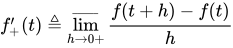
denoted byf+′ {\ displaystyle f '_ {+}} {\ displaystyle f '_ {+}} and is defined as

f+′(t)≜lim¯h→0+⁡f(t+h)-f(t)h{\ displaystyle f '_ {+} (t) \ triangleq \ varlimsup _ {h \ to {0 +}} {\ frac {f (t + h) -f (t)} {h}}} f '_ {+} (t) \ triangleq \ varlimsup _ {{h \ to {0 +}}} {\ frac {f (t + h) -f (t)} {h}} ,

Wherelim¯ {\ displaystyle \ varlimsup} \ varlimsup there is an upper partial limit .

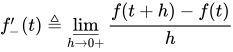
Dini lower derivative ,f-′, {\ displaystyle f '_ {-},} {\ displaystyle f '_ {-},} defined as

f-′(t)≜lim_h→0+⁡f(t+h)-f(t)h{\ displaystyle f '_ {-} (t) \ triangleq \ varliminf _ {h \ to {0 +}} {\ frac {f (t + h) -f (t)} {h}}} f '_ {-} (t) \ triangleq \ varliminf _ {{h \ to {0 +}}} {\ frac {f (t + h) -f (t)} {h}} ,

Wherelim_ {\ displaystyle \ varliminf} \ varliminf there is a lower partial limit .

If af {\ displaystyle f} f is defined on the vector space , then the upper Dini derivative at the pointt {\ displaystyle t} t towardsd {\ displaystyle d} d defined as

f+′(t,d)≜lim¯h→0+⁡f(t+hd)-f(t)h.{\ displaystyle f '_ {+} (t, d) \ triangleq \ varlimsup _ {h \ to {0 +}} {\ frac {f (t + hd) -f (t)} {h}}.} f '_ {+} (t, d) \ triangleq \ varlimsup _ {{h \ to {0 +}}} {\ frac {f (t + hd) -f (t)} {h}}.

If af {\ displaystyle f} f locally Lipschitz (i.e., each point has a neighborhood , the restrictionf {\ displaystyle f} f which is the Lipschitz function), thenf+′ {\ displaystyle f '_ {+}} {\ displaystyle f '_ {+}} finite. If af {\ displaystyle f} f differentiable at a pointt {\ displaystyle t} t , then the Dini derivative at this point coincides with the ordinary derivative int {\ displaystyle t} t .

Notes

  • Sometimes use the notationD+f(t) {\ displaystyle D ^ {+} f (t)}   insteadf+′(t), {\ displaystyle f '_ {+} (t),}   andD+f(t) {\ displaystyle D _ {+} f (t)}   used insteadf-′(t). {\ displaystyle f '_ {-} (t).}  
  • Also use the notation
D-f(t)≜lim¯h→0-⁡f(t+h)-f(t)h{\ displaystyle D ^ {-} f (t) \ triangleq \ varlimsup _ {h \ to {0 -}} {\ frac {f (t + h) -f (t)} {h}}}  
and
D-f(t)≜lim_h→0-⁡f(t+h)-f(t)h{\ displaystyle D _ {-} f (t) \ triangleq \ varliminf _ {h \ to {0 -}} {\ frac {f (t + h) -f (t)} {h}}}  
  • So when usedD {\ displaystyle D}   Annotation of derivatives Dini, plus and minus signs indicate the left-side or right-hand limit , and the position of the sign indicates the type of derivative (upper or lower).
  • On the extended number line, each of the Dini derivatives always exists, however, they can sometimes take values+∞ {\ displaystyle + \ infty}   or-∞ {\ displaystyle - \ infty}  

Literature

  • Royden, HL Real analysis. - 2nd. - MacMillan, 1968. - ISBN 978-0-02-404150-0 .
Source - https://ru.wikipedia.org/w/index.php?title=Dini derivative&oldid = 86308763


More articles:

  • Tyurin, Nikolai Maksimovich
  • Konyukhov, Sergey Semenovich
  • Rowing at the 1960 Summer Olympics
  • Kruglikov, Semyon Nikolaevich
  • Awe at life
  • Bernard I Odon de Fesansack
  • Markovo (Lotoshino urban settlement)
  • Bobylevo (Yaroslavl region)
  • Rural settlement “Chernysheno Village” (Kozelsky district)
  • Species of the Genus Encyclical

All articles

Clever Geek | 2019