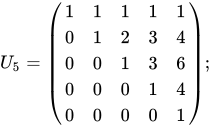
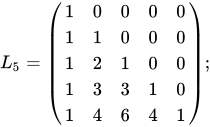
In mathematics , especially in matrix theory and combinatorics , the Pascal matrix is an infinite matrix whose elements are binomial coefficients . There are three options for the arrangement of elements in the matrix: in the form of an upper triangular , lower triangular or symmetric matrix . 5 × 5-restrictions of such matrices have the form:
Upper Triangular Matrix:
- {\ displaystyle U_ {5} = {\ begin {pmatrix} 1 & 1 & 1 & 1 & 1 \\ 0 & 1 & 2 & 3 & 4 \\ 0 & 0 & 1 & 3 & 6 \\ 0 & 0 & 0 & 1 & 4 \\ 0 & 0 & 0 & 0 & 1 \ end {pmatrix}};}
lower triangular matrix
- {\ displaystyle L_ {5} = {\ begin {pmatrix} 1 & 0 & 0 & 0 & 0 \\ 1 & 1 & 0 & 0 & 0 \\ 1 & 2 & 1 & 0 & 0 \\ 1 & 3 & 3 & 1 & 0 \\ 1 & 4 & 6 & 4 & 1 \ end {pmatrix}};}
symmetric matrix
- {\ displaystyle S_ {5} = {\ begin {pmatrix} 1 & 1 & 1 & 1 & 1 \\ 1 & 2 & 3 & 4 & 5 \\ 1 & 3 & 6 & 10 & 15 \\ 1 & 4 & 10 & 20 & 35 \\ 1 & 5 & 15 & 35 & 70 \ end {pmatrix}}.}
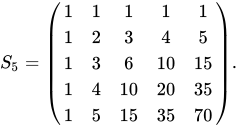
These matrices satisfy the relation S n = L n U n . Hence it is easy to see that all three matrices have a unit determinant , since the determinant of the triangular matrices L n and U n is equal to the product of their diagonal elements. In other words, the matrices S n , L n , and U n are unimodular . The trace of the matrices L n and U n is n .
Elements of a symmetric Pascal matrix have the form:
- {\ displaystyle S_ {ij} = {n \ choose r} = {\ frac {n!} {r! (nr)!}}, \ quad n = i + j, \ quad r = i.}

Equivalent to:
- {\ displaystyle S_ {ij} = \ textstyle C_ {i + j} ^ {i} = {\ frac {(i + j)!} {(i)! (j)!}}.}
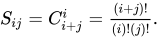
Thus, the trace of the matrix S n is
- {\ displaystyle {\ text {tr}} (S_ {n}) = \ sum _ {i = 1} ^ {n} {\ frac {[2 (i-1)]!} {[(i-1) !] ^ {2}}} = \ sum _ {k = 0} ^ {n-1} {\ frac {(2k)!} {(K!) ^ {2}}}}
![{\ displaystyle {\ text {tr}} (S_ {n}) = \ sum _ {i = 1} ^ {n} {\ frac {[2 (i-1)]!} {[(i-1) !] ^ {2}}} = \ sum _ {k = 0} ^ {n-1} {\ frac {(2k)!} {(K!) ^ {2}}}}](https://wikimedia.org/api/rest_v1/media/math/render/svg/807ef023bf273f4d6285d938df8948ab45df0332)
depending on n forming a sequence: 1, 3, 9, 29, 99, 351, 1275, ... the sequence A006134 in OEIS .
Content
The Pascal matrix can be constructed by taking an exponent from a sub-diagonal or super-diagonal matrix of a special form. In the following example, 7 × 7 matrices are constructed, but this method works for any Pascal n × n matrices. (Dots indicate zero elements.)
- {\ displaystyle {\ begin {array} {lll} & L_ {7} = \ exp \ left (\ left [{\ begin {smallmatrix}. &. &. &. &. &. &. &. \\ 1 &. &. &. &. &. &. \\. & 2 &. &. &. &. &. &. \\. &. & 3 &. &. &. &. \\. &. &. & 4 &. &. &. \\. &. &. &. & 5 &. &. \\. &. &. &. &. &. & 6 &. \ End {smallmatrix}} right] \ right) = \ left [{\ begin {smallmatrix} 1 &. &. & . &. &. &. \\ 1 & 1 &. &. &. &. &. &. \\ 1 & 2 & 1 &. &. &. &. &. \\ 1 & 3 & 3 & 1 &. &. &. \\ 1 & 4 & 6 & 4 & 1 &. &. \\ 1 & 5 & 10 & 10 & 5 & 1 &. \\ 1 & 6 & 15 & 20 & 15 & 6 & 1 & \ end {smallmatrix}} \ right]; \ quad \\\\ & U_ {7} = \ exp \ left (\ left [{\ begin {smallmatrix}. & 1 &. &. &. &. &. \\. & . & 2 &. &. &. &. &. \\. &. &. & 3 &. &. &. \\. &. &. &. & 4 &. &. \\. &. &. &. &. & 5 &. \\ . &. &. &. &. &. & & 6 \\. &. &. &. &. &. &. \ End {smallmatrix}} \ right] \ right) = \ left [{\ begin {smallmatrix} 1 & 1 & 1 & 1 & 1 & 1 & 1 & 1 \\. & 1 & 2 & 3 & 4 & 5 & 6 \\. &. & 1 & 3 & 6 & 10 & 15 \\. &. &. & 1 & 4 & 10 & 20 \\. &. &. &. & 1 & 5 & 15 \\. &. &. &. &. & 1 & 6 \\. &. &. &. & . &. & 1 \ end {smallmatrix}} \ right]; \\\\\ therefore & S_ {7} = \ exp \ left (\ left [{\ begin {smallmatrix}. &. &. &. &. &. &. \\ 1 &. &. &. &. &. &. \\. & 2 &. &. &. &. &. \\. &. & 3 &. &. &. &. &. \\. &. &. & 4 & . &. &. \\. &. &. &. & 5 &. &. \\. &. &. &. &. & 6 &. \ End {smallmatrix}} \ right] \ right) \ exp \ left (\ left [{\ begin {smallmatrix}. & 1 &. &. &. &. &. &. \\. &. & 2 &. &. &. &. \\. &. &. & 3 &. &. &. \\ . &. &. &. & 4 &. &. \\. &. &. &. &. &. & 5 &. \\. &. &. &. &. &. & 6 \\. &. &. &. &. & . &. \ end {smallmatrix} } \ right] \ right) = \ left [{\ begin {smallmatrix} 1 & 1 & 1 & 1 & 1 & 1 & 1 \\ 1 & 2 & 3 & 4 & 5 & 6 & 7 \\ 1 & 3 & 6 & 10 & 15 & 21 & 28 \\ 1 & 4 & 10 & 20 & 35 & 56 & 84 \\ 1 & 5 & 15 & 35 & 70 & 126 & 210 \\ 1 & 6 & 21 & 56 & 126 & 252 & 462 \\ 1 & 7 & 28 & 84 & 210 & 462 & 924 \ end {smallmatrix}} \ right]. \ end {array}}}
It is important to note that one cannot simply set exp ( A ) exp ( B ) = exp ( A + B ) for the n × n matrices A and B , such equality holds only for AB = BA (i.e., when the matrices A and B commute ) In the above construction of symmetric Pascal matrices, the off-diagonal and sub-diagonal matrices do not commute. Thus, it is impossible to carry out (possibly) the expected simplification, including the sum of the matrices.
A useful property of the sub-diagonal and over-diagonal matrices used in this construction is their nilpotency , that is, when raised to a sufficiently large integer degree, they degenerate into a zero matrix . (See the shift matrix for further details.) Since the generalized n × n shift matrices used here become equal to zero when raising to the power of n , when calculating the matrix exponent, it is only necessary to consider the first n + 1 term of the infinite series to obtain exact result.
Interesting options can be obtained through obvious modifications of the PL 7 matrices, from which the exponent is taken.
The first example below uses squares of values in PL 7 instead of the original ones and leads to the construction of a 7 × 7 Laguerre matrix (a matrix whose elements are Laguerre polynomials ).
- {\ displaystyle {\ begin {array} {lll} & LAG_ {7} = \ exp \ left (\ left [{\ begin {smallmatrix}. &. &. &. &. &. &. \\ 1 &. &. &. &. &. &. \\. & 4 &. &. &. &. &. &. \\. &. & 9 &. &. &. &. \\. &. &. & 16 &. &. &. \\. &. &. &. & 25 &. &. \\. &. &. &. &. & 36 &. \ End {smallmatrix}} right] \ right) = \ left [{\ begin {smallmatrix} 1 &. &. & . &. &. &. \\ 1 & 1 &. &. &. &. &. &. \\ 2 & 4 & 1 &. &. &. &. &. \\ 6 & 18 & 9 & 1 &. &. &. \\ 24 & 96 & 72 & 16 & 1 &. &. \\ 120 & 600 & 600 & 200 & 25 & 1 &. \\ 720 & 4320 & 5400 & 2400 & 450 & 450 \ end {smallmatrix}} \ right]; \ quad \ end {array}}}
(The Lagerra matrix actually uses different scaling and signs of some coefficients.)
The second example uses v ( v + 1) as elements if v are elements of the original matrix. It leads to the construction of a 7 × 7 Lach matrix (matrices with elements in the form of Lach numbers ).
- {\ displaystyle {\ begin {array} {lll} & LAH_ {7} = \ exp \ left (\ left [{\ begin {smallmatrix}. &. &. &. &. &. &. &. \\ 2 &. &. &. &. &. &. \\. & 6 &. &. &. &. &. &. \\. &. & 12 &. &. &. &. \\. &. &. & 20 &. &. &. \\. &. &. &. & 30 &. &. \\. &. &. &. &. &. & 42 &. \ End {smallmatrix}} right] \ right) = \ left [{\ begin {smallmatrix} 1 &. &. & . &. &. &. &. \\ 2 & 1 &. &. &. &. &. &. &. \\ 6 & 6 & 1 &. &. &. &. &. \\ 24 & 36 & 12 & 1 &. &. &. &.. \\ 120 & 240 & 120 & 20 & 1 &. & . &. \\ 720 & 1800 & 1200 & 300 & 30 & 1 &. &. \\ 5040 & 15120 & 12600 & 4200 & 630 & 42 & 1 &. \\ 40320 & 141120 & 141120 & 58800 & 11760 & 1176 & 56 & 1 \ end {smallmatrix}} \ right]; \ quad \ end {array}}}
Using v ( v - 1) results in a diagonal down-right shift.
The third example uses the square of the original PL 7 matrix divided by 2, in other words: binomial coefficients of the first order {\ displaystyle C_ {k} ^ {2}} on the second sub-diagonal and leads to the construction of the matrix, which arises in connection with the derivatives and integrals of the Gaussian error function :
- {\ displaystyle {\ begin {array} {lll} & GS_ {7} = \ exp \ left (\ left [{\ begin {smallmatrix}. &. &. &. &. &. &. \\. &. & . &. &. &. &. \\ 1 &. &. &. &. &. &. &. \\. & 3 &. &. &. &. &. \\. &. & 6 &. &. &. &. \ \. &. &. & 10 &. &. &. \\. &. &. &. & 15 &. &. \ End {smallmatrix}} \ right] \ right) = \ left [{\ begin {smallmatrix} 1 &. & . &. &. &. &. \\. & 1 &. &. &. &. &. &. \\ 1 &. & 1 &. &. &. &. \\. & 3 &. & 1 &. &. &. \\ 3 &. & 6 & . & 1 &. &. \\. & 15 &. & 10 &. & 1 &. \\ 15 &. & 45 &. & 15 &. & 1 \ end {smallmatrix}} \ right]; \ quad \ end {array}}}
If we reverse this matrix (for example, again taking the exponent, but with a different sign), then the signs of the coefficients change and give the coefficients of the derivatives of the Gaussian error function.
Another option can be obtained by expanding the original matrix by negative numbers:
- {\ displaystyle {\ begin {array} {lll} & \ exp \ left (\ left [{\ begin {smallmatrix}. &. &. &. &. &. &. &. &. &. &. &. &. \\ - 5 &. &. &. &. &. &. &. &. &. &. &. &. \\. & - 4 &. &. &. &. &. &. &. &. &. &. &. \\. &. & - 3 &. &. &. &. &. &. &. &. &. &. \\. &. &. & - 2 &. &. &. &. &. &. &. &. \\. &. &. &. & - 1 &. &. &. &. &. &. &. &. \\. &. &. &. &. & 0 &. &. &. &. &. &. \\ . &. &. &. &. &. & 1 &. &. &. &. &. &. \\. &. &. &. &. &. &. &. & 2 &. &. &. &. &. \\. &. & . &. &. &. &. &. &. & 3 &. &. &.. \\. &. &. &. &. &. &. &. &. &. & 4 &. &. \\. &. &. &. & . &. &. &. &. &. & 5 &. \ End {smallmatrix}} \ right] \ right) = \ left [{\ begin {smallmatrix} 1 &. &. &. &. &. &. &. &. & . &. &. &. \\ - 5 & 1 &. &. &. &. &. &. &. &. &. &. &. \\ 10 & -4 & 1 &. &. &. &. &. &. &. &. &. &. \\ - 10 & 6 & -3 & 1 &. &. &. &. &. &. &. &. &. \\ 5 & -4 & 3 & -2 & 1 &. &. &. &. &. &. &. &. \\ - 1 & 1 & -1 & 1 & - 1 & 1 &. &. &. &. &. &. \\. &. &. &. &. & 0 & 1 &. &. &. &. &. \\. &. &. &. &. &. & 1 & 1 &. &. &. &. \\. &. &. &. &. &. & 1 & 2 & 1 &. &. &. \\. &. &. &. &. &. & & 1 & 3 & 3 & 1 &. &. \\. &. &. &. & . &. & 1 & 4 & 6 & 4 & 1 &. \\. &. &. &. &. &. & & 1 & 5 & 10 & 10 & 5 & 1 \ end {smallmatrix}} \ right]. \ End {array}}}
- Pascal's Triangle
- LU decomposition
- GS Call and DJ Velleman, "Pascal's matrices", American Mathematical Monthly , volume 100, (April 1993) pages 372–376
- Edelman, Alan & Strang, Gilbert (2004), Pascal Matrices , American Mathematical Monthly T. 111 (3): 361–385 , < http://mathdl.maa.org/images/upload_library/22/Ford/Edelman189 -197.pdf > . Retrieved July 21, 2013. Archived July 4, 2010 on Wayback Machine
- Weisstein, Eric W. Gaussian-function
- Weisstein, Eric W. Erf-function
- Weisstein, Eric W. "Hermite Polynomial." Hermite-polynomials
- Endl, Kurt "Über eine ausgezeichnete Eigenschaft der Koeffizientenmatrizen des Laguerreschen und des Hermiteschen Polynomsystems". In: PERIODICAL VOLUME 65 Mathematische Zeitschrift Kurt Endl
- "Coefficients of unitary Hermite polynomials He n ( x )" in the Online Encyclopedia of Integer Sequences
A066325 (Related to Gauss-matrix).