Adolf von Thadden ( German: Adolf von Thadden ; July 7, 1921, Triglaf - July 16, 1996, Bad Oeynhausen ) - German far-right politician, conservative , nationalist . Member of the NSDAP , a participant in the Second World War . Activist of ultra-right movement of Germany . Member of the leadership of the German Conservative Party - the German Right Party in 1947 - 1950 , chairman of the German Imperial Party in 1961 - 1964 , chairman of the National Democratic Party in 1967 - 1971 . In the 1940-1950s - deputy of the Bundestag and the Gottingen City Council. He left politics in the 1970s under the pressure of neo-Nazi radicals.
| Adolf von Thadden | |
|---|---|
| him. Adolf von thadden | |
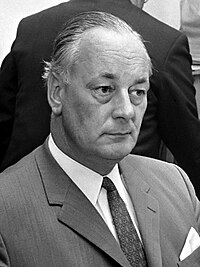 | |
| Aliases | Bubi |
| Date of Birth | July 7, 1921 |
| Place of Birth | Triglaf , Pomerania , Weimar Republic |
| Date of death | July 16, 1996 (aged 75) |
| Place of death | Bad Oeynhausen , Federal Republic of Germany |
| Citizenship |
 Germany Germany |
| Occupation | agricultural administrator; politician, chairman of the German Imperial Party, chairman of the National Democratic Party; deputy of the city council of Göttingen , deputy of the German Bundestag |
| The consignment | NSDAP , German Conservative Party - German Right Party , German Imperial Party , National Democratic Party |
| Main ideas | nationalism , conservatism |
| Awards | iron Cross |

Content
Nobility and Nazism
Born in Pomerania , in what is now Poland . Came from an old noble family. Adolf von Thadden's father was a cunker and hereditary royal-Prussian official. He graduated from high school in Grefenberg and agricultural school. Passed labor duty in the Third Reich .
September 1, 1939 , the day the Second World War began , Adolf von Thadden joined the Nazi party . He served in the Wehrmacht , was wounded several times, received a lieutenant rank. In 1945 he was arrested by the Polish communist authorities , the next year he managed to escape.
Conservator of National Conservatism
Party Building
In 1946 - 1947, Adolf von Thadden served as curator of agriculture in the British military administration. After the resignation, he took up politics, joining the far-right national conservative forces.
Since 1947, Adolf von Thadden was a member of the German Conservative Party - the German Right Party , in 1949 - 1950 was one of its leaders. He advocated the maximum consolidation of ultra-conservative and right-wing radical forces located to the right of the CDU . In 1949, von Thadden developed a major unification project. However, this plan failed because the British administration refused to authorize it. In 1952, von Thadden submitted an application to the FDP , hoping to strengthen the right-wing tendencies in the liberal party and move it towards conservatism - but was refused.
In 1948 - 1958, von Thadden was a member of the city council of Göttingen . In 1949 - 1959 - deputy of the German Bundestag (he was the youngest member of the West German parliament, in connection with which he received the nickname Bubi ). Since 1961, Adolf von Thadden led the ultra-conservative German Imperial Party ( DRP ) [1] .
Ideological and Political
The key ideological principles of the German Imperial Party and personally of Adolf von Thadden were set forth in an interview with Der Spiegel (together with the then DRP chairman Wilhelm Meinberg ) January 20, 1960 [2] .
Von Thadden : We believe that our historical fate, especially in the last sixty years, is not connected with our bad character. The geographical, geopolitical and military-political situation pushed us again and again to a role in which we could not act successfully. In our fate there were many predictions of the inevitable and more fulfilled than in the English fate. We refuse to accept the thesis of our guilt and punishment.
At the same time, von Thadden was restrained about Germany’s participation in NATO , giving priority to national interests:
The policy of the CDU and its partners is aimed exclusively at strengthening the so-called Western bloc. They forget about the strengthening of West Germany ... Our duty is to find a balance between East and West on the German question, to lead in this due to our own initiatives.
Subsequently, von Thadden became more loyal to NATO. In 1961, this led to a conflict between him and the "radical nationalist purist " Heinrich Kunstmann , then chairman of the DRP.
Intense - and unsuccessful - DRP rivalry with the Christian Democratic Union led to a paradoxical rapprochement of the positions of former Nazis with the Social Democrats (von Thadden even allowed the DRP coalition with the SPD based on the similarity of the socio-economic platform):
Von Thadden : We adopted our program in October 1956 . The SPD included similar things in the 1959 Godesberg program . We see in this a sign of transformations in the position of the Social Democratic Party and we treat it positively.
Der Spiegel : If broad opportunities are allowed in this matter, why not join the SPD?
Von Thadden : Why aren't we joining the SPD? We believe that the national party should be an integral part of the German people ... Nationality, national thinking - they still have not revised their positions in this direction.
In the NPD: Leadership and the gap
Chairmanship. Party Ideology
In November 1964, Adolf von Thadden was one of the founders of the National Democratic Party (NDP), which was considered as a single party of German ultra-right nationalists . On November 11, 1967, von Thadden was elected chairman of the NDP.
The National Democratic Party was often perceived as a neo-Nazi organization, "repeating the Nazi attitude." Often left-wing opponents even beat the name of Adolf von Tadden as the " Führer of the NDP." This was facilitated by the adjoining to the NDP of former activists of the NSDAP, the Wehrmacht and the SS , as well as some policy statements:
Enough lies about the fault of the Germans alone, thanks to which the squeezing of billions of dollars from our people continues. The glorious and courageous behavior of German soldiers of all times should be an example for the Bundeswehr ... Until the fathers are openly and unpunished among criminals, sons will not be able to become good soldiers [3] .
However, the ideology of the NDP was not based on National Socialism . The party recognized the Constitution of Germany . Speaking from the position of extreme right-wing nationalism, the NDP distanced itself from totalitarianism and racism . The expressed revanchist motives in the foreign policy part of the program did not develop into propaganda for an aggressive war. Moreover, in her ideology a prominent place was occupied by social populism , which did not very fit with the figure of the hereditary cadet-nobleman von Thadden.
Right-wing pressure. Resigning and leaving the party
In the early 1970s, there was a split in the NDP. A significant part of the party activity was oriented towards an alliance with the CDU / CSU as the most powerful right-wing force in Germany. At the same time, the radical groups of the party insisted on extra-parliamentary activation in the spirit of Italian neo-fascists . Von Thadden tried to master this trend by proposing various street-level political campaigns. However, he was clearly lagging behind the radicals, his course did not look so moderate as "sluggish" [4] .
In 1971, von Thadden resigned as chairman, supporting the candidacy of his successor lawyer Martin Musgnug . For several years he worked in the party press .
In 1975, Adolf von Thadden defiantly left the NDP in protest against the election of the publisher Gerhard Fry , with whom he had a difficult relationship. Von Thadden sharply criticized the growth of populism, radicalism and adventurism in party politics.
Today’s NDP has nothing to do with the NDP of the 1960s, when I was chairman of the party.
Adolph von Thadden, 1994 [5]
Strokes to the portrait
Adolf von Thadden's half-sister, Elizabeth von Thadden , participated in the anti-Nazi Resistance and was executed in 1944 .
The fate of the half-sister did not stop Adolf von Thadden from condemning "endless digging in concentration camp stories" [6] .
In early 1961, the then chairman of the German Imperial Party, Heinrich Kunstmann, accused von Tadden of receiving funding from the USSR . However, von Thadden was able to prove that these sponsorship funds for party needs were received from the entrepreneur Erich Lubbert , a former SA Standartenfuhrer , who worked in South-West Africa [7] .
After the death of von Thadden in 1996, statements appeared in the press that he was a secret agent of the British intelligence service MI-6 [8] .
In Soviet Cinema
Adolf von Thadden is mentioned in the 1977 Soviet television film Dialogue , in which Vyacheslav Tikhonov plays the main role [9] . The character of Tikhonov, an international journalist Ershov, being in Germany, notes the growth of ultra-right sentiments:
Please note: when von Tadden's figure appeared on the screen, the bartender added a sound.
Notes
- ↑ History of fascism in Western Europe. Neo-Nazism in Germany
- ↑ WIR SIND DIE PARTEI DER ZUKUNFT. Ein SPIEGEL-Gespräch mit dem DRP-Vorstandsmitgliedern Wilhelm Meinberg und Adolf von Thadden
- ↑ Die westdeutschen Parteien 1945-1965. Berlin, 1966.
- ↑ Neofascism and its development trends in the Federal Republic of Germany / Formation of the current balance of power. The emergence of "new right" within neo-fascism in Germany
- ↑ Adolf von Thadden: "Ich wollte Deutschland verteidigen." Junge Freiheit, 2. September 1994.
- ↑ FINAL ATHE / Where Hitler Left. "... and it started from scratch" ?!
- ↑ DRP. Hilfe aus afrika
- ↑ Neo-Nazi leader 'was MI6 agent' , John Hooper, The Guardian , 13 August 2002, retrieved June 24, 2009]
- ↑ Dialogue