Archimede ( Archimede ) - bathyscaphe of the French Navy . Built to replace the bathyscaphe FNRS-3 . In 1969, transferred to the National Center for Ocean Research.
| Archimedes | ||
|---|---|---|
| Archimede | ||
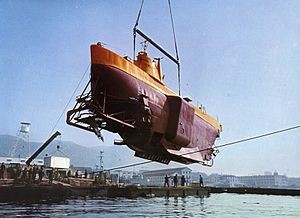 | ||
| Launching the bathyscaphe "Archimedes" | ||
| Device history | ||
| State flag |  France France | |
| Launching | 1961 | |
| Current status | Museum piece | |
| Main characteristics | ||
| Speed (underwater) | 3-3.5 knots | |
| Working depth | sunk at 9545 m | |
| Immersion depth | theoretically up to 11,000 m | |
| Crew | 2 pax | |
| Dimensions | ||
| Dry weight | 60 tons | |
| The greatest length (on design waterline) | 21.3 m | |
| The width of the body naib. | 5 m | |
| Height | float height - 4 m; full height - 7.8 m | |
| Power point | ||
| Batteries and three electric motors | ||

The development of the bathyscaphe with the provisional name B11000 (Bathyscaphe 11,000 meters) began in 1957 in the arsenal of Toulon . Funding was provided by the French National Center for Scientific Research ( CNRS ) and the Belgian National Research Foundation ( FNRS ). The project was led by Pierre Wilm , FNRS-3 captain Georges Wo took a significant part in the design. Archimedes was intended to sink to the bottom of the Mariana Trench , but the Trieste bathyscaphe was ahead of Archimedes, conquering the Challenger Abyss on January 23, 1960.
July 28, 1961 "Archimedes" was launched, the captain was George Woo. The first dive was on October 5 to a depth of 40 meters. In the same year, comprehensive tests of the apparatus were carried out, including diving to a depth of 2400 meters.
Subsequently, Archimedes participated in expeditions to Japan (1962 and 1967, with a dive to a depth of 9545 meters in the Kuril Islands ), in the Puerto Rican Trench (1964, with a dive to a depth of 8300 meters), in Greece ( 1965, 5110 meters), to the area of Madeira (1966) and the Azores (1969).
In 1968, Archimedes participated in the search for the French submarine Minerva sunken at Toulon, and in 1970 in search of the Eurydice submarine.
Archimedes did not manage to sink to the bottom of the Mariana Trench, in 1974 the bathyscaphe was decommissioned and transferred to the reserve of the naval arsenal, and in 2001 it was transferred to the naval museum of the French city of Cherbourg-Octeville .
Specifications
- Gondola (material - forged nickel - chromium - molybdenum steel )
- Diameter - 2.1 meters
- Wall thickness - 15 centimeters
- Portholes - a bow and two side windows (since 1967, a camera was used to control except a porthole)
- The diameter of the shaft for landing in a gondola - 1.2 meters
- Float volume - 170,000 liters of gasoline
- Ballast - 19 tons of steel shot in 7 bins
- Engines:
- Chassis - 20 liters. with.
- Swivel shunting - 5 l. with.
- Vertical shunting - 5 l. c, vertical screw drive (like a helicopter ), which facilitates maneuvering near the bottom.
- The maximum diving depth is 11,000 meters.
The Archimedes gondola was drowned in the float, which reduced its dimensions and increased streamlining .
A large number of research equipment was mounted on the bathyscaphe designed to study the parameters of water, currents, soil and plankton. Cameras functioned (including stereoscopic ).
The gripping device (“mechanical arm”) made it possible to lift objects weighing up to 20 kilograms.
Literature
- Georges Wo. Twenty years in the bathyscaphe. L. Gidrometeoizdat 1976
- M.N. Diomidov, A.N. Dmitriev. Conquest of the depths .. - Leningrad: Shipbuilding, 1964. - S. 264-266. - 379 p.