Sengbe Pye ( born Sengbe Pieh , after baptism - Joseph Cinke English. Joseph Cinqué ; ca. 1813 or 1814 - ca. 1879 [1] ) - a representative of the West African people Mende , captured by slave traders and leading an uprising of captive Africans on the Spanish ship Amistad .
| Sengbe Pye | |
|---|---|
| English Sengbe pieh | |
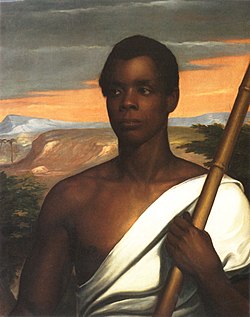 Portrait of Nathaniel Jocelyn, 1839 | |
| Date of Birth | about 1814 |
| Place of Birth | Sierra Leone |
| Date of death | about 1879 |
| Place of death | Sierra Leone (presumably) |
| A country | |
| Occupation | Rebel, a fighter against slavery. |
| Autograph | |
Biography
Born in the territory of modern Sierra Leone ; exact date of birth is unknown. He had his own rice field, was married, had three children, was a Muslim by religion. In 1839, he was captured by slave traders from his own people and sold to Portuguese slave traders who imprisoned him aboard the slave ship Tecora. Despite the existence of international treaties banning the slave trade by that time, it was brought on this ship to Havana , the administrative center of the Spanish colony of Cuba , where, together with 110 other African-enslaved Africans, was sold to two Spanish slave traders Jose Ruiz and Pedro Montes.
The Spaniards loaded the captured Africans aboard the Amistad slave schooner with the intention of selling slaves in another region of Cuba to work on sugarcane plantations. However, on June 30, Sengbe Pye led an African uprising aboard the ship, which resulted in the death of almost all whites, including the captain and the coca; two Africans also died, and two white sailors managed to escape. Sengbe Pye ordered to save life only for Ruiz and Mendez, whom he ordered to send the ship back to Africa. Instead, they attempted to steer the ship toward North and South America, hoping for salvation from the Spaniards; however, in the end, the ship “traveled” across the Atlantic between the African and American coasts for about two months.
As a result, Amistad reached the territorial waters of the United States at Long Island . On the ship landed sailors from the ship USS Washington . Having learned from the Spanish prisoners about what had happened, they arrested the Africans as rebels and murderers and took them to New Haven , Connecticut, for trial. At trial, both Spaniards claimed that all Africans were already officially slaves at the time of their purchase by the Spaniards in Cuba, and therefore were their legal property. However, the Americans decided to listen to the other side too. Fortunately for the revolted Africans, they were able to find translators from the Mende language, which allowed the leader of the Africans, Sengbe Pye, to tell their story to lawyers and the judge. As a result, the court ruled in favor of the Africans.
After that, the Spaniards appealed a court decision in a number of district and district courts, and then, when the courts rendered the same decision, to the US Supreme Court . In March 1840, the Supreme Court ruled that Africans revolted to gain freedom, and were sold into slavery illegally; The support of Africans from former President John Quincy Adams and Roger Sherman Baldwin played an important role in making this decision. Africans were allowed to return to Africa if they so wished. The decision was made despite protests from then-President Martin van Buren , who feared the consequences of such a decision regarding future relations with Spain and slavery within the United States.
In 1842, Sengbe Pye and all Africans who were on Amistad returned to their native lands with the help of funds collected by American abolitionists. There is little information about the future life of Sengbe Pye, and all of them are contradictory and not completely reliable. It is believed that he lost his family, which was enslaved, for some time maintained contact with the local European Christian mission and took an active part in the local civil war. According to one version, he soon left for Jamaica , and according to another, he himself became a slave trader [2] ; The latest version is disputed by most historians [3] . The exact date of his death is also unknown, but there is information that in 1879 he, a dying man, arrived on a Christian mission, where he asked to baptize him under the name Joseph Chinkeye and bury him according to the Christian rite [4] .
See also
- Amistad (film)
Notes
- ↑ Cinqué // American National Biography . - Oxford University Press. Subscription nee ded.
- ↑ "Cinque (Sengbe Pieh)", Exploring Amistad at Mystic Seaport . The appeal date is November 7, 2007. Archived November 17, 2007.
- ↑ Joseph Yannielli, Cinqué the Slave Trader: Some New Evidence on the Old Controversy, Common-Place , Vol. 10th (October 2009)
- ↑ Joseph Cinque . The appeal date is November 7, 2007.