Not to be confused with the Republic of Sudan
| autonomous republic, a member state of the French Community and a member of the Federation of Mali , then an independent state | |||
| Sudan Republic | |||
|---|---|---|---|
| Republique soudanaise | |||
| |||
 | |||
←   → →November 24, 1958 - September 22, 1960 | |||
| Capital | Bamako | ||
| Languages) | French | ||
| Currency unit | CFA Franc | ||
| Square | 1,241,238 km² (1959) | ||
| Population | 3,700,000 (1959, estimated) [1] | ||
| Form of government | Parliamentary republic | ||
| Heads of state | |||
| High Commissioner | |||
| • November 24, 1958 - June 20, 1960 | Jean Charles Sikyurani | ||
| Chairman of the Provisional Government | |||
| • November 24, 1958 - April 5, 1959 | Jean-Marie Coney | ||
| Chairman of the Council of Ministers | |||
| • April 5, 1959 - September 22, 1960 | Modibo keita | ||

The Sudanese Republic ( French République soudanaise ) is an autonomous republic, a state member of the French Community in West Africa , from April 4, 1959, also one of the two subjects of the Federation of Mali , which gained independence on June 20, 1960, from August 20 to September 22, 1960 - de facto independent state. One month after the collapse of the Federation of Mali, the Sudan Republic was proclaimed the Republic of Mali .
Content
General information
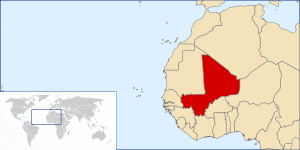
The Sudan Republic was located in the central part of West Africa within the borders coinciding with the borders of the former French Sudan and the future Republic of Mali. The area of the country exceeded one million square kilometers and was two and a half times larger than the territory of France. The borders of the republic were determined arbitrarily, without taking into account ethnic and geographical realities: the Sahara desert occupied most of the north of the country, in the south its territory extended to the middle reaches of the Senegal and Niger rivers, thus including both the Sahel and Sudan climatic zones .
The country did not have access to the seas. Prior to the declaration of independence of the Federation of Mali on June 20, 1960, the Republic of Sudan had a state border with only one independent state - the Republic of Guinea . All other external borders of the country were administrative, and separated it from other autonomies of French West Africa - Niger , Upper Volta , Ivory Coast , Senegal and Mauritania , as well as from French Algeria . Since June 1960, the Sudanese Republic, while maintaining the administrative border with Senegal, remained surrounded by territories controlled by France, but in August of that year, Niger, Upper Volta and the Ivory Coast gained independence and the length of the borders with the territories of the former metropolis was reduced to the border with Algeria and Mauritania in the north. After the collapse of the Federation of Mali, the administrative border with Senegal also became state.
The country's population had a multinational composition and included more than 20 peoples: Bambara , Soninki , Malinka , Fulba , Songai , Arabs , Berbers , Dogon , Mosi , etc. [2] . The layer of French colonists remained, but lost its size, and the Arab diaspora from Lebanon and Syria continued to trade. The Sudanese republic remained an agrarian country, the basis of the economy of which was agriculture [3] , some peoples retained elements of feudalism and pre-class relations [4] . In the south of the country fishing and cattle breeding were widespread, among nomads in the north - nomadic cattle breeding. More than half of the country's population professed Islam [3] .
The administrative center of the republic remained the city of Bamako, which, according to an estimate of 1959, was inhabited by about 68,000 inhabitants [1] [5] .
Government structure
The Sudanese Republic was proclaimed on November 24, 1958 and initially inherited the colonial system of government in French Sudan, which was subsequently modified. In accordance with the French Constitution of October 4, 1958, the Republic became part of the French Community , headed by the President of France, whose competence included foreign policy, defense, finance, a common economic policy and control over strategic materials. The autonomy government was deprived of the right to make decisions in these areas, which remained under the complete control of France. President of the Community in accordance with Art. 81 of the French Constitution was represented in autonomy by the High Commissioner: from the moment of the declaration of the Sudan to the declaration of independence of the Federation of Mali on June 20, 1960, this post was held by Jean Charles Sikyurani (1915-1977). The foreign policy of autonomy, in accordance with the order of January 31, 1959, was led by the French Minister of Foreign Affairs, defense issues in accordance with the order of May 25, 1959 were controlled by the Committee of Defense of the Sudan as part of the High Commissioner, the head of the autonomous government and the French commander of the armed forces of the territory. In addition, in accordance with Art. 78 of the French Constitution, the metropolis could retain control over the judiciary, higher education, transport and telecommunications [6] , but according to Article 78 of the French Constitution, the Sudanese authorities gained control over the legal system [7] . In the field of economics, in accordance with Ordinance No. 58-1254 of December 19, 1958, the general distribution of budget funds for the territory was assigned to the Executive Council of the Community. Since June 12, 1959, the Central Bank of the West African States in Dakar has also exercised general control over the finances of the autonomy. In the field of legislative activity over the Legislative Assembly of the Sudanese Republic, the Community Senate took precedence (in 1960 it was transformed into the Inter-Parliamentary Advisory Council), which had previously considered certain legislative initiatives. The Sudanese delegation to the Senate of the Community, headed by the chairman of the Sudanese Parliament, M. A. Haidara, was the largest and consisted of 13 deputies [7] [6] .
After the proclamation of an autonomous Sudanese republic, the Government Council of French Sudan was transformed into the Provisional Government, and after the adoption of the Constitution, into the Council of Ministers of the Sudanese Republic.
The ruling party of the republic throughout the entire period of its existence was the Sudanese Union , quickly crowding out other parties to the political periphery.
After the creation of the Federation of Mali on January 17, 1959, the Sudanese Republic delegated to the federal center in Dakar some of the competencies in the areas of defense, security, information, justice, finance, health, public works and culture.
On January 23, 1959, the Legislative Assembly of the Sudanese Republic adopted the first Constitution of the Autonomy, which proclaimed the former French Sudan an indivisible, democratic, secular and social state (Article 1) with a republican form of government that could not be changed (Article 50). The preamble of the constitution stated that the republic is a member of the Federation of Mali and confirms fidelity to the principles of the Declaration of Human Rights and Citizen of 1789 and the Universal Declaration of Human Rights of 1948 , its sovereignty is the property of the whole people and no group of people can appropriate the right to implement it (art. .2). The republic had its own independent judiciary (art. 43), guaranteed the right to work, rest, freedom of association in cooperatives [6] and trade unions, as well as the right of workers to strike. The Constitution provided for the equality of citizens before the law, regardless of origin, religion, status and political views (Article 1) and allowed for a multi-party system (Article 3). The supreme legislative body of the republic - the unicameral Legislative Assembly was elected by direct and secret ballot for a term of 5 years. In special cases, the government could extend its term of office (Art. 18, 19). The meeting discussed and passed laws in all spheres of state and public life, with the exception of the "issues of general competence" of the French Community. It ratified the agreements on the transfer of competencies, which were transferred to the Senate of the Community and to the Federal Assembly of Mali (Articles 21.27). Sessions of the meeting were convened twice a year, but at the request of the government or the vast majority of deputies, an extraordinary emergency session could be convened [8] .
The supreme executive body of the Sudan Republic was the Council of Ministers , which had broad powers, consisting of the chairman, his deputies, and ministers. Its members were appointed by the Legislative Assembly and were accountable to it (Art. 6.26). The Chairman of the Council of Ministers of the Sudan Republic was the head of the administration and executive power, as well as the guarantor of the territorial integrity of the republic. He had the right to appoint senior officials (Article 12) and promulgate laws (Article 14), monitored the correct observance of the constitution, agreements with the Community, the Federation and other states. The internal security forces obeyed him and, within the framework of the Community Constitution, the army (Articles 9, 10), stationed on the territory of the republic.
The supreme bodies of the Republic were also the State Council and the Supreme Legal Council . The State Council monitored the conduct of elections and referenda, monitored the constitution of bills and decrees (Article 45). The Supreme Legal Council was elected by the Legislative Assembly from among the deputies and had the right to prosecute members of the government for violations or crimes in the performance of duties (Articles 48, 49) [9] . In accordance with the Cooperation Agreement between France and the Federation of Mali dated April 4, 1960 (approved by the parliaments of the Sudan Republic and Senegal, and then enshrined in Law of the French Republic No. 60.682 of July 18, 1960 and published by the Journal official on July 30, 1960), the metropolis In June 1960, she simultaneously transferred her competencies in various areas to the Sudan Republic and the Federation of Mali.
After the transfer of Community competencies and the declaration of independence of the Federation of Mali on June 20, 1960, the post of High Commissioner, representing the President of the French Community in the Sudan Republic, was abolished. The functions of the head of state were transferred to the chairman of the Council of Ministers, but part of his powers were still delegated to the federal center in Dakar. At the same time, the head of the government of the Sudanese Republic, Modibo Keita, was also the head of the federal government of Mali.
Administrative division
The administrative-territorial division of the Sudan Republic was approved by Law N ° 60-3 / AL / RS (Loi N ° 60-3 / AL / RS) and generally repeated the system of times of French Sudan. According to the law, the country was divided into six districts (Région): Bamako , Kayes , Sikaso , Mopti , Segu and Gao . The law confirmed Decree N ° 19 D-1-2 of January 30, 1959, according to which [10] the district head was still appointed by the government, but now with him there were District Councils (Conseil de corconscription), elected for 5 years by 1 deputy from 10,000 inhabitants (but not more than 25 advisers and not less than 9) and sitting in the administrative center of the district. The Council voted on the administration’s decisions on the distribution of the district budget, which consisted of taxes and other revenues in favor of the state, the maximum of which was established by the Legislative Assembly of the republic [11] . However, during the period of the Sudanese republic’s existence, the district councils did not begin to function, and the real representatives of the government remained in the field. In the best case, instead of them, special commissions functioned that did not have any real powers [10] . The district was divided into districts (cercle), headed by heads of administrative posts appointed by the government. The smallest (basic) administrative unit, according to Decree N ° 43 / DI, was a village - one or more settlements with a population of at least 100 inhabitants. The village, if necessary, could be divided into even smaller units (fraction). The head of the village was the headman (Chef de village), elected by the Village Council (Conseil de village) and approved by the decision of the district administration (in the mid-1950s, there were 10-12,000 cantonal and village leaders in French Sudan [12] ). The village council was elected by the inhabitants for 5 years and controlled the headman in matters of maintaining public order, justice, the construction of public buildings, roads, bridges, etc. The headman did not have the right to conduct events without consulting the Council and carried out only those for which he voted the majority [11] . The administrative units also included full-fledged urban communes and communes with limited rights (communes de plein ou de moyen exercice), urban neighborhoods (arrondissement) and nomadic tribes (tribus) [10] . In large cities, there were elected municipalities that replaced the leaders of urban neighborhoods and districts [11] . In the north, a nomadic tribe was considered as a unit corresponding to the district. The leaders were predominantly elected by the tribe, they were assisted by advisory elected Councils. Sometimes tribes united into tribal groups. After the election, the leader was approved by the district administration and automatically became a state official [13] . In the northern districts of Goa, Gundem and Tombouctou, inhabited by warlike tribes, the French military administration was abolished only in 1959 [14] . Law N ° 60-5 / AL-RS of June 7, 1960 granted districts and districts greater rights and greater autonomy in distributing finances than before [10] , but by this time real power in the localities was already concentrated in the hands of party cells of the Sudanese Union [15] .
History
Education of the Sudan Republic
The political crisis of 1958 in France and the transition to the Fifth Republic led to a change in the status of the overseas territories that made up the French colonial empire. Even during the drafting of the new constitution, on August 8, 1958, the Chairman of the Council of Ministers of France, General Charles de Gaulle, made a short televised speech and stated that during the constitutional referendum scheduled for September, African territories should choose between independence and association with France. According to Art. 77 of the new Constitution, the French Union gave way to the French Community, and overseas territories ( French Les territoires d'Outre-Mer ), according to Article 76, could, by decision of local legislative bodies, receive the status of overseas departments of the Republic or Member States of the Community ( French États membres de la Communauté ) [7] [16] .
The Sudanese Union Party, which since 1956 had a majority in the Territorial Assembly of French Sudan, and whose representative Jean-Marie Cohnet headed the Government Council since 1957, supported de Gaulle's initiatives. In August 1958, the Fifth Party Congress was convened, which decided to seek approval in the referendum of the 1958 Constitution. Party leader Modibo Keita stated [17] :
| “Independence implies that Sudan, like French West Africa, will have its own diplomacy, its army, its own monetary unit, etc. Are we ready for this? Do we have the means to solve all our problems by ourselves and only by ourselves: to build roads, hospitals, schools, enterprises? Our lack of such means forces us to unite with someone who can help us - in this case, France ”(L'Essor quotidian, 08.19.58) |
About 40% of voters in French Sudan participated in the referendum on September 28, 1958, while out of 970,000, 945,500 voted for the French Constitution, and only 23,800 against it [18] . On October 5, General de Gaulle promulgated the Constitution and the French Community became a reality [16] , and on November 24, 1958, the Territory Assembly of the French Sudan meeting in Bamako proclaimed the Autonomous Republic of Sudan (Délibération N ° 47 / ATS du 24 novembre 1958 de l'Assemblé Terle 1958 de l'Assemblé Terélé du Soudan, portant proclamation de la République Soudanaise) and was transformed into an interim Legislative Assembly, which was to develop a constitution for autonomy [18] . В тот же день верховного комиссара Анри Виктора Жипулона сменил новый представитель президента Сообщества верховный комиссар Жан Шарль Сикюрани, а Жан Мари Коне возглавил Временное правительство республики, главной задачей которого стало проведение выборов в соответствии с первой конституцией страны. Тем временем руководство Суданского союза, структуры которого, начиная с 1957 года, действовали параллельно с административными органами и всё больше их подменяли [19] , напрямую, минуя Правительственный совет, выступило с инициативой создания федерации африканских республик. В декабре 1958 года собравшиеся в Бамако лидеры родственных Суданскому союзу партий Сенегала, Верхней Вольты и Дагомеи приняли решение об объединении их стран в Федерацию Мали [20] . Суданская республика направила 11 делегатов в Конституционную ассамблею Федерации и 17 января 1959 года стала членом Федерации Мали [6] .
Федерация Мали
21 января 1959 года Законодательное собрание автономии одобрило федеральную Конституцию и 23 января того же года членство в Федерации было закреплено в преамбуле новой конституции Суданской республики [6] . Реализация идеи африканской федерации встретила сопротивление ряда суданских вождей и кади Тимбукту. В феврале их эмиссары совершили поездки по северу Судана, по Нигеру, Сенегалу и Верхней Вольте с агитацией против Федерации, а Генеральный секретарь оппозиционной Суданской партии перегруппировки Аммадун Дикко призвал не растворяться в федерации, а «смело создавать Судан» [21] . Но влияние правящего Суданского союза среди населения было слишком велико, чтобы идеи оппозиции получили широкое распространение, к тому же в феврале Правительственный совет распустил Демократический союз Сегу и арестовал его лидеров («Paris-Dakar», Дакар, 9 февраля 1959 года) [22] .
4 апреля 1959 года лидер Суданского союза Модибо Кейта возглавил правительство Федерации, а вскоре был назначен председателем Совета министров автономии, что открывало большие политические перспективы. Объединение было выгодно двум странам не только политически, но и экономически: Судан получал через Сенегал выход к морю, а для Сенегала федерация открывала перспективы поставок суданского сырья и беспрепятственный доступ на внутренний рынок Суданской республики, где проживало около половины населения Французской Западной Африки [16] . При этом сельское хозяйство Сенегала было экспортным и нуждалось в продовольствии, а Судан был экспортёром традиционных африканских культур, риса, проса, рыбы и пр. В обмен он получал от Сенегала промышленные изделия, пользование железными дорогами и портами, и ежегодно десятки тысяч суданцев уходили на заработки в Сенегал на плантации арахиса.
Уже в апреле — июле 1959 года Федеральная ассамблея и Федеральное правительство Мали создали в автономии органы межреспубликанских управлений и служб информации, связи, почт, общественных работ, железных дорог, здравоохранения, образования, искусства и литературы [23] . Однако в остальном внутреннее развитие Сенегала и Суданской республики пошло разными путями.
Внутриполитическое развитие
In parallel with the formation of the Federation of Mali, the ruling party and the Provisional Government of the republic were preparing for the formation of new national authorities. In early February 1959, an election campaign for the Legislative Assembly began in Sudan, during which the Sudanese Union launched agitation for an alliance with Senegal, Upper Volta and Dagomei [24] . The confrontation with the opposition ended in early March by clashes at pre-election rallies in Segu, where there were those killed (Paris-Dakar, Dakar, March 4, 1959), but opponents of Modibo Keita had no chance to change the situation. In the March 8, 1959 elections, 525,600 (78%) of voters voted for the Sudanese Union, while only 167,700 (7.8%) voted for the Sudanese regrouping party. Even party leaders Fili Dabo Sissoko and Ammadun Dikko did not go to the Legislative Assembly. The defeat turned out to be a complete collapse for the SPP: on March 31, 1959, most of its leaders [22] , led by Sissoko, announced their withdrawal from the party and their desire to join the Sudanese Union. They were supported by almost all local SPP organizations, and Ammadun Dikko and a small group of his supporters were completely isolated [25] . The Sudanese Union Modibo Keita became the undisputed master of the situation.
On April 16, 1959, the new Legislative Assembly elected Keita as chairman of the Council of Ministers of the Sudan [26] , and in his keynote speech he announced the beginning of wide-ranging reforms in various fields [27] , which were initially set by the local unions. Already in April, a conference of the National Union of Sudanese Workers put forward the demands of "Africanization of personnel", the creation of conditions for the rapid training of workers, the introduction of uniform benefits rates, freedom of trade union activity and the protection of the rights of liberated union workers. The trade unions actually controlled by the party demanded the creation of committees at the enterprises with the participation of workers and the administration, improvement of conditions and wages, increase in wage rates [28] taking into account price increases, the creation of a state body to control prices, simplify the procedure for resolving labor conflicts, and increase the role of labor inspections.
Subsequently, the ruling party also took decisive initiatives. In September 1959, the Third Conference of Personnel Workers of the Sudanese Union obliged all party organizations to monitor the work of the French administration in implementing government decisions [29] . A month later, the Minister of Internal Affairs of the Republic of Madeira Keita speaks in Gao and declares that there is no difference between the party and state apparatus, since the leader of the party leads the government, and the leaders of local party centers - districts and districts: “the party and governments, the party and the administration are one and also". The party cells that came to power in the localities are in favor of lowering the rates of land rent and offerings to the leaders, for canceling the privileges of the tribal nobility, and for lifting the ban on their fishing spots and hunting grounds. They carry out their undertakings in an explicit manner: in early 1960, the Gundam County Conference of Party Workers Conference reduced rental rates from 50-70% to 30% of the crop and completely canceled them in the places where the state had ameliorated, as well as reduced ransom for the bride and forbade to marry women against their will [15] .
At the same time, the administrative apparatus is being cleaned up and already at the beginning of 1960 the “Africanization of personnel” was completed. Now all leadership positions are held by members of the Sudanese Union, and the French remain only as technical advisers and consultants to the administration [29] .
By the end of 1959, the last opposition parties were leaving the political arena. In December, the African Independence Party decides to merge with the Sudanese Union, and soon a group of leaders of the Sudanese regrouping party will be transferred to it [30] . By the beginning of 1960, a one-party system was actually being approved in the country: the Sudanese Union became the only party in the Sudanese republic, its party cells were created in every village without fail. Even earlier, in November, all the youth organizations of the country united in the Youth of the Sudanese Union, and in April 1960 all trade unions came under the control of the Trade Union of Workers of the Sudan [31] .
Social Transformation
The government of Modibo Keita, which came to power in March 1959, despite its continued dependence on France, launched large-scale social reforms, some of which were too radical from the point of view of the metropolis. In 1959-60, the government increased wages, pensions and benefits, and implemented measures to stabilize prices. In large cities of autonomy, model state stores with a large stock of products were created, which meant active government intervention in the retail sector. Unemployment was reduced: in 1959 alone, about 1,500 people were able to find jobs in Bamako and Goa. At the beginning of 1960, the Labor Force Administration was reorganized, in which representatives of the government and trade unions began to take part. The functions of the Office included accounting for workers, approval of employment contracts and vocational training.
In the field of medical services, loans were provided for loans from the European Economic Community to medical institutions in the nomadic, Sahel, and the north of the country, where there were almost none before.
In the field of education, in 1959 the Government of Keita developed a five-year plan for teacher training and school construction. Its purpose was to create conditions for the education of all school-age children (in 1957-58 only 8% of such children received education). In 1959, two new training centers were built to train primary school teachers [32] . At local schools, one-year accelerated teacher training courses were opened with inculcation of adult literacy skills. The creation of private schools was encouraged. All these measures began to produce results already during the short existence of the republic: in the 1959–60 school year, over 9.6% of school-age children were enrolled in primary education. Government efforts in the field of education were not limited to the level of primary school. In 1959, about 400 students from the Sudan Republic studied in Europe and the United States. Accelerated training courses for builders were created for work on the construction of bridges and roads, for digging wells and for drilling artesian wells. In early 1960, the Ministry of Agriculture, Economics and Planning of the Republic opened an exemplary training center for the training of specialists in agriculture, animal husbandry and horticulture.
At the same time, the ruling Sudanese Union considered it necessary to return to the modified practice of forced public work, canceled by the French government on April 11, 1946. In 1959, the party initiated the movement “Investissements humains” (“Human Capital Investments”), the essence of which was formally voluntary free labor of the population in the improvement, construction of housing, public buildings, roads and bridges [33] .
The Path to Independence
But in the first place Modibo Keita was faced with the task of obtaining the country complete independence from France. In parallel with the development of the federation, with administrative, economic and social reforms, the party and the government of Keita have been actively negotiating this issue since the fall of 1959. Initially, it is planned on September 29, 1959, to declare withdrawal from the French Community and demand a referendum on independence. However, Senegalese leaders oppose this radical step and propose relying not on the 86th, but on the 76th article of the French constitution and demand a gradual transfer of competencies [34] . After long disputes, the leaders of the Sudan Republic and Senegal come to a decision to start negotiations on transferring competencies to two republics separately and the Federation of Mali as a whole. From January 18 to March 28, 1960, representatives of Senegal and Sudan are negotiating with France, and on April 4 of the same year they sign an agreement on the transfer of issues of general competence to the republics and initialed an agreement on relations between the Federation of Mali and the French Community [35] . On June 7, 1960, the Legislative Assembly of the Sudanese Republic ratifies agreements with France, amends the Constitution of the autonomy, and delegates a number of sovereignty issues to the Federal Assembly of Mali [36] .
Independence
On June 20, 1960, at the solemn meeting of the Federal Assembly in Dakar, the independence of the Federation of Mali and its constituent republics was proclaimed [37] . However, the union of the two states lasted only two months. On August 20, 1960, the growing conflict in the leadership of the Federation, the rejection by the Senegalese leaders of the "Sudanese line" and the desire of activists of the Sudanese Union to extend social reforms to Senegal, led to a coup in Dakar. Modibo Keita was removed from his post as chairman of the federal government and arrested. Together with other representatives of the Sudan Republic, he was put on a train and deported from Senegal [38] . The Federation of Mali ceased to exist and weak attempts to restore its state unity have not yielded results. The head of the Government of the Sudanese Republic, Modibo Keita, did not want to admit this fact for a whole month, but on September 22, 1960, he still convened an extraordinary congress of the Sudanese Union in Bamako, which approved the severance of all ties with Senegal. On the same day, the Sudanese Republic ceased to exist, and its constitution was repealed. The country received a new constitution and was proclaimed the Republic of Mali , at the request of Modibo Keita, who inherited the name of the disintegrated Federation and the medieval empire of Mali [39] .
Sudanese Republic Economy and Reform
Agriculture , specializing in the cultivation of peanuts, rice, cotton, corn, sorghum, cassava and sisal, part of which was exported, continued to be the basis of the economy of the Sudan Republic, as well as French Sudan. Also exported were livestock products, including hides and livestock. Mostly food, textiles, automobiles, oil products and building materials were imported in exchange [40] . The basis of agricultural production was the state-owned enterprise Office du Niger, created by France in 1932 (Office du Niger - Office of the Niger), which was involved in the development of land and the cultivation of rice and cotton in the central delta of the Niger. Almost all of the company's products were exported to France [41] . By the end of 1959, another export item was the export of smoked and dried fish to Senegal and the Ivory Coast. However, even then, the republic’s agriculture remained little connected with the market, and the share of marketable products it produced was only 30% [42] . Yes, the data of the same year, agriculture gave 64% of the country's gross national income [43] and 97% of its imports [43] .
The autonomy industry was represented by rice refineries, oil mills and soap factories, as well as salt mining in Agorgo near Taudeni, artisanal gold mining on the River Falem and the development of phosphates in Burema [40] [44] . In addition, the republic inherited a small metal processing plant, repair shops for agricultural machinery and small repair yards [45] . In 1959, the share of industry in gross national income was only 2% [43] .
The republic’s transport system included a section of the Bamako-Dakar railway line with a branch to the river port of Kulikoro, a network of highways and dirt roads, most of which are suitable for transportation in the dry season, and several small steamers that transported Niger from Kulikoro to Timbuktu and in the rainy season Gao, and from Bamako to Kurusa in Guinea [40] . In 1959, the share of transport in gross national income reached 11.7%, and was in second place after the share of agriculture [43] .
The republic's foreign trade continued to be controlled by French export-import campaigns, and the Sudanese market, protected by high duties, was closed to states outside the franc zone. France accounted for 80% of exports and 65% of imports of the republic, while French goods were sold in Sudan at prices significantly higher than world prices, while Sudan goods were bought by France at inflated but favorable prices for metropolitan companies [46] . In general, trade, both internal and external, provided in 1959 5.4% of gross national income [43] .
In a keynote speech in March 1959, Modibo Keita stated that his government’s efforts would be mainly focused on the accelerated development of agriculture [27] , to which the French government had directed major government investments [45] . Keita proposed to send many specialists to this area, to accelerate the introduction of new advanced methods, to create a large fleet of agricultural machinery [27] .
In practice, the government began expanding the network of agricultural modernization centers created in 1957 and headed for its cooperation. To further unite the peasants into cooperatives, it already had the base and could use the French experience: as early as 1910, the Indigenous Providence Societies (Sociétés indigenes de Prévoyance) were created in African colonies, in which the entire rural population had been forcibly since 1915. These societies, renamed in 1955 the Sociétés mutuelle de protection rurale (Sociétés mutuelle de protection rurale), collected membership fees, distributed seeds and fertilizers, promoted the introduction of new methods of cultivating the land and controlled the sale of peasant products. Now the Government of the Sudanese Union has developed a program for the modernization of agriculture for 1959-1960, which envisaged the expansion of the network of modernization centers and mutual aid societies, as well as the widespread creation of basic sales and production cooperatives. In 1959, Sudanese Union activist workers in the Baguineda commune near Bamako took the initiative to create production cooperatives, and it was supported at the Congress of the Peasants' Union. By the beginning of 1960, almost all party cells in agricultural areas had followed this call, creating local cooperatives. In addition, on the initiative of the congress, a special peasant field was allocated in each village, which was to be worked together by all residents and the proceeds of which went to the construction of schools, hospitals and office buildings. The practice of introducing “collective fields” (champs collectives) continued throughout the reign of Modibo Keita and contributed significantly to the decline in its popularity.
In addition to cooperating in agriculture, the government also expanded the Office du Niger, which remained a state-owned enterprise. In 1959, hydraulic structures were built on its lands, including a canal for irrigation and shipping [47] , and by the end of the year, the planted area of the enterprise increased by 1,520 hectares, of which 200 hectares of rice and 1,320 hectares of cotton ha.
In 1959, the Sudan Republic proved to be attractive for investment. The government managed to attract almost a billion francs into the economy, which foreign firms invested in industrial and commercial buildings, equipment and other assets [48] . 170 agreements were concluded with French and other companies for the search for bauxite, iron, lithium, gold, diamonds and oil. At the beginning of the year, a six-year plan for the modernization and expansion of the communications network was developed, involving the construction of new roads between the districts and the main highways connecting Sudan to neighboring countries. The amount of investment was estimated at 1.5 billion francs. Already in early 1960, the construction of a bridge over the Niger in Bamako and the tarmac of Bamako-Segu, which exported cotton to Dakar, was completed with French loans. At the same time, the main funding for economic modernization came from French state funds, of which 1,095.6 million francs were spent in 1959. In addition, more than 120 million francs have been allocated by the European Economic Community for the construction of a number of facilities.
The government of Keita intended to follow the principle of broad government participation in the economy and the predominance of public investment: in early 1960, the development of a regulation on mixed joint-stock companies with a predominance of state control was begun [49] .
See also
Government of the Sudan
Notes
- ↑ 1 2 Federation of Mali. TSB Yearbook, 1960 , p. 299.
- ↑ G. Kondratiev, 1970 , p. 12.
- ↑ 1 2 Kondratiev G.S., 1970 , p. 13.
- ↑ G. Kondratiev, 1970 , p. sixteen.
- ↑ G. Kondratiev, 1970 , p. 103-104.
- ↑ 1 2 3 4 5 Кондратьев Г.С., 1970 , с. 107.
- ↑ 1 2 3 Constitution du 4 octobre 1958. Titre XII De la Communauté (фр.) . Jean-Pierre Maury. Digithèque de matériaux juridiques et politiques. Дата обращения 2 июля 2013. Архивировано 4 июля 2013 года.
- ↑ Кондратьев Г.С., 1970 , с. 108.
- ↑ Кондратьев Г.С., 1970 , с. 109.
- ↑ 1 2 3 4 Modibo Keïta, Kô Samaké. Présentation historique de l'évolution de la décentralisation administrative au Mali (фр.) (недоступная ссылка) . Penser pour agir (2006). Дата обращения 2 июля 2013. Архивировано 2 августа 2009 года.
- ↑ 1 2 3 Кондратьев Г.С., 1970 , с. 120.
- ↑ Кондратьев Г.С., 1970 , с. 20.
- ↑ Кондратьев Г.С., 1970 , с. 121.
- ↑ Кондратьев Г.С., 1970 , с. 14.
- ↑ 1 2 Кондратьев Г.С., 1970 , с. 123.
- ↑ 1 2 3 Chronologie Mali. Le Mali de Modibo Keita (1960-1968) (фр.) . Clio. Дата обращения 2 июля 2013. Архивировано 4 июля 2013 года.
- ↑ Кондратьев Г.С., 1970 , с. 98.
- ↑ 1 2 Кондратьев Г.С., 1970 , с. 101.
- ↑ Кондратьев Г.С., 1970 , с. 83.
- ↑ Кондратьев Г.С., 1970 , с. 106.
- ↑ Кондратьев Г.С., 1970 , с. 111.
- ↑ 1 2 Кондратьев Г.С., 1970 , с. 112.
- ↑ Кондратьев Г.С., 1970 , с. 114.
- ↑ Кондратьев Г.С., 1970 , с. 110.
- ↑ Кондратьев Г.С., 1970 , с. 113.
- ↑ AM Thiam. DOSSIERGOUVERNEMENTS DE MODIBO,Portraits de quelques ténors (фр.) (недоступная ссылка) . BamaNet (Friday, 16 October 2009 11:16). Дата обращения 2 июля 2013. Архивировано 4 июля 2013 года.
- ↑ 1 2 3 Кондратьев Г.С., 1970 , с. 115.
- ↑ Кондратьев Г.С., 1970 , с. 125.
- ↑ 1 2 Кондратьев Г.С., 1970 , с. 122.
- ↑ Кондратьев Г.С., 1970 , с. 132.
- ↑ Кондратьев Г.С., 1970 , с. 133.
- ↑ Кондратьев Г.С., 1970 , с. 118.
- ↑ Кондратьев Г.С., 1970 , с. 119.
- ↑ Кондратьев Г.С., 1970 , с. 128.
- ↑ Кондратьев Г.С., 1970 , с. 131.
- ↑ Кондратьев Г.С., 1970 , с. 136.
- ↑ Кондратьев Г.С., 1970 , с. 127.
- ↑ Кондратьев Г.С., 1970 , с. 147 -160.
- ↑ Кондратьев Г.С., 1970 , с. 155.
- ↑ 1 2 3 Судан Французский. БСЭ, 1956 , с. 207.
- ↑ Кондратьев Г.С., 1970 , с. 23.
- ↑ Кондратьев Г.С., 1970 , с. 24.
- ↑ 1 2 3 4 5 Кондратьев Г.С., 1970 , с. 28.
- ↑ Кондратьев Г.С., 1970 , с. 21.
- ↑ 1 2 Кондратьев Г.С., 1970 , с. 22.
- ↑ Кондратьев Г.С., 1970 , с. 27.
- ↑ Кондратьев Г.С., 1970 , с. 116.
- ↑ Кондратьев Г.С., 1970 , с. 26.
- ↑ Кондратьев Г.С., 1970 , с. 117.
Literature
- Journal officiel de la République soudanaise. Bamako
- Kondratiev G.S. Mali's path to independence. 1945-1960 .. - M .: Institute of Africa . Publishing House "Science" , 1970.
- Sudan French // Great Soviet Encyclopedia 2nd ed .. - M .: Soviet Encyclopedia, 1956. - T. 41 . - S. 206-207 .
- Alekseev A. Federation of Mali // Yearbook of the Great Soviet Encyclopedia . - M. , 1960 .-- S. 299 .