Frederick Bailey Deeming for the murder of his two wives and four children. Suspected of involvement in the killings attributed to Jack the Ripper .
| Frederick Dimming | |
|---|---|
| Frederick bailey deeming | |
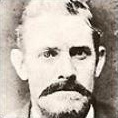 | |
| Date of Birth | July 30, 1853 |
| Place of Birth | , Leicestershire , England , UK |
| Citizenship |  Great Britain Great Britain |
| Date of death | May 23, 1892 (38 years old) |
| Place of death | Melbourne , Victoria , Australia |
| Cause of death | Hanging |
| Occupation | |
| The killings | |
| Number of victims | 6 |
| Kill period | July - December 1891 |
| Date of arrest | March 12, 1892 |
| Punishment | The death penalty |
Biography
Frederick Bailey Diming was born into the family of the coppersmith Thomas Deeming and his wife Anne Diming, nee Bailey ( Eng Ann Deeming, née Bailey ). In childhood, he was a “difficult child” [1] ; at the age of sixteen he escaped from home at sea. He earned money for theft by stealing, received money on fake claims. On July 26, 1891, in the village of killed his first wife, Mary Diming, nee James ( English Marie Deeming, née James ), and four own children. On December 24 of that year, in the Melbourne suburb, killed his second wife, Emily Deeming, née Mather ( born Emily Deeming, née Mather ).
From the moment Emily’s body was found in Windsor in March 1892 until the execution of Dimming in May of that same year, only three months passed - an unusually short time compared to modern Western legal standards [2] . This happened not only due to the effective work of the police, but also due to the wide interest of the world press in the murder. So, the news of the murder of Emily Dimming was spread by the English correspondent of the newspaper Melbourne Argus , the first to interview Emily's mother in Reinhill [~ 1] . Another factor was the habits and temperament of Dimming himself: he often used different names and attracted attention with his behavior, which various sources describe as aggressive, provocative and overly annoying towards women.
1880s. Australia
A police investigation after Diming's arrest in 1892 found that he moved to Australia in 1882, working mainly in Sydney, but also working for John Denks, a Melbourne importer of gas pipes. Melbourne employers spoke of him as an excellent worker, they gave him a loan of 200 pounds to open a business in Rockampton, Queensland. Dimming did not return the money [3] . It was known that Dimming worked for the Sydney gasman, the employer accused him of stealing copper fittings. Dimming denied the charge, but the missing fittings were found at his home and he was sentenced to six months in prison. During the announcement of the verdict, Dimming fainted. After his release, he continued to work as a gas specialist in Sydney, until in December 1887 he appeared in court on charges of false insolvency. After being released on bail, he disappeared from New South Wales [4] .
In Australia, Dimming was accompanied by Mary's wife, nee James, “a typical Welsh girl” [5] . He married her in February 1881 in Lower Tranmere (England), they lived in Birkenhead for a while, and then left for Melbourne [6] . Dimming's brother Alfred was married to Mary's sister, Martha. In 1886, Dimming and Mary already had two daughters born in Australia: Berthe and Mary. In 1888, his brothers Alfred and Walter learned that Dimming and his family returned to England “with a significant fortune” [6] .
South Africa. Return to England
Later, during police and journalistic investigations, it was found that Dimming lived in Cape Town in South Africa in 1888-1889, but there is no exact information about his relocation. Perhaps he returned to Birkenhead, England, at least once. At that time, Mary gave birth to another baby [~ 2] . It was known that in 1889, Dimming was engaged in fraud in the diamond mines in Transvaal . To the passengers and the captain of the steamer Yumna, on which Dimming was returning to England, he was well remembered for demonstrating his valuables and money and interest in some passengers [7] .
Dimming arrived in Gull in November 1889 and stayed in Beverly. He lived under the name of "retired livestock owner" Harry Lawson from Mount House, Rockampton, Queensland, and spent 1.5 thousand pounds a year. He got married to Helen Matson, the 21-year-old daughter of his landlady, and married her on February 18, 1890, thus becoming a bigamist [8] . A month later, after a honeymoon spent in Southern England , he suddenly disappeared, taking with him the expensive Matson gifts. According to Gurvich and Ray, Dimming's wife and family were aware of Dimming's new marriage [4] .
Mary with four children visited Dimming in Birkenhead. Apparently, he gave Mary several hundred pounds and announced that he was leaving for South America and would send her and the children when he settled there. Before leaving, he conducted a new fraud with Gull jewelers. Upon arrival in Montevideo, he was arrested and extradited back to England on charges of "receiving goods under false demands." He was sentenced to nine months in prison [9] .
Rainhill
After his release from prison in July 1891, Dimming went to Liverpool , settling in a hotel in the village of Rainhill, Meyerside under the name Albert Williams. At the hotel he was visited by a mysterious woman (almost certainly his wife Mary), who introduced himself as his sister, then she allegedly left for Port Said. Dimming rented a house in Rainhill (Villa Dingham), presumably on behalf of a military friend, a “Colonel Brooks.” Dimming himself settled in this villa, along with a woman and several children. Dimming passed them off as “a sister with her children who returned home” [10] . Soon he complained that the gutters in the villa were out of order and the kitchen door needed to be replaced. He personally observed the replacement of the door [4] .
While in Rainhill, Dimming began to look after Emily Lydia Mather, the daughter of a widowed local shopkeeper, Mrs. Dove Mather. Mather and Dimming (under the name Albert Williams) were married on September 22, 1891 [4] .
Windsor Assassination
In November 1891, Dimming (under the name "Williams") and Maser sailed to Australia aboard the German steamer Kaiser Wilhelm II. Arriving in Melbourne on December 15, 1891, Dimming rented a house on Andrew Street in the Melbourne suburb of Windsor. On December 24 or in the morning of December 25, he killed Maser, buried his body under a stone slab (the base of the hearth) in one of the bedrooms and poured cement on it [11] . Dimming paid the rent a month in advance, using the name "Mr. Draun", but almost immediately left this dwelling. Homeowner Butcher John Stamford was happy to rent his house to Dimming, as he looked respectable and at first his name was not known to anyone [4] .
On March 3, 1892, a tenant about to rent a house in Windsor complained of an “unpleasant smell” in the second bedroom [12] . The landlord and real estate agent raised the stove to establish the reason, "because of which, according to their estimates, one could barely breathe" [12] . They called the police who found Mather's body. An investigation conducted on March 4 found that although her skull was fragmented by several blows, the most likely cause of death was that her throat was cut [13] .
The find attracted wide public attention. In the issue of The Age , a few days later, the murder of Mather was associated with the Whitechapel murders in London:
From the very beginning, a suspicion of insanity was practically assumed and hinted at a resemblance to the Whitechapel murders. The body is hacked and mutilated, the composure with which the body was cemented, hiring at home, etc., the thorough destruction of all traces of the crime - all these circumstances imply anger and skill that can hardly be regarded as a mentally healthy killer, no matter how cruel and heartless.
Original textFrom the outset a suspicion of insanity is almost suggested and a tinge of the Whitechapel murders is hinted. The body hacked and mangled, the cool manner in which the cementing was carried out, the taking a house etc, the laborious obliteration of all traces of the crime - all these things suggest the malevolence and craft which can scarcely accompany the sane murderer, no matter how callous and brutal.- [14]
Thanks to the keys found in an abandoned house in Andrew Street and information from local merchants, including Stamford and his agent, the investigating police sergeants managed to get on “Mr. Williams,” who had recently arrived aboard the Kaiser Wilhelm II. The police interviewed other passengers who gave conflicting descriptions of "Mr. Williams" and Mather. Over the weeks of sailing, Mather told other passengers about her family in Rainhill, which gave the police a thread. Dimming's behavior aboard the ship also attracted attention. Many passengers said that they “hated Dimming, but everyone agreed that he treated his wife with love and delicacy” [15] . Now the police had a very accurate description of "Mr. Williams", which was sent to other Australian colonies, but his true identity was still unknown [4] .
An investigation conducted on March 8 found that in early January 1892, a man similar to the description of “Mr. Williams” sold a lot of household utensils, possibly wedding gifts, under the hammer. During this time, he resided in Melbourne at the Cathedral Hotel on Swanstone Street under the name of Mr. Duncan. Later it became known that Dimming, a few days after the murder, Mather wrote a gentle letter (on behalf of Albert Williams) to her mother. Dimming under the name of Duncan visited the marriage agency Holt's Matrimonial Agency, wanting to get acquainted with a young woman with the intention to marry [16] . He also fraudulently tricked the local Melbourne jeweler [4] .
Capture
On January 12, 1892, Dimming arrived in Sydney under the name of Baron Svenston. In Sydney, Dimming met Kate Runsfell and began to look after her. He told Kate that if she agreed to become his wife, then “he would never regret it and would always congratulate herself on having married him” [17] . Dimming gave Runsfell some jewelry (stolen from a Melbourne jeweler, as was later established). Kate agreed to marry him and go with him to western Australia, but they soon broke up. Taking advantage of fake evidence, Dimming got a position at a mine in the Australian city of Southern Cross. On January 22, Baron Svenston left for Fremantle. Under the same name, Dimming boarded the ship, boasting of his wealth and status in society. He began to look after a young woman, Miss Mod Beach, who was under the care of her uncles and aunts: Mr. and Mrs. Wakeley. [4]
This time, Dimming came across a stiff rebuff. Mr. Wakeley told Svenston: “I will tell you frankly: I do not believe your stories, and it is not in my habit to let a person from your class into my family circle” [18] . Having settled in the Southern Cross, Dimming continued to seek the location of Runsfell. In a letter dated February 8, he wrote: “Don't make me wait, dear. If you love me at least half as much as I love you, you would not make me wait a day ” [~ 3] . Tracking telegrams to western Australia, Victoria State Police tracked Dimming and arrested him in Southern Cross on March 12, 1892. At first he refused to give his real name, but then said: “I think I know the one who was killed. I don’t believe that someone had the cruelty to kill such a girl ” [19] . During a search among his property, Maser found a number of things, including her prayer book.
Rainhill Murders
While Dimming was being transported back to Melbourne, news of the murders in Rainhill came from England.
The find of Mather's body attracted the attention of the public. An investigation into Rainhill revealed the dismembered bodies of Mary Dimming and four children: Berta (9 years old), Mary (7 years old), Sydney (5 years old) and Lila (18 months old), buried under the newly concreted floor of Dinkham Villa. Most of the victims had their throats cut (Bert was strangled). The killings were apparently committed when Dimming (under the name of Albert Williams) was courting Maser around July 26, 1891. [21] At the Rainhill investigation, on March 18, 1892, the Dimming brothers identified Mary and gave some explanations about Frederick's activities.
The killings in Rainhill were not known for eight months. It seems that the Dimming brothers and sister Mary believed that she and the children were in Brington on holiday, and then went overseas. Dimming visited Birkenhead several times to assure Martha that her sister and children were fine [22] . The disclosure of the crime was also hindered by the rent by Dimming (under the name of Williams) of Dingham villa on the condition that the house could not be sold or rented out for six months, due to the imminent arrival of Colonel Brooks and / or Williams sister. Lease terms also allowed Williams to re-concrete the floor [23] .
Court
During the transfer of Dimming to Perth and Albany, a wave of violent demonstrations rose against him. On April 25, 1892, Dimming appeared before the Melbourne Supreme Court. The prosecution team was led by Robert Walsh. Dimming's lawyer Alfred Dikin tried to achieve recognition of the defendant as insane. Defense also pointed out to the jury the influence of newspaper publications. Hoping to secure a confession of insanity and help defend himself, Dimming stated that he had contracted syphilis in London and that his mother’s spirit had visited him when he committed his crimes. Before the jury retired to the meeting, Dimming "made a long ... incoherent speech about self-justification." He repeated the story (which the police had already told) that Emily “ran with another man.” “Only one thing gives me comfort — to know that she is alive.” [24]
The jury rendered the verdict "guilty." Dimming spent the last days writing his autobiography and writing poetry. “The jury listened to that long story that I was forced to tell. But they sent me straight to hell ” [25] . He also spoke with Anglican priests, whom he allegedly confessed. On May 9, 1892, the Executive Council upheld the verdict of the court. On May 19 of that year, the Privy Council Judicial Committee dismissed the appeal. Dimming was hanged on May 23, 1892 at 10:01 a.m. He weighed 65 kg - 6.4 kg less than when he was imprisoned. The autobiography he wrote in the cell was destroyed [26] .
After execution
Edward Thunderbolt, Melbourne's public safety inspector and friend of the Meather family, organized a public subscription. A monument was erected at the main cemetery in Melbourne [~ 4] . The Australian public was shocked by the brutality of the Windsor murder. In the press (both Australian and British), new hypotheses appeared regarding the identity of the criminal, it was assumed that Dimming was Jack the Ripper. So, an article in the issue of The New York Times dated March 17, 1892 came out under the heading:
Possible Jack the Ripper. A stunning discovery made in Liverpool. A suspect has been arrested in Australia.
Original textPerhaps Jack the Ripper. The Startling discovery made in Liverpool. A Man arrested in Australia.- [28]
Many episodes of Dimming's life remain unclear; he may have been in England at the end of 1888 during the Whitechapel murders. At the Creitmeier wax exhibition in Melbourne in 1912, there was a figure from Dimming burying Mather, which may have been a reflection of the belief that Dimming was Jack the Ripper. Assumptions that Dimming was Jack the Ripper have not been disproved to this day [29] . Dying's death mask is exhibited in Melbourne's Old Prison, where he was executed, and in the Black Museum of the new Scotland Yard .
Comments
- ↑ The article was first published by The Argus on March 14, 1892. “Mrs. Mather has not heard anything about the crime in Melbourne [or] <...> about the fate of her daughter. When I told her about the tragedy, she fainted. " Gurvich and Ray also list many newspapers that wrote about the Windsor murder.
- ↑ It is possible that Dimming traveled to South Africa without his family.
- ↑ Gurvich and Ray also argue that the assumption that Dimming acquired cement in the Southern Cross in preparation for the arrival of Runsfell is incorrect.
- ↑ The monument stands to this day, on it you can read the inscription: EMILY LYDIA MATHER beloved daughter of JOHN & DOVE MATHER of RAINHILL, ENGLAND. MURDERED 24th DEC 1891, AT WINDSOR, MELBOURNE. AGED 26 YEARS. Erected by public subscription. Who all her days while yet alive, To live in honor she did strive. Till he she trusted as her guide, without cause or warning her life denied. ADVICE To those who hereafter come reflecting, Upon this text of her sad ending. To warn her sex of their intending. For marrying in haste, is depending, On such a fate, too late for amending. By her friend, E.THUNDERBOLT [27] .
Notes
- ↑ Gurvich, Wray, 2007 , p. 15.
- ↑ Gurvich, Wray, 2007 , p. 290
- ↑ Gurvich, Wray, 2007 , p. 99.
- ↑ 1 2 3 4 5 6 7 8 Frederick Deeming | Murderpedia, the encyclopedia of murderers
- ↑ Gurvich, Wray, 2007 , p. 101.
- ↑ 1 2 Gurvich, Wray, 2007 , p. 115.
- ↑ Gurvich, Wray, 2007 , p. 105.
- ↑ Biography - Frederick Bailey Deeming - Australian Dictionary of Biography
- ↑ Gurvich, Wray, 2007 , p. 109.
- ↑ Gurvich, Wray, 2007 , p. 111.
- ↑ Deeming, Frederick Bailey (1853–1892) . Australian Dictionary of Biography. Date of treatment June 26, 2014.
- ↑ 1 2 The Crime of Century Revisited // Journal of the Public Records Office. - Winter 2007. - No. 40. - P. 4.
- ↑ Frederick Bailey Deeming . Murderpedia. Date of treatment June 26, 2014.
- ↑ The Age (March 5, 1892).
- ↑ Gurvich, Wray, 2007 , p. 51.
- ↑ Gurvich, Wray, 2007 , p. 65.
- ↑ Gurvich, Wray, 2007 , p. 80.
- ↑ Gurvich, Wray, 2007 , p. 89.
- ↑ Gurvich, Wray, 2007 , p. 79.
- ↑ The Extraordinary Tale Of Frederick Bailey Deeming (Link not available) . Date of treatment July 3, 2014. Archived on September 3, 2014.
- ↑ Gurvich, Wray, 2007 , p. 117.
- ↑ Gurvich, Wray, 2007 , p. 119.
- ↑ Gurvich, Wray, 2007 , p. 118.
- ↑ Gurvich, Wray, 2007 , pp. 258-259.
- ↑ Gurvich, Wray, 2007 , p. 273.
- ↑ Biography - Frederick Bailey Deeming - Australian Dictionary of Biography . Date of treatment September 5, 2014.
- ↑ Gurvich, Wray, 2007 , p. 304.
- ↑ Perhaps Jack the Ripper: The Startling discovery made in Liverpool // The New York Times . - 1892. - March 17. - P. 1.
- ↑ Missing skull may hold Melbourne clue in hunt for Jack the Ripper . The age. Date of treatment July 7, 2014.
Literature
- Deeming: Prehistoric Man. Story of a Skull // The Argus. - 1930. - No. 26 038 (25 January). - P. 6.
- Serle, Percy. Deeming, Frederick Bailey (1853–1892) // Dictionary of Australian Biography. - Angus and Robertson, 1949.
- Gurvich, Maurice. The Scarlet Thread: Australia's Jack the Ripper, A True Crime Story / Maurice Gurvich, Christopher Wray. - 2007. - ISBN 978-1-921190-42-1 .
Links
- Bigamy, Theft and Murder: The Extraordinary Tale of Frederick Bailey Deeming . Public Record Office Victoria (2007). Date of treatment June 30, 2013. Archived on April 6, 2011.