On Wednesday , July 19, 1961, in the vicinity of Pardo Aerolíneas Argentinas DC-6 crashed, killing 67 people. The largest plane crash in Argentina .
| Flight 644 Aerolíneas Argentinas | |
|---|---|
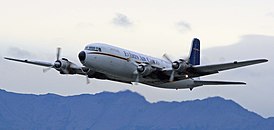 Similar in design to the Douglas DC-6 | |
| General information | |
| date of | July 19, 1961 |
| Time | 08:00 |
| Character | Destruction in the air due to turbulence |
| Cause | Flying through the storm |
| A place |  12 km west of Pardo , Buenos Aires ( Argentina ) 12 km west of Pardo , Buenos Aires ( Argentina ) |
| Coordinates | |
| Dead | |
| Aircraft | |
| Model | Douglas DC-6 |
| Aircraft name | La Maria eugenia |
| Airline | Aerolíneas Argentinas |
| Departure point | Buenos Aires |
| Destination | Comodoro Rivadavia |
| Flight | AR644 |
| Board number | LV-ADW |
| Date of issue | 1948 year |
| Passengers | 60 |
| Crew | 7 |
| Dead | 67 (all) |
Content
- 1 Aircraft
- 2 disaster
- 3 reasons
- 4 notes
- 5 See also
Aircraft
DC-6 with the tail number LV-ADW (serial number 43136, serial number 137) and with the name La Maria Eugenia was built by the Douglas Aircraft Company in 1948 and was equipped with four Pratt & Whitney R-2800-CB16 engines. At the time of the crash, the airliner had a total of 20,211 flight hours [1] .
Holocaust
The aircraft operated flight AR644 from Buenos Aires to Comodoro Rivadavia . On board were 7 crew members and 60 passengers, and the take-off weight was 38,682 kilograms, which was within the permissible limits. The airliner departed from Ezeiza Airport at 07:31 exactly on schedule and began to climb to a predetermined level of 4800 meters. At 07:33 the crew contacted the airport dispatcher and reported on the estimated time of flight Lobos at 07:45. At 07:42 from the plane, they reported on the passage of Lobos at an altitude of 2200 meters and reported the estimated travel time of Gorsha at 07:50. This deviation from the route was caused by the presence of a thunderstorm ahead of which the crew was warned by the dispatcher. At 07:50, as calculated, the crew reported on Gorsha’s flight at an altitude of 3400 meters, exit from the aerodrome’s control zone and the estimated time for the 4800-meter train at 07:57. Then the dispatcher allowed to change the frequency. After that, the AR644 flight did not contact anyone else [2] .
Since the aircraft was not equipped with a weather radar, the crew, flying at night, did not know about the actual weather along the route. According to the forecast, the airliner was supposed to pass over a warm front 1800 meters high. However, the forecast did not materialize, and DC-6 flew into cumulonimbus clouds , where it fell under the influence of ascending and descending vertical air currents at speeds of 100-120 km / h. At one point, the speed of the vertical air flow exceeded the speed of 140 km / h, which was above the limit for the design of the airframe. The right wing plane separated, after which the plane that lost control flew down and at 08:00 (the time was set by the hours of some passengers) crashed into the ground 12 kilometers west of Pardo station at [2] . Upon impact, the DC-6 completely collapsed, and all 67 people on board died. In 2013, this crash remains the largest in Argentina and in the history of Aerolíneas Argentinas [1] .
Reasons
The commission called the cause of the disaster the destruction of the right plane due to the effects of overloads that exceeded the calculated ones. The very hit of the aircraft in a powerful front was caused by an incorrect assessment by the crew commander and dispatcher of the airline of the weather forecast on the route, which led to an incorrect choice of flight altitude. The absence of local airports with weather radars along the highway, as well as the lack of necessary equipment on airplanes, did not allow enough weather information in the area. The very probability of an aircraft falling on cumulus clouds at this section of the route was estimated at 31% [2] .
In the final report, the commission indicated the need for early work on the start of equipping Aerolíneas Argentinas aircraft with weather radars [2] .
Notes
- ↑ 1 2 Aircraft accident Douglas DC-6 LV-ADW Pardo, BA . Aviation Safety Network . Date of treatment June 27, 2013. Archived July 1, 2013.
- ↑ 1 2 3 4 Informe Final de Accidente de Aviación Nro. 1526 (Spanish) . Junta de Investigación de Accidentes de Aviación Civil (JIAAC). Date of treatment June 27, 2013. Archived July 1, 2013.
See also
- Accident of IL-14 near Syktyvkar - occurred a day before the year before.
- Fokker F27 disaster near Balad - occurred exactly 20 years later and 1 day