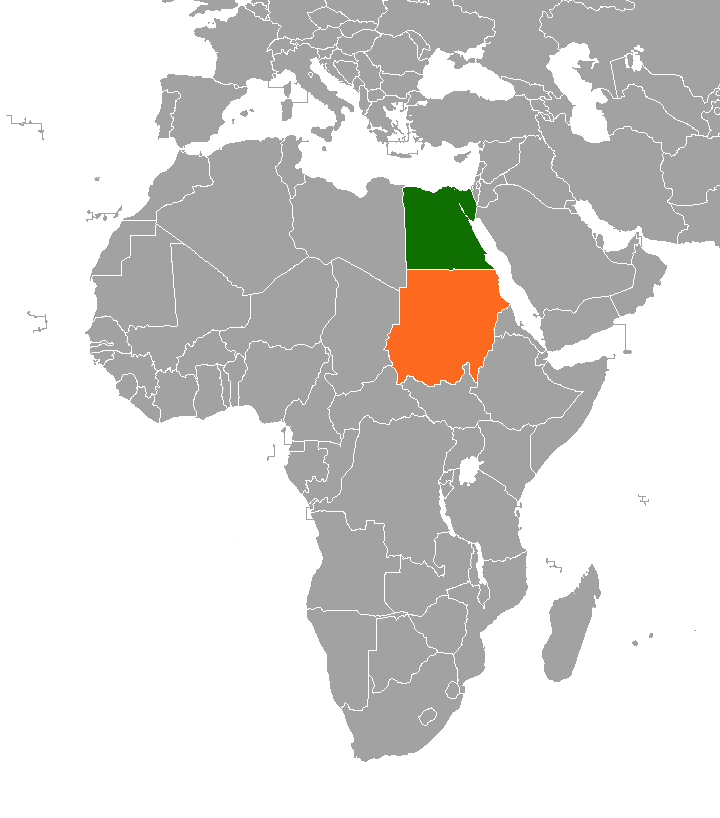
Egyptian-Sudanese Relations - Bilateral diplomatic relations between Egypt and Sudan . The length of the state border between the countries is 1276 km [1] .
| Egyptian-Sudanese Relations | |||||
|---|---|---|---|---|---|
 | |||||


History
Egypt and Sudan have long-standing cultural and historical ties . From 1899 to 1956, Sudan was a condominium of Egypt and Great Britain [2] . In 1979, Sudan became one of the few Arab countries to support the decision of Egyptian President Anwar Sadat to sign a peace treaty with Israel . Then, Sudanese President Jafar Mohammed Nimeyri played a leading role in restoring Egypt's authority in dealing with the rest of the Arab world . In 1985, Jafar Mohammed Nimeyri was in Egypt after a trip to the United States of America when his government was overthrown. Egyptian President Hosni Mubarak granted political asylum to Jafar Nimeyri and rejected subsequent Sudan requests for his extradition. Since 1986, relations between countries have gradually improved, and by the time the coup d'etat in Sudan in 1989 , they were already relatively normal [3] . But since 1989, Sudan has begun to distance itself from its traditional allies : Egypt and the United States of America . In 1991, relations between Sudan and Egypt were tense. This was partly due to the fact that Cairo supported Jafar Mohammed Nimeyri until 1985 [4] .
Relations with Egypt steadily worsened after the National Salvation Revolution Command Council came to power in Sudan. Omar al-Bashir was convinced that Egypt supported Sudan’s opposition politicians, some of whom, including Ahmed Ali al-Mirgani , received political asylum in that country. Egypt allowed the opposition Sudanese National Democratic Alliance party to operate on its territory. Ahmed Ali al-Mirgani and other Egyptian opposition leaders, including Jafar Nimeyri, regularly criticized the Sudanese government while in Cairo . The Council of the National Salvation Revolution Command considered it possible to provide asylum to Islamic activists against whom criminal cases were instituted in Egypt, as well as to finance the activities of the National Islamic Front in Egypt to carry out attacks on opponents of the Sudanese regime. In early 1990, the Egyptian government invited a senior delegation of the People’s Army for the Liberation of Sudan to Cairo, which seriously aggravated relations with Sudan. In 1990, Hosni Mubarak accused Sudan of deploying Iraqi missiles on its territory and intending to attack the Aswan Dam , which was categorically denied by the Council of the Revolution of National Salvation Command. In 1991, Sudan refused to join the Arab coalition and fight against Iraq, which was sharply negatively received by the Egyptian authorities. In 1991, Egypt did not return its ambassador to Khartoum and openly provided financial support to opposition groups in Sudan [3] .
The Halaib Triangle - a land area of about 20,500 square kilometers on the Egyptian-Sudanese border, which both countries claim, after gaining Sudan gained independence from Britain in 1956. Egypt established a military outpost in this territory in the 1990s, but the territorial dispute did not continue in the next two decades. In 2016, the issue of belonging to the Khalaib Triangle again appeared on the agenda of bilateral relations, after the Egyptian authorities signed an agreement with Riyadh on transferring two strategically important islands in the Red Sea to Saudi Arabia : Tirana and Sanafira . After signing this agreement between Egypt and Saudi Arabia, it turned out that the Egyptian-Sudanese maritime border had changed and, in fact, unilaterally recognized Egypt’s sovereignty over the Halaib Triangle [5] [6] .
In December 2017, Sudan sent a statement to the United Nations in which it stated that it categorically does not accept the deal to transfer the islands between Egypt and Saudi Arabia. Egyptian politicians condemned the Sudanese statement and added that they consider the Halaib Triangle to be Egyptian territory. On January 4, 2018, Sudan recalled its ambassador from Cairo for consultations. Meanwhile, in response to Sudan’s claims that the Halaib Triangle belongs, as well as for fears that Turkey is expanding its influence in the region [7] , Egypt sent its troops to the UAE base in Eritrea , which is located near the border with Sudan [8] . Egypt denied any military presence in Eritrea, but damage to relations with Sudan has already been done. A few days later, Sudan closed the border with Eritrea and sent several thousand troops to the area. It is likely that Khartoum was trying to aggravate the territorial dispute with Egypt in order to exploit nationalist sentiments within the country and divert the attention of the population from serious domestic problems, in particular from increasing the price of bread and other basic goods [5] .
In February 2018, a meeting of Egyptian and Sudanan foreign ministers took place, following which politicians made a statement that the countries intend to restore bilateral relations [9] . In March 2018, Sudanese President Omar al-Bashir ordered the return of the ambassador to Cairo, which was evidence of the normalization of Egyptian-Sudanese relations [10] [11] [12] .
Trade
In the first half of 1989, Sudan exported goods worth $ 2,216,000 to Egypt. Sudan exports to Egypt: sesame seeds, watermelon seeds and camels. Camel exports totaled $ 120 million. Egypt's exports to Sudan amounted to 9,423,000 US dollars, investments were concentrated in the textile and other industries [13] . In 2015, Sudan imported goods worth $ 596 million from Egypt [14] .
Notes
- ↑ The World Factbook - Central Intelligence Agency
- ↑ Sudan - THE ANGLO-EGYPTIAN CONDOMINIUM, 1899-1955
- ↑ 1 2 Sudan - Egypt
- ↑ Sudan - Foreign Relations
- ↑ 1 2 What is going on between Egypt and Sudan? | Africa | Al jazeera
- ↑ What is behind Egypt-Sudan diplomatic standoff? | Middle east eye
- ↑ Egypt, Sudan Relations at a new Low Over Erdogan's Visit
- ↑ Gulf tension: Are Egypt and Sudan about to go to war? | Middle east eye
- ↑ Egypt, Sudan agree on measures to restore relations - Sudan Tribune: Plural news and views on Sudan
- ↑ Restoring Egyptian-Sudanese relations - Politics - Egypt - Ahram Online
- ↑ Are Egyptian-Sudanese relations on the right track? - Egypt Today
- ↑ Great momentum in Egypt-Sudan relations expected soon: Sudanese ambassador - Egypt Independent
- ↑ Sudan - Egypt Relations
- ↑ OEC - Sudan (SDN) Exports, Imports, and Trade Partners