The Arab-Khazar Wars ( 642 - 799 ) are a series of armed conflicts between the Khazar Kaganate on the one hand and the successive Arab , Umayyad and Abbasid caliphates on the other. In Western historiography [2] , the First Arab-Khazar War is sometimes distinguished from them (about 642 - 652 )and the Second Arab-Khazar War ( 722 [3] - 737 ) .
| Arab Khazar wars | |||
|---|---|---|---|
| Main Conflict: Arab Conquest | |||
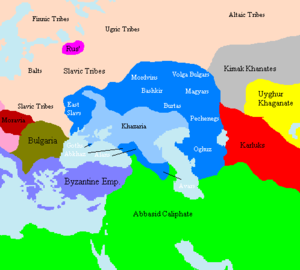 Khazar Khaganate and neighboring states in the 9th century . | |||
| date of | 642 - 799 years | ||
| A place | Dagestan , Transcaucasia , Iranian Azerbaijan , East Turkey [1] | ||
| Total | Maintaining the status quo | ||
| Opponents | |||
| |||
| Commanders | |||
| |||
Conflicts of varying strength between Arabs and Khazars flared up during the 7th - 8th centuries . Their reason was the desire of both parties to expand their influence in the Caucasus and Transcaucasia .
The first war began with the Arab raid on Khazar territory in 642/643 . A decade later, an attempt to re-raid ended in the defeat of the Arab army led by Salman ibn Rabi under Belenger .
The second war, which became the most ambitious in time and intensity, began in the 1st decade of the VIII century and lasted until 737 . Its culmination was the invasion of the Khazar troops led by Prince Bardzhil into the territory of modern Iranian Azerbaijan in 730 , when the Khazars defeated the Arab army led by Jarrah ibn Abdallah al-Khakami in the battle of Ardabil and penetrated deep into the territory of the Caliphate, reaching the environs of Mosul . In 737, a retaliatory Arab campaign followed, as a result of which all the major cities of Khazaria were taken, including Semender , which was the Khazar capital at that time, and Al-Baida , where the kagan’s headquarters were located. The kagan was forced to make peace, and the Khazar raids stopped for a long time. However, instability within the Caliphate forced the Arabs to urgently retreat to their homeland. There was no question of their control over the Khazaria, and they no longer made attempts to conquer the lands beyond the Caucasus.
The next war took place already under the Abbasids, in 762-764 . The Khazar invasion affected Albania , Armenia and Georgia . Tiflis was stormed.
The last major conflict between the Arabs and the Khazars occurred in 799/800 . The Khazars invaded the territory of Shirvan and robbed it for more than two months, until they were driven back by the Arab governor Yazid ibn Maziyad al-Shaibani . Sometimes the last Arab-Khazar war is considered the clash that took place in 853/854 , when the Arab commander Buga al-Kabir , a Khazarin by origin, made a trip to the Khazars and Alans and received tribute from them [4] .
From the 9th century, relations between Khazaria and the Caliphate were mostly peaceful. Despite the fact that the borders of the Khazaria came close to Derbent, the Khazar rulers no longer made attempts to recapture the South Caucasian lands from Muslims [5] . Between the countries, prosperous trade was established. An extensive Muslim community arose in Khazaria, and the caliphs established a guard recruited from the Khazar soldiers . The Jewish-Khazar Correspondence dating back to the middle of the 10th century states that the Khazars protected Arab ports on the Caspian Sea from Russian raids .
Content
Background and Reasons
The Arab-Khazar wars were an episode of a long struggle between the various nomadic peoples living north of the Caucasus and the civilized states located south of it, whose roots go back to ancient times. The main routes of invasion of the nomads were the Darial Gorge and the Caspian Gate , and therefore located south of the state have long sought to control them. That is why the shahs of the State of Sassanids showed great interest in them and launched a grandiose fortification construction in Derbent in the 5th – 6th centuries [1] [6] , which became in the future one of the key places of clash between the Khazars and Arabs [7] . At this time, such structures as the Derbent wall and the Naryn-kala fortress were erected. It is worth noting that in the Middle Ages a legend arose according to which Alexander the Great erected all these fortifications, thereby imprisoning the mythical tribes Gog and Magog [8] . It is thanks to this legend that the Caspian Gate got its second name - the Alexander Gate. In addition, early medieval authors associated Gog and Magog with the Khazars , who replaced the Scythians and Huns [9] .
After the Arab caliphate conquered the State of the Sassanids , the Arabs themselves faced the problem of protecting their northern borders from the steppes. However, unlike the Persians, who took up a defensive defense, the Arabs, following the Muslim concept of dividing the world into Dar al-Islam ( “Space of Islam” ) and Dar al-harb ( “Space of war” ), considered it their duty to Islamize the pagan tribes of the nomads and include their lands as part of their power [10] .
In addition, the Arab-Khazar wars were to some extent connected with the Arab-Byzantine struggle for the eastern part of Asia Minor . The Byzantine emperors understood that the Khazar Khaganate could be a very valuable ally against the Muslims for them and sought to strengthen relations with it. Therefore, in 705, Emperor Justinian II married the Khazar Princess [11] [12] . The ability of the Khazars and the Byzantines to interact through the territory of Armenia posed a serious danger for the Caliphate, especially given the relative proximity of Armenia to Syria , in which the capital of the Umayyads , Damascus, was located [1] . Therefore, some Byzantines, in particular, Dmitry Obolensky , call the main reason for the Arab-Khazar wars the desire of Muslims to deprive Byzantium of a strong ally in the person of Khazaria [13] . However, it is more likely that the Byzantines themselves encouraged the Khazars to attack the Caliphate, trying to reduce the growing tension near their eastern borders [14] . A little later, in 733 , another Byzantine emperor, Leo III Isaur , in order to strengthen the Khazar-Byzantine union, married his son and heir Konstantin to the Khazar princess Chichak [15] [16] .
Also, as an additional reason for conflicts, it was suggested that the Arabs sought to take control of the northern branch of the Great Silk Road with their help. However, the historian Gerald Mako disputes this statement, pointing out that the attenuation of the Arab-Khazar conflicts dates back to the time of the highest flowering of the Silk Road, that is, to the second half of the VIII century [17] .
Theater of War
The object of the Khazar raids were two Transcaucasian provinces of the Caliphate: Arminiya , which included Kartli , Albania ( Arran ) and Armenia itself (the center of Dvin , Berdaa from 752) and Azarbaijan (roughly corresponds to modern Iranian Azerbaijan, the center of Maraga , the largest city of Ardabil ) [18] . At least twice hostilities reached the province of al-Jazeera ( Northern Mesopotamia , the center of Mosul ). In Transcaucasia, only the western part of modern Georgia and Abkhazia remained free from clashes between the two powers [19] .
The main objectives of the Arab troops were Derbent, which the Arabs repeatedly captured, but could not hold, and the Khazar cities located behind it: Belenger (Balanjar) (according to some sources, the first capital of the Khazars appears in most descriptions as a separate region with its own ruler) and Semender ( Samandar). Both cities were within modern Dagestan. The most remote Khazar point is Al-Baida . The location of this city is not known. Perhaps he was at the mouth of the Volga, on the site of the future Khazar capital Itil [20] [21] , according to another point of view, this was the nomadic headquarters of the ruler [22] [23] .
Other countries of the Caucasus were drawn into the war: small possessions in Mountain Dagestan, which supported one side or another, depending on the circumstances, and Alania , on whose territory there was a second strategic passage through the mountains. With rare exceptions, the Alans acted on the side of the Khazars [24] . They remained in vassal dependence on the kaganate until the middle of the 10th century.
First Arab-Khazar War
The Khazars first appeared in Transcaucasia during the Iranian-Byzantine war of 602-628 , as part of the West Turkic Khanate and, probably, the basis of its troops [25] . Türkic troops captured Derbent and helped the Byzantines in the siege of Tiflis . Their assistance greatly helped Byzantium to win this war. Over the next several years, the Khazars controlled the territory of Iberia , Albania and Atropatena [26] . In Albania, they established their own administration and levied taxes based on previous Persian censuses. In 630, as a result of internal unrest that swept the West Turkic Kaganate, the Khazars left Albania.
The conflict between the Arabs and the Khazars began as a result of the rapid expansion of the Arab caliphate . The Muslim armies defeated the Byzantines and the Persians weakened by a bloody war, and in 640 reached Armenia [27] . According to at-Tabari, in 642/643 the Arab troops under the command of Abd al-Rahman ibn Rabi made the first raid into the Khazar lands, reaching Belenjer and Al-Bayda, after which they returned safely to Derbent with great loot [7] [28] . The problem, however, is that none of the other Arab authors mentions this campaign, so many historians deny its reliability [29] . On the other hand, such rapid raids at the dawn of the Arab conquests were common [30] . In 645/646, Arabs and Khazars met again on the battlefield, when the Byzantine army was defeated in the Battle of Kalikale in the upper Euphrates , consisting of a contingent of Alans , Abkhazians and Khazars [27] [31] . In the year 652/653, Muslims, led by Salman ibn Rabi (according to another version, his brother, Abd al-Rahman ibn Rabi), the 4,000-strong army marched on Belenjer , but suffered a crushing defeat in the battle of the city . Both sides in the battle used catapults , throwing shells [7] [32] . The deceased Arab commander became an object of religious veneration on both sides. The Khazars placed his body in a sarcophagus made of reed and began to use it as a magical means to cause rain [33] . In the Islamic world, Salman and other prominent participants in the campaign were recognized as martyrs for their faith [34] .
The civil war that broke out in 656 forced the Arabs to focus on internal problems, leave Transcaucasia and stop trying to conquer Khazaria until the beginning of the VIII century [35] . The Transcaucasian countries recognized themselves as vassals of the caliph, but retained independence, maneuvering between the Arabs and Byzantium. They themselves had to repel the raids of the nomads, who became regular. Twice, in 664 and 681, vassals and the closest Khazar neighbors, known as the " Huns, " invaded Albania. To get rid of the danger on their part, the ruler of Albania, Javanshir, became related with the ruler of the Huns Alp Ilutver, and in 682 a bishop was sent to the Huns, who converted Alp Ilutver himself and the local nobility to Christianity. However, Christianity was not approved among the nomads, probably due to the negative attitude of the Khazars to this [36] [37] . Actually, the Khazar troops invaded Albania in 661/662, but were defeated. Another, already successful, large-scale Khazar invasion occurred in the summer of 685 [38] - the Khazars managed to capture large booty and many prisoners [28] [39] . The rulers of all three countries: Armenia , Iberia and Albania, died in battle. The Khazars imposed tribute to Albania, in addition to the one that it already paid at the same time to Byzantium and the Caliphate. Apparently, the Khazar raid was even deeper than previously thought: according to the testimony of Khalifa ibn Khayyat, the Khazars managed to reach Mosul, where one of the Arab emirs died in a battle with them [38] [40] .
Second Arab-Khazar War
By the beginning of the VIII century, the political situation in the Caucasus had changed significantly: Byzantium fell into decay, which replaced the Arab Umayyad Caliphate, on the contrary, has grown stronger. Arabs regained control of Transcaucasia. In Albania, they abolished the power of the local dynasty of the Mihranids , and in Armenia they crushed a large-scale uprising in 705 . The war for the right to rule Transcaucasia between the Caliphate and Khazaria became inevitable.
The beginning of the war
The conflict flared up again around 706 [41] [42] when the Arabs attempted to regain Derbent control. For several years the city passed from hand to hand. In 713/714 , Umayyad troops under the command of Maslama , the son of Caliph Abdul-Malik ibn Mervan captured this strategic fortress, after which they moved further north, unsuccessfully trying to conquer the lands of the "Huns". In response, the Khazars began to raid Caucasian Albania , and in 717/718 they gathered a large army and invaded the Iranian region of Azerbaijan (south of the Araks river), from where they were driven back by Arab troops under the command of Khatin ibn al-Numan [28] [43] . The main part of the Arab army under the leadership of Maslama at that moment besieged Constantinople and, presumably, the actions of the Khazars were very useful to the Byzantines.
After several years of calm, a new phase of the war began in 722 . A year earlier, in 721/722 , the Khazars fought with the Alans, which suggests some friction between the allies [24] . In February-March 722, the 30,000th Khazar army invaded Armenia and inflicted a crushing defeat on Muslim troops. In response, Caliph Yazid II sent one of his best commanders, Jarrah ibn Abdallah al-Hakami , along with the 25 thousandth Syrian army against the Khazars. Jarrah’s troops expelled the Khazars from Armenia, captured Derbent and attacked Belenger . The Khazars tried to defend the city, surrounding it with a ring of connected wagons, but the Arabs managed to break through it and on August 21, 722 they broke into the city and destroyed it. Part of the population fled to the north, and prisoners were drowned in the surrounding river [43] [44] . The ruler of Belenjer himself fled and took refuge in Semender , but after Jarrah gave him his captured wife and children, he returned and recognized the power of the Arabs. The Arab army captured a lot of booty, and the soldiers received large sums of money. Nevertheless, the main forces of the Khazars were not yet defeated, and the possibility of their attack forced the Arabs to abandon the semender and push the troops back to the Caucasus. In response, the Khazars moved south, but in February 724, Jarrah inflicted a crushing defeat in the battle lasting several days between the Kura and Araks rivers [43] [45] . Soon after, Jarrah conducted several more successful campaigns in the Caucasus, capturing Tiflis and turning Iberia and Alans into Arab vassals. During these campaigns, he became the first Arab commander to cross the Darial Gorge , and thereby opened up a new path for the Muslim troops in the land of the Khazars [46] .
In 725, the new caliph, Hisham ibn Abdul-Malik , transferred the authority of Jarrah to his brother Maslama [47] [48] . However, Maslama remained in Jazir and was mainly engaged in attacks on Byzantium . Harris ibn Amr al-Thai took command of the Caucasian troops. Throughout the year, he strengthened Arab power in Transcaucasia and conducted several military campaigns against local tribes. It also probably has something to do with the population census that year [49] . However, in 726, the Khazars under the command of Prince Bardzhil launched a large-scale attack on the territory of Caucasian Albania. At the same time, besieging the fortresses, they used paterals . And although Haris managed to defeat the Khazars near the Araks River, on the whole, the situation of the Arabs turned out to be very precarious [43] [50] .
The current situation forced Maslama to personally take command of the troops in the Caucasus. He arrived at the front in 727, probably taking reinforcements from Syria with him, and led the attack on the Khazars. The Arab army crossed the Darial Gorge and returned back to the onset of winter. What they achieved by this is not clear, but when Maslam repeated the invasion the following year, it ended in disaster. Arab sources report that Muslim troops fought for 30 or even 40 days in the mud and in heavy rain, which is why the campaign was called the "dirty campaign . " As a result, the Arabs defeated the Khazars on September 17, 728. However, it was hard to say how great this victory was: when the Arabs returned home, they were ambushed by the Khazars, after which they simply fled, dropping carts [43] [51] . After this “victory”, Maslam was again replaced by Jarrah. In 729, the Arabs lost control of the north-eastern Transcaucasia [52] . In Khazaria, the ruling kagan died at that time, and the power was in the hands of his mother - the Parsbit khan. Obviously, she was regent with a minor heir. According to the assumption of Igor Semenov , the unprecedentedly large-scale campaign of the Khazars undertaken next year could be caused by a desire to avenge the death of his ruler.
The Battle of Ardabil and Arabs'
In 730, the Arab army under the command of Jarrah left Tiflis, crossed the Darial Gorge and invaded the Khazars. Arab sources report that Jarrah managed to take Al-Bayd, but modern historians such as Mikhail Artamonov and Khalid Blankinship consider this unlikely. In response, the Khazars attacked Arab territories in Transcaucasia, gathering a huge army, which included militias from all tribes subject to the kaganate. According to al-Kufi, the army numbered 300 thousand people. This number is probably overestimated (as well as almost all the figures used by the sources), but it is undoubted that the scale of the invasion was extraordinary. The Khazars crossed the Caucasus along the Darial Gorge (according to other sources also through Derbent and other passages) and, bypassing the Arab army, besieged Ardabil , the main city of Azerbaijan, in whose walls about 30 thousand people lived. The success of the Khazars was facilitated by the fact that they were well aware of the whereabouts of the Arab troops - such information was provided to them by the ruler of Georgia. As soon as Jarrah learned about the invasion, he retreated to Transcaucasia, moved to Ardabil and attacked the Khazars. After a two-day battle that took place on December 6–8, 730 , the Khazars led by the Khagan’s son, Bardzhil, almost completely destroyed the 25,000-strong Arab army [53] [54] . After that, they took the city and scattered around the country for robbery, reaching Diyarbakir and Mosul , located very close to Damascus , the capital of the Umayyad caliphate [55] [56] .
The defeat at Ardabil was a real shock for Muslims, who first had to meet with the enemy in the heart of the Caliphate and for the first time in the battle the governor himself died. Caliph Hisham sent Russian against the Khazars Said ibn Amr al-Harashi , one of his best warlords. Despite the fact that the forces that Said managed to gather (among his soldiers were some refugees from Ardebil who were persuaded to fight by paying ten gold dinars ) were very modest, he managed to recapture Akhlat , a city near Lake Van . After that, he moved to the northeast, liberated several more cities and met with the 10,000-strong Khazar army at Bajarvan. The Arabs managed to win and free the captives who were with them. After that, Said went north, following the surviving Khazars [57] . However, despite his success, he was dismissed at the beginning of 731 and even ended up in prison for some time due to the envious Maslama, who was again appointed by the caliph to the post of governor of Arminia and Azarbai. After this, Maslama himself led the troops and led them north. He reached Derbent , occupied by the Khazar garrison. Bypassing the fortress, Maslama continued the pursuit of the retreating Khazars, capturing Belenger and Semender along the way. Soon after, he encountered the Khazar army, led by the kagan itself. Despite the fact that Prince Bardzhil was killed in the battle, the Muslims had to retreat back to Transcaucasia. Near Derbent, in a place called Bab-Vak , the Khazars again attacked them, but the Arabs dug trenches and defeated them. In this battle, the kagan was wounded [56] [58] . After that, Maslama lured enemies from Derbent, poisoning them with water in the wells. Only from this moment on did the Arabs finally control the strategic fortress. Maslama left the 24 thousandth Syrian army in the city and returned for the winter with the main forces to Azerbaijan. At the same time, the Khazars restored their destroyed settlements. Despite the capture of Derbent, the caliph was not satisfied with the actions of Maslama and in March 732 replaced him with his brother Marwan ibn Muhammad , who in the future became the last ruler of the Umayyad caliphate [59] .
In the summer of 732, Marwan assembled the 40,000th army and moved with it to the Khazar lands. What happened after that is not entirely clear. According to al-Kufi, the Arabs reached Belenjer and returned, capturing a lot of cattle. However, this campaign is suspiciously very similar to Maslama’s previous campaigns, and therefore is in doubt. Khalifa ibn Hayat, in turn, reports that the expedition advanced slightly north of Derbent, and then returned to it for the winter [60] . It is worth noting that at the same time, Marwan provided the Armenian Tsar Ashot III Bagratuni wide autonomy in exchange for an increase in the number of recruits from Armenia. Modern historians consider this a sign of the severe shortage of human resources faced by the Caliphate [61] [62] .
In addition, at the same time, the Khazars and Byzantines renewed their alliance against the Arabs, holding him together in marriage to the Byzantine Tsarevich Konstantin , son of Emperor Leo III Isaurus , and the daughter of the Kagan Virchor Princess Chichak in 733 [63] [64] .
Marvan's campaign in Khazaria
After 732, a period of calm began on the Arab-Khazar border. In the spring of 733, Marwan was replaced by the governor of the Transcaucasia, Said al-Harashi . However, he no longer took any military action against the Khazars, and in 735, Said lost his sight and resigned. The newly appointed governor Marwan until 737 did not undertake any serious campaigns against the Khazars , limiting himself to only a few expeditions against the small Caucasian kings. The historian Khalid Blankinship explains this inaction by the depletion of human resources of the Umayyad Caliphate, drawing a parallel with exactly the same lull that occurred at the same time on the Arab borders in Maverannahr [65] [66] . Authors such as Mikhail Artamonov and Anatoly Novoseltsev see this as a tactical move by Marvan that he used to buy time to prepare for a new invasion and secure his rear.
Be that as it may, in 737 the Arabs prepared a large-scale invasion with the goal of permanently ending the wars with the Khazars. Shortly before the expedition, Marwan personally visited Damascus to convince Caliph Hisham to support his undertaking. His attempt was crowned with success: about 120 thousand soldiers, including the regular army from Syria, the Armenian forces of Ashot Bagratuni and volunteers who wanted to participate in jihad, stood under the Arab banners. This number is probably an exaggeration, however, regardless of the real size of Marwan’s army, it was a huge force at that time and certainly the largest Arab army ever sent against the Khazars [67] . To begin with, Marwan decided to secure a reliable rear, and therefore subjugated all Armenian groups hostile to the Arabs or Ashot Bagratuni, vassal to them. After that, the Arab troops moved to Abkhazia controlled by Byzantium and besieged Anacopia . However, Marwan soon had to withdraw his troops due to the outbreak of dysentery in them [67] .
Having completed the conquest of Transcaucasia, Marwan launched an attack on the Khazaria. The troops were divided into two parts: the 30,000th detachment under the command of the governor of Derbent, Asid Zafit ibn al-Sularni, crossed the Caspian Gate , while the main forces, led personally by Marwan, invaded the Khazars through the Darial Gorge . Both groups met again at Semender, after which they headed north, and, according to Arab sources, captured Al-Baida , the Volga capital of Khazaria. The Arabs themselves overtook the Khazar army on the banks of the "Slavic River" - the Volga (according to other estimates - the Don [68] ). In the battle that began, 10 thousand Khazars fell and their military leader, Khazar-Tarkhan , another 7 thousand were captured. As a result, the kagan himself asked for peace, converted to Islam and recognized himself as a vassal of the Caliphate [5] [69] [70] . In addition, the Arabs brought to their homeland many Khazar and Slavic captives who were resettled in Transcaucasia. According to the Arab historian al-Belazuri , 20 thousand Slavs were settled in Kakheti , the Khazars were resettled in Lezgistan . However, the Slavs soon killed their Arab governor and fled north, but Marvan caught up with them and killed them all [71] [72] .
The campaign of Marwan in 737 was the culmination of the Arab-Khazar wars, but in fact it did not entail any serious consequences. The Khazars stopped making large raids on the Arabs [71] , but their recognition of Arab domination and the adoption of Islam by the Kagan was obviously nominal or short-lived. Marvan managed to inflict a crushing defeat on the Khazars, but he did not have the strength for long-term control over its lands, and therefore the Khazars retained their independence [5] . Moreover, the very fact of the adoption of Islam by the kagan is disputed: al-Belazuri reports that Islam was not accepted by the kagan, but only a noble Khazarin, who was resettled in Lezgistan to control the Khazar prisoners settled there. In addition, around 740, the Khazars adopted Judaism , seeking to emphasize their independence from both Christian Byzantium and the Muslim Caliphate [73] .
Nevertheless, whatever the consequences of this campaign, the Khazar raids on the Umayyad caliphate really stopped for several decades [62] . The Arabs continued military operations in the Caucasus until 741, and they were directed mainly against the small North Caucasian rulers. However, these campaigns were mainly predatory and did not carry aggressive goals [74] . Despite success in the wars with the Khazars, the Umayyad border was stably established in the Derbent region [19] [75] . Blankinship also criticizes the long-term consequences of the second Arab-Khazar war: Arab spending on it was very high and they were simply not able to compensate for them [75] . In addition, the need to keep a large garrison in Derbent further depleted the already overloaded Syrian army, on which the Umayyad regime relied [75] . In the end, it was the weakening of the Syrian army that became one of the most important reasons for the fall of the Umayyad and the birth of the Abbasid caliphates as a result of the civil war of the 740s [76] .
Late Conflicts
With the establishment in the Muslim world of the power of the Abbasids, the Khazars resumed their raids in the Caucasus .
The first Khazar conflict with the new Abbasid caliphate erupted in 762/763 due to diplomatic scandal. In an effort to strengthen relations with the Khazar Khaganate, the Caliph al-Mansur ordered his governor in the Caucasus, Yazid ibn Asid Zafir ibn al-Sulami, to marry the daughter of the Khazar Khagan Bagatur . Kagan agreed and sent his daughter south with a dowry of 100 thousand dirhams, accompanied by a 10 thousand retinue, herds of horses, camels, cattle and 20 carts with gold and silver items. The princess converted to Islam and became the wife of the governor, having given birth to two sons. However, two years and four months later, in 762/763, she and her children suddenly died. The furious kagan decided that the Arabs had poisoned his daughter, and declared war on them. In 762–764, a huge Khazar army invaded Transcaucasia under the command of the commander Ras-Tarkhan , ruined Caucasian Albania , Iberia, Armenia and burned Tiflis . Yazid himself managed to escape captivity, but the Khazars returned home with thousands of prisoners and many trophies [5] [77] . However, when a few years later, in 780, the overthrown ruler of Iberia, Nerse asked the Khazars to invade Transcaucasia and restore him to the throne, they refused. This is probably to some extent connected with the deterioration of the Khazar-Byzantine relations due to the arisen territorial disputes in the Crimea . Around the same time, the Khazars helped Abkhaz tsar Leon II (his mother was the daughter of the Khazar Kagan) to withdraw from the subordination of Byzantium [5] [78] .
The last major Arab-Khazar war occurred in 799/800 . The reason for her, as well as the previous time, was an unsuccessful marriage. Arab sources attribute the conflict to the fact that Abbasid vizier Fadl ibn Yahya Barmakid wanted to marry the daughter of the Hagan, but she died on the way to the south. At the same time, At-Tabari reports that the Khazars were invited by a noble Arab in order to avenge the execution of his father, the governor of Derbent, the military leader Saeed ibn Salma. Be that as it may, Arab sources report that the Khazars were defeated by troops under the command of Yazid ibn Maziyad [5] [79] [80] . The final Khazar raid is also noteworthy in that it was the last recorded case when the kagan personally led the hostilities. Subsequently, the Khagans did not command the army, because they were removed from real power [81] [82] [83] .
В середине IX века имело место ещё одно столкновение между хазарами и арабами, подробности которого, однако, почти не известны. Закавказские владения Халифата в этот момент были охвачены восстанием, причём в нём участвовали не только армянские князья, но и арабские наместники, такие как эмир Тифлиса (он и многие другие влиятельные мусульмане принадлежали к оппозиционному движению мутагаллибов ). Причиной возмущений стал непомерный налоговый гнет. Для подавления мятежа халиф ал-Мутаваккиль снарядил 120-тысячное войско, во главе которого был поставлен полководец Буга ал-Кабир (Буга Старший), сам хазарин по происхождению [84] . В 852 году он успешно подавил большинство очагов сопротивления в Армении, а затем в августе 853 года взял Тифлис, при этом в городе заживо сгорели 50 тыс. жителей. После этого на Бугу напал абхазский царь Феодосий , но потерпел поражение и отступил в сторону Алании. Преследуя его, Буга двинулся к Аланским воротам, путь к которым лежал через владения славящегося своей воинственностью и непокорностью горного племени санарийцев (цанаров) в пределах современной Кахетии . С призывом о помощи горцы обратились к трём правителям: владетелям Византии, хазар и славян. То, что произошло дальше, не совсем понятно. Источники говорят об упорной, но безуспешной попытке арабов разбить санарийцев (по сообщению Товмы Арцруни , между ними произошло 19 сражений), и сообщают, что Буга не смог попасть в Аланию из-за обильного снегопада и падежа коней, который поразил арабское войско. Однако, по-видимому, Буга всё же перешёл Кавказ и достиг Хазарии. Лаконичная запись в «Хронике Ширвана и Дербенда» утверждает, что Буга победил хазар и алан и взял с них джизию — подушную подать, которую арабы взимали с неверных [85] [86] . Этот же источник сообщает, что тогда же наместник Дербента Мухаммед б. Халид предпринял набег на неверных в окрестностях города. Грузинская летопись и Белазури , ничего не говоря о самом факте столкновения, сообщают под следующим, 854 / 855 годом , что Буга привёл с собой 100 семей алан и 300 семей хазарских мусульман. Хазары были поселены в городе Шамкор , который пребывал в запустении, с тех пор как столетие назад его разрушили восставшие савиры — кочевники, переселённые при таких же обстоятельствах. Белазури называет этих хазар «мирными». Некоторые историки интерпретируют это как указание на то, что они были не военнопленными, а добровольными переселенцами. Например, Артамонов предположил, что они спасались от религиозных гонений в Хазарии [87] . Несмотря на успех, Буга вызвал опасение у халифа в намерении сговориться с соплеменниками [88] , и в 856 году был отозван из Закавказья.
Consequences
Арабо-хазарские войны остановили арабскую экспансию в Восточную Европу , установив северный предел владений Халифата по линии Большого Кавказского горного хребта [89] [90] . В то же время война оказала пагубное влияние и на Хазарию: массы булгарского и аланского населения бежали со ставшего опасным из-за постоянных военных действий Кавказа в Крым , на Дон , а также в Среднее Поволжье , где в IX веке возникла Волжская Булгария [91] . Хазары перенесли свою столицу из дагестанского Семендера в поволжский город Итиль , подальше от владений мусульман [28] [92] . Дагестан же из центральной области страны превратился в её южную окраину. Неудачи в войнах с арабами заставили хазар переориентировать свою внешнюю политику на славянские земли, из-за чего многие восточнославянские племена превратились в их данников.
Кроме того, арабо-хазарские войны постоянно перетягивали на Кавказ большие силы арабов от границ враждебной им Византийской империи . Это помогло византийцам на какое-то время сдержать натиск мусульман и сохранить под своим контролем Малую Азию [93] [94] .
See also
- Арабские завоевания
- Арабо-византийские войны
- Хазарский каганат
- Хазары
Notes
- ↑ 1 2 3 Blankinship, 1994 , p. 106.
- ↑ Dunlop DM The history of the Jewish Khazars . — Princeton, NJ: Princeton University Press, 1954. — P. 41, 61. Koestler A. The thirteenth tribe: the Khazar empire and its heritage . — London, 1976. — P. 28. Изредка и в российской историографии: Ромашов С. А. Хазары и народы южнорусских степей в V—X веках // История России и её ближайших соседей: Энциклопедия для детей. / С. Исмаилова. — М. : Аванта+ , 1997. — Т. 5. — С. 123,128. — 670 с.
- ↑ По традиции, которая принадлежит автору первого обобщающего труда по истории хазар Д. М. Данлопу, термином «Вторая арабо-хазарская война» в англоязычной историографии обозначается не весь период второй серии столкновений, а только их наиболее интенсивная часть, в 722—737 годах. В русскоязычной историографии началом войны считается первое десятилетие VIII века.
- ↑ Гадло А. В. Этническая история Северного Кавказа IV—X вв. — Л. : Изд-во Ленинградского университета, 1979. — С. 185.
- ↑ 1 2 3 4 5 6 Barthold, W. ; Golden, P. The Encyclopedia of Islam, New Edition. — Leiden and New York: BRILL, 1997. — Vol. IV. — P. 1174. — ISBN 90-04-05745-5 .
- ↑ Mako, 2010 , p. 51—52.
- ↑ 1 2 3 Brook, 2006 , p. 126.
- ↑ Mako, 2010 , p. 50—51.
- ↑ Brook, 2006 , p. 7-8.
- ↑ Mako, 2010 , p. 52—53.
- ↑ Blankinship, 1994 , p. 108-109.
- ↑ Lilie, 1967 , p. 157.
- ↑ Mako, 2010 , p. 49—50.
- ↑ Blankinship, 1994 , p. 109.
- ↑ Blankinship, 1994 , p. 149-154.
- ↑ Lilie, 1967 , p. 157—160.
- ↑ Mako, 2010 , p. 48—49.
- ↑ Шагинян, 2011 , с. 340—346.
- ↑ 1 2 Cobb, 2011 , p. 136.
- ↑ Артамонов, 2001 , Существуют точки зрения, что он являлся предшественником Саркела на Дону (П. Голден) или идентичен Семендеру (А. П. Новосельцев), с. 309.
- ↑ Новосельцев, 1990 , с. 125.
- ↑ Гараева Н. Г. К проблеме распространения ислама на территории России (анализ сведений арабских источников) // Ислам в Среднем Поволжье: история и современность. — Каз. , 2001. — С. 22.
- ↑ Лобанова-Гулак М., Тортика А. «Река славян» (Нахр-ас-Сакалиба) в системе географических реалий Восточной Европы: по данным средневековых мусульманских авторов Архивировано 21 октября 2013 года. . // Іслам і Україна: роботи учасників Першого Всеукр. ім. А. Кримського конкурсу ісламознав. дослідж. молодих учених / Іслам. громад. культ. центр м. Києва. — К. , 2005. — С. 155—174.
- ↑ 1 2 Новосельцев, 1990 , с. 179.
- ↑ Kaegi, Walter Emil. Heraclius: Emperor of Byzantium . — Cambridge University Press,: Cambridge University Press, 2003. — С. 143. — ISBN 0-521-81459-6 .
- ↑ Brook, 2006 , p. 133—135.
- ↑ 1 2 Lilie, 1967 , p. 54.
- ↑ 1 2 3 4 Barthold, W. ; Golden, P. The Encyclopedia of Islam, New Edition. — Leiden and New York: BRILL, 1997. — Vol. IV. — P. 1173. — ISBN 90-04-05745-5 .
- ↑ Артамонов, 2001 , с. 250.
- ↑ Н. Г. Гараева признаёт достоверным поход на Беленджер, но исключает поход на Ал-байда (см.: Гараева Н. Г. К проблеме распространения ислама на территории России (анализ сведений арабских источников) // Ислам в Среднем Поволжье: история и современность. — Каз. , 2001. — С. 22.).
- ↑ Гадло А. В. Этническая история Северного Кавказа IV—X вв.. — Л. : Изд-во Ленинградского университета, 1979. — С. 153.
- ↑ Новосельцев, 1990 , с. 174.
- ↑ Гмыря Л. Б. Обряд вызова дождя в стране гуннов Прикаспия в VII в. н. e. по данным арабских и армянских источников // Древнетюркский мир: история и традиции. Материалы научной конференции. Казань, 24—25 января 2001. — Каз. , 2002.
- ↑ Саидов З. А. Биографические сведения об участниках первых походов Халифата на Восточный Кавказ Архивировано 10 октября 2013 года. . // Вісник ЛНУ імені Тараса Шевченка. — № 19 (206). - 2010.
- ↑ Mako, 2010 , p. 45.
- ↑ Артамонов, 2001 , с. 253.
- ↑ Шагинян, 2011 , с. 136-137.
- ↑ 1 2 Шагинян, 2011 , с. 146.
- ↑ Brook, 2006 , p. 126—127.
- ↑ Гараева Н. Г. К проблеме распространения ислама на территории России (анализ сведений арабских источников) // Ислам в Среднем Поволжье: история и современность. — Каз. , 2001. — С. 22.
- ↑ Артамонов, 2001 , с. 282.
- ↑ Семёнов И. Г. Хазаро-византийские политические отношения в периоды правления императора Юстиниана II (685—695, 705—711) // Материалы XVI ежегодной международной междисциплинарной конференции по иудаике. — Ч. 3. — М. , 2009. — С. 13—21.
- ↑ 1 2 3 4 5 Brook, 2006 , p. 127.
- ↑ Blankinship, 1994 , p. 121—122.
- ↑ Blankinship, 1994 , p. 122.
- ↑ Blankinship, 1994 , p. 122—123.
- ↑ Артамонов, 2001 , с. 289.
- ↑ Blankinship, 1994 , p. 123.
- ↑ Blankinship, 1994 , p. 123—124.
- ↑ Blankinship, 1994 , p. 124.
- ↑ Blankinship, 1994 , p. 124—125.
- ↑ Blankinship, 1994 , p. 125, 149.
- ↑ Blankinship, 1994 , p. 149—150.
- ↑ Brook, 2006 , p. 127—128.
- ↑ Blankinship, 1994 , p. 150.
- ↑ 1 2 Brook, 2006 , p. 128.
- ↑ Blankinship, 1994 , p. 150-151.
- ↑ Blankinship, 1994 , p. 151—152.
- ↑ Blankinship, 1994 , p. 152.
- ↑ Blankinship, 1994 , p. 152—153.
- ↑ Blankinship, 1994 , p. 153.
- ↑ 1 2 Cobb, 2011 , p. 237.
- ↑ Blankinship, 1994 , p. 153-154.
- ↑ Lilie, 1967 , p. 157—158.
- ↑ Blankinship, 1994 , p. 170-172.
- ↑ Blankinship, 1994 .
- ↑ 1 2 Blankinship, 1994 , p. 172.
- ↑ Обзор мнений см. Калинина Т. М. Ал-хазар и ас-сакалиба: контакты. Конфликты? // Хазары. — С. 106—107.
- ↑ Blankinship, 1994 , p. 172—273.
- ↑ Brook, 2006 , p. 128—129.
- ↑ 1 2 Blankinship, 1994 , p. 174.
- ↑ Brook, 2006 , p. 179.
- ↑ Blankinship, 1994 , p. 173-174.
- ↑ Blankinship, 1994 , p. 174—175.
- ↑ 1 2 3 Blankinship, 1994 , p. 175.
- ↑ Blankinship, 1994 , p. 223—225, 230—236.
- ↑ Brook, 2006 , p. 129—130.
- ↑ Brook, 2006 , p. 131—132.
- ↑ Brook, 2006 , p. 131, 132.
- ↑ Bosworth, Clifford Edmund. The History of Al-Tabari, Volume XXX: The 'Abbāsid Caliphate in Equilibrium. The Caliphates of Musa Al-Hadi and Harun Al-Rashid, AD 785–809/AH . — Albany, New York: State University of New York Press, 1989. — P. 170—171. — ISBN 0-88706-564-3 .
- ↑ Артамонов, 2001 , с. 381.
- ↑ Исключение составляет упоминание об участии кагана в сражении с князем Святославом при падении Хазарии в 965 году .
- ↑ Степанов Ц. Развитие концепции сакрального царя у хазар и болгар эпохи раннего Средневековья // Хазары, сб. статей. — М. , 2005. — С. 317—318.
- ↑ Голден П. Тюрки-хазары — гулямы на службе у халифов // Хазары, сб. статей. — М. , 2005.
- ↑ Новосельцев, 1990 , с. 192.
- ↑ Шагинян, 2011 , с. 306—308.
- ↑ Артамонов, 2001 , с. 442.
- ↑ Голден П. Тюрки-хазары — гулямы на службе у халифов // Хазары, сб. статей. — М. , 2005. — С. 468.
- ↑ The history of the Jewish Khazars. — Princeton, NJ: Princeton University Press, 1954. — P. 87.
- ↑ Артамонов, 2001 , с. 311.
- ↑ Плетнёва С. А. Хазары. — М. : Наука, 1976. — С. 43.
- ↑ Новосельцев А. П. Хазария в системе международных отношений VII—IX веков . — 1987. — С. 20—32. Архивная копия от 3 декабря 2013 на Wayback Machine
- ↑ Плетнёва С. А. Глава 4. Арабские войны. // Хазары. — М. : Наука, 1976.
- ↑ Хазарский лабиринт . Вокруг Света . Дата обращения 14 июля 2013.
Literature
Источники на русском языке
- Ибн-ал-Асир . Из Тарих-ал-камиль (полного свода истории) / Пер. П. К. Жузе // Материалы по истории Азербайджана. — Баку. 1940.
- История халифов вардапета Гевонда, писателя VIII века . / Per. К. Патканьяна. - SPb. , 1862.
- Абу Мухаммад ибн А'сам ал-Куфи . Книга завоеваний . / Per. З. М. Буниятова. — Баку, 1981.
- Халифа ибн Хаййат ал-'Усфури . «Та'рих» («История») / Пер. В. М. Бейлиса. // Древнейшие государства Восточной Европы. 1998. — М. , 2000. — С. 33—53.
Literature in Russian
Monographs
- Артамонов М. И. История хазар. - 2nd ed. - SPb. , 2001. — ISBN 5-8114-0377-1 .
- Новосельцев А. П. Хазарское государство и его роль в истории Восточной Европы и Кавказа. — М. , 1990. — ISBN 5-02-009552-4 .
- Плетнёва С. А. Хазары / Отв. ed. Б. А. Рыбаков . — М. : Наука , 1976. — 96 с. — (Научно-популярная серия). - 120,000 copies.
- Шагинян А. К. Армения и страны Южного Кавказа в условиях византийско-иранской и арабской власти. - SPb. : Алетейя, 2011. — ISBN 5-02-009552-4 .
Articles
- Гараева Н. Г. К проблеме распространения ислама на территории России (анализ сведений арабских источников) . // Ислам в Среднем Поволжье: история и современность. — Каз. , 2001.
- Гараева H. Г. О дате принятия ислама хазарами // Языки, духовная культура и история тюрков: традиции и современность. Труды международной конференции. Казань, 9—13 июня 1992 г. — Т. 3. — М. , 1997.
- Ромашов С. А. Хазары и народы южнорусских степей в V—X веках // История России и её ближайших соседей: Энциклопедия для детей. / С. Исмаилова. — М. : Аванта+ , 1997. — Т. 5. — С. 123—131. — 670 с.
- Саидов З. А. Биографические сведения об участниках первых походов Халифата на Восточный Кавказ // Вісник ЛНУ імені Тараса Шевченка. — № 19 (206). — 2010.
- Семёнов И. Г. Военная тактика хазарской армии в период войны против Арабского халифата в 706—737 годы . // Материалы XVII международной ежегодной конференции по иудаике. — Т. 2. — М. , 2010.
- Семёнов И. Г. Эпизоды биографии хазарского принца Барсбека . // Материалы XV ежегодной международной междисциплинарной конференции по иудаике. — Ч. 2. — М. , 2008.
Литература на иностранных языках
- Barthold, W. ; Golden, P. The Encyclopedia of Islam, New Edition. — Leiden and New York: BRILL, 1997. — Vol. IV. — P. 1172–1181. — ISBN 90-04-05745-5 .
- Blankinship, Khalid Yahya. The End of the Jihâd State: The Reign of Hishām ibn ʻAbd al-Malik and the Collapse of the Umayyads . — State University of New York Press, 1994. — ISBN 978-0-7914-1827-7 .
- Bosworth, Clifford Edmund. The History of Al-Tabari, Volume XXX: The 'Abbāsid Caliphate in Equilibrium. The Caliphates of Musa Al-Hadi and Harun Al-Rashid, AD 785–809/AH . — Albany, New York: State University of New York Press, 1989. — ISBN 0-88706-564-3 .
- Brook, Kevin Alan. The Jews of Khazaria, Second Edition . — Plymouth: Rowman & Littlefield Publishers, Inc., 2006. — ISBN 978-0-7425-4982-1 .
- Cobb, Paul M. The empire in Syria, 705–763. // Robinson, Chase F. The New Cambridge History of Islam, Vol. 1: The Formation of the Islamic World, Sixth to Eleventh Centuries. — Cambridge, UK: Cambridge University Press, 2011. — P. 226–268. — ISBN 978-0-521-83823-8 .
- Dunlop, Douglas M. The History of the Jewish Khazar. — Princeton, NJ: Princeton University Press, 1954.
- Lilie, Ralph-Johannes. Die byzantinische Reaktion auf die Ausbreitung der Araber. Studien zur Strukturwandlung des byzantinischen Staates im 7. und 8. Jhd.. — Munich: Institut für Byzantinistik und Neugriechische Philologie der Universität München, 1967.
- Mako, Gerald. The Possible Reasons for the Arab–Khazar Wars. — Archivum Eurasiae Medii Aevi, 2010. — P. 45-57.