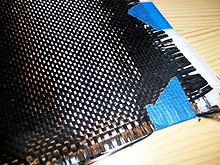
Carbon fiber - a material consisting of thin filaments with a diameter of 5 to 15 microns , formed mainly by carbon atoms . Carbon atoms are combined into microscopic crystals aligned parallel to each other. Aligning the crystals gives the fiber greater tensile strength. Carbon fibers are characterized by high tensile strength, low specific gravity, low coefficient of thermal expansion and chemical inertness.

Content
- 1 History
- 2 Getting
- 3 Additional HC processing
- 4 Properties
- 5 Application
- 6 See also
- 7 notes
- 8 References
History
For the first time, the production and use of carbon fibers was proposed and patented in 1880 by the American inventor Edison for filament in electric lamps. These fibers were obtained as a result of pyrolysis of cotton or viscose fiber and were characterized by high porosity and fragility.
A second interest in carbon fibers arose when searching for materials suitable for use as components for the manufacture of rocket engines. By their qualities, carbon fibers turned out to be one of the most suitable reinforcing materials for such a role, since they have high heat resistance, good thermal insulation properties, corrosion resistance to gas and liquid media, high specific strength and rigidity.
In 1958, hydrocarbons based on viscose fibers were obtained in the USA. In the manufacture of carbon fibers of the new generation, stepwise high-temperature treatment of hydrated cellulose (GTZ) fibers (900 ° C, 2500 ° C) was used, which made it possible to reach tensile strengths of 330-1030 M Pa and an elastic modulus of 40 G Pa . A little later (in 1960) a technology was proposed for the production of short single-crystal fibers ("whiskers") of graphite with a strength of 20 GPa and an elastic modulus of 690 GPa. "Whiskers" were grown in an electric arc at a temperature of 3600 ° C and a pressure of 0.27 MPa (2.7 atm). The improvement of this technology has been given a lot of time and attention over the years, but at present it is rarely used due to its high cost in comparison with other methods for producing carbon fibers.
Almost at the same time in the USSR and somewhat later, in 1961, in Japan, hydrocarbons based on polyacrylonitrile (PAN) fibers were obtained. The characteristics of the first carbon fibers based on PAN were not high, but the technology was gradually improved and after 10 years (by 1970) carbon fibers were obtained on the basis of PAN fibers with a tensile strength of 2070 MPa and an elastic modulus of 480 GPa. At the same time, the possibility of producing carbon fibers using this technology with even higher mechanical characteristics was shown: an elastic modulus of up to 800 GPa and a tensile strength of more than 3 GPa. HCs based on oil pitch were obtained in 1970 also in Japan.
Chen and Chun investigated the effect of carbon fiber with the addition of silica on shrinkage during drying of concrete and concluded that the volume ratio of carbon fiber in the amount of 0.19% (with an average fiber length of 5 mm and a diameter of 10 μm) with a silica fume ratio of 15% by weight of cement, caused a decrease in shrinkage upon drying up to 84%. The researchers found that the use of carbon fiber with silica fume can improve properties such as compressive strength and chemical resistance [1] .
Alhadisi Abdul Kadir and others investigated the effect of carbon fiber additives on the mechanical properties of lightweight concrete. The fiber was added in a ratio of 0.5%, 0.1%, 1.5% by volume. All compositions were characterized by increased compressive strength and tensile strength, as well as bending resistance of about 30%, 58% and 35%, respectively, compared with the reference mixture [2] .
Getting
HC is usually obtained by heat treatment of chemical or natural organic fibers, in which mainly carbon atoms remain in the fiber material. Heat treatment consists of several stages. The first of these is the oxidation of the original ( polyacrylonitrile , viscose) fiber in air at a temperature of 250 ° C for 24 hours. As a result of oxidation, staircases are formed, shown in Fig. 1. After oxidation, a carbonization step follows — heating the fiber in nitrogen or argon at temperatures from 800 to 1500 ° C. As a result of carbonization, the formation of graphite-like structures occurs. The heat treatment process ends with graphitization at a temperature of 1600-3000 ° C, which also takes place in an inert atmosphere. As a result of graphitization, the amount of carbon in the fiber is brought up to 99%. In addition to ordinary organic fibers (most often viscose and polyacrylonitrile), special fibers from phenolic resins, lignin, coal and oil pitch can be used to obtain hydrocarbons.
Additional HC processing
Carbon fibers can be produced in a variety of forms: stapled (cut, short) threads, continuous threads, woven and non-woven materials. The most common type of products - tows, yarn , roving , non-woven canvas. All types of textile products are manufactured using conventional technologies, just like for other types of fibers. The type of textile product is determined by the intended method of using HC in the composite material, just like the method for producing the composite. The main methods for producing composites reinforced with carbon fibers are common for fibrous materials: laying, injection molding, pultrusion and others. Currently, a number of types of HC and HCM are being produced, the main of which are listed below.
- Based on viscose yarns and fibers:
- threads, ribbons , fabrics;
- nonwoven fabric;
- activated sorbent tissues;
- activated sorbent nonwoven materials.
- Based on viscose staple fibers:
- fibers and nonwovens: carbonized and graphitized;
- Based on PAN threads and tows:
- ribbons and fabrics;
- activated sorbent fibers and nonwoven materials;
- dispersed powder of ground fibers.
- Based on PAN fibers:
- Fibers and nonwovens: carbonized and graphitized.
Properties
HCs have exceptionally high heat resistance: under thermal influence up to 1600–2000 ° С in the absence of oxygen, the mechanical parameters of the fiber do not change. This makes it possible to use HC as heat shields and heat-insulating material in high-temperature technology. Based on hydrocarbons, carbon-carbon composites are made, which are characterized by high ablation resistance. HC are resistant to aggressive chemical environments, however, they are oxidized when heated in the presence of oxygen. Their maximum operating temperature in the air is 300-370 ° C. The application of a thin layer of carbides, in particular, SiC or boron nitride , to the hydrocarbon can significantly eliminate this drawback. Owing to their high chemical resistance, HCs are used for filtering aggressive media, gas purification, the manufacture of protective suits, etc. By changing the heat treatment conditions, HCs with various electrophysical properties can be obtained (specific volumetric electrical resistance from 2⋅10 −3 to 10 6 Ω / cm) and use them as electric heating elements of various purposes, for the manufacture of thermocouples, etc.
By the activation of hydrocarbons, materials with a large active surface (300-1500 m² / g) are obtained, which are excellent sorbents. The application of catalysts to fiber allows the creation of catalytic systems with a developed surface.
Typically, HCs have a strength of the order of 0.5–1 GPa and a module of 20–70 GPa, and those subjected to orientational drawing have a strength of 2.5–3.5 GPa and a module of 200–450 GPa. Due to the low density (1.7–1.9 g / cm³) in terms of the specific value (the ratio of strength and modulus to density) of the mechanical properties, the best HC surpass all known heat-resistant fibrous materials. The specific strength of hydrocarbons is inferior to the specific strength of fiberglass and aramid fibers. Structural carbon plastics are obtained on the basis of high-strength and high-modulus HC using polymer binders. Composite materials based on hydrocarbons and ceramic binders, hydrocarbons and a carbon matrix, as well as hydrocarbons and metals capable of withstanding more severe temperature effects than conventional plastics have been developed.
Application
HC is used for reinforcing composite, heat-shielding, chemical-resistant and other materials as fillers in various types of carbon plastics . The most capacious market for HCs at present is the production of primary and secondary structures in aircraft of various manufacturers, including such companies as Boeing and Airbus (up to 30 tons per product). Due to the sharply increased demand in 2004-2006. there was a large shortage of fiber on the market, which led to a sharp rise in price.
Electrodes, thermocouples , screens absorbing electromagnetic radiation, and products for electrical and radio engineering are made from HC. On the basis of HC, rigid and flexible electric heaters are obtained, including the so-called so-called popular ones. “Carbon heaters” that heat clothes and shoes. Carbon felt is the only possible thermal insulation in vacuum furnaces operating at a temperature of 1100 ° C and above. Due to chemical inertness, carbon fiber materials are used as filter layers for cleaning aggressive liquids and gases from dispersed impurities, as well as sealants and stuffing boxes. UVA and carbon fiber ion exchangers are used to purify air, as well as process gases and liquids, to isolate valuable components from the latter, and to produce personal respiratory protection equipment. UVA (in particular, actylene) is widely used in medicine for the purification of blood and other biological fluids. In special wipes for the treatment of purulent wounds, burns and diabetic ulcers, the AUT-M fabric developed in the early 80s and tested during the fighting in Afghanistan is indispensable [3] . As a medicine, it is used in cases of poisoning (due to its high ability to absorb poisons. For example, Belosorb, or AUT-MI based on Svetlogorsk sorbent), as carriers of medicinal and biologically active substances. HC-catalysts are used in high-temperature processes of inorganic and organic synthesis, as well as for the oxidation of impurities contained in gases (СО to CO 2 , SO 2 to SO 3 , etc.). It is widely used in the manufacture of body parts in motorsport, as well as in the production of sports equipment (clubs, oars, skis, bicycle frames and components, shoes), etc.
Carbon fiber is used in construction in various external reinforcement systems (CBA) - it reinforces reinforced concrete, metal, stone and wooden structural elements of buildings and structures in order to eliminate the effects of material destruction and corrosion of reinforcement as a result of prolonged exposure to natural factors and aggressive environments during operation , as well as for seismic amplification. The essence of this method is to increase the strength of the elements that absorb loads during the operation of buildings and structures, using carbon fabrics, lamellas and nets. Strengthening building structures with carbon fiber increases the bearing capacity without changing the structural diagram of the object.
See also
- Carbon nanotubes
Notes
- ↑ Chen PW and Chung DDL “Low-Drying-Shrinkage Concrete Containing Carbon Fiber”, Composites, Part B 27B. 1996. PP. 269-274.
- ↑ Al-Hadithi, Abdulkader Ismail; Al-Jumaily, Ibrahim AS and Al-Samarai, Noor Salah Najim Al-Samarai "Mechanical Properties of Carbon Fiber
- ↑ Around the war. Notes of the seconded
Links
- S. Simamura. Carbon fiber. M .: "World", 1987.
- Konkin A.A., Carbon and other heat-resistant fibrous materials, M., 1974.