Ivan Nikitich Skobelev ( 1778 or 1782 - 1849 ) is a Russian infantry general and writer from the Skobelev family. Father of General Dmitry Skobelev , grandfather of General Mikhail Skobelev .
| Ivan Nikitich Skobelev | ||||||||||||||||
|---|---|---|---|---|---|---|---|---|---|---|---|---|---|---|---|---|
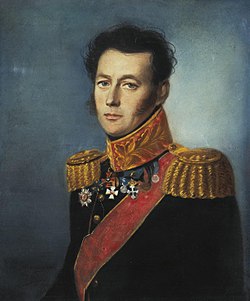 Alleged portrait of I. N. Skobelev (??) | ||||||||||||||||
| Date of Birth | July 2, 1782 | |||||||||||||||
| Place of Birth | Novikovka, Stavropol district of Simbirsk province | |||||||||||||||
| Date of death | February 19 ( March 3 ) 1849 (66 years old) | |||||||||||||||
| Years of service | 1793-1810 1812-1849 | |||||||||||||||
| Rank | general from infantry | |||||||||||||||
| Awards and prizes |
Weapon:
Foreign:
| |||||||||||||||


Biography
Born in the village of Novikovka in the Stavropol district of the Orenburg province . The son of a sergeant-one- palace, Skobelev lost his father early and his childhood passed under the supervision of his mother, a religious woman, in the Orenburg region , in an extremely poor environment. According to some reports, his mother, Tatyana Mikhailovna, came from the noble family of Korevykh, according to others, she was a simple peasant woman who did not even know the letter.
Military
At the age of fourteen, I. N. Skobelev entered the Orenburg 1st Field Battalion (later the 66th Butyrsky Infantry Regiment ) as a soldier and soon attracted the attention of his superiors with his abilities and brisk character: for the 4th year of service, he received the rank of sergeant and transferred to the Orenburg Dragoon Regiment , and then to the Ufa Musketeers ; in the latter, he rose to the rank of officer.
Colonel I.M. Erickson brought him closer to himself, and Ivan Nikitich took part in the formation of the 26th Jaeger Regiment , which in 1807 began military operations in Prussia against Napoleon . Skobelev proved himself in the first battle, distinguishing himself especially in the Battle of Peterswald . After the conclusion of the Tilsit Peace, he participated in the Swedish campaign , for which he was awarded a golden sword with the inscription "for courage" and the Order of St. Vladimir of the 4th degree.
During the campaign, he was first under the command of N. N. Raevsky , and then with two companies a soldier was assigned to the regiment of the hussars Y. P. Kulnev . At the battle of Kirk Kourtan, Skobelev was torn off by two fingers of his right hand, the third one was crushed, and besides, he was heavily shell-shocked in the chest. The wounds received did not prevent, however, Skobelev accept the proposal of N. N. Raevsky to go to the army, operating in Bulgaria against the Turks . In this campaign, Skobelev distinguished himself during the occupation of Silistra and Shumly and received the Order of St. Anne of the 3rd degree.
The wounds and consequences of the concussion bothered him, and in 1810 Ivan Nikitich “was dismissed at the request of the service, injured and mutilated with his uniform and full pay pension” with the rank of captain. He lived in St. Petersburg, where he got a job as a police bailiff. However, civilian life did not last long.
In 1812, Skobelev was appointed captain under the rank of Field Marshal Prince Kutuzov , who soon made him his senior adjutant . Upon the death of his boss, he spent his remains in St. Petersburg , Skobelev again returned to the army. He was especially distinguished by repulsing a sortie of the French garrison from the fortress of Mainz and near Reims . In the latter case, Skobelev managed with his Ryazan regiment to break through the enemy cavalry, which cut him off from the rest of the army, and, at the same time, save the wounded EF Saint-Pry , who was in the hands of Ryazans. For this feat, as well as others, Ivan Nikitich received the Order of St. George 4th degree, then Vladimir 3rd degree, and the Prussian “ pour le mérite ”.
In 1817, Ivan Nikitich Skobelev was promoted to major general . In 1820 he defended the "rebels" of the Semenovsky regiment and for a long time fell into disgrace for his opinion that "the police themselves are not needed in the army."
In 1828 he was promoted to lieutenant general. Over the years, Skobelev was first the commander of the 3rd brigade of the 2nd Grenadier Division, then the general-police chief of the first army. After was the head of the 3rd Infantry Division. But the wounds made themselves felt, and Skobelev went for a cure to a village that was bought shortly.
With the start of the uprising in Poland , Ivan Nikitich was drafted into the army. In March 1831 , commanding the 3rd Brigade of the Grenadier Division and the reserve divisions of the 1st, 2nd and 3rd Corps, he entered the borders of the Kingdom of Poland . This was the last military campaign in the life of Skobelev. In the battle of Minsk, the enemy core crushed his left hand. She had to amputate, and at the time when the doctors performed the operation on him, Skobelev was sitting on the drum and dictating his farewell order on the shelf.
Awarded the Order of St. George of the 3rd degree, Skobelev went to the village, returning from six months later, was appointed responsible for military settlements, then a member of the Auditor General, inspector of reserve infantry in Nizhny Novgorod , after the commandant of the Peter and Paul Fortress , director of the Chesmensky poorhouse and member Committee on the wounded. In 1842, Skobelev received the Order of St. Alexander Nevsky , the following year he was promoted to general from Infantry, granted the badge of immaculate service, a mayor in the Kingdom of Poland , and was appointed chief of the Ryazan Regiment.
Writer
Skobelev was a well-known writer at the time, speaking under the pseudonym " Russian disabled person ". He wrote exclusively on military topics. His works were very popular, especially among the military. According to some reports, he only mastered the letter late by the age of 19, because of this he made many spelling mistakes, which were corrected by his literary friends, for example, N. I. Grech and others.
In 1822-1826, being in some kind of disfavor with his superiors (Skobelev interceded for a soldier of the Semenov regiment ) and being in the position of police general of the first army, he wrote several complaints about A.S. Pushkin . In one of them, he called the poet "helipad" and suggested "tear off a few pieces of skin from him." “Stuck” - so Skobelev described these episodes later.
The first work was published in 1833 [1] - "A gift to comrades, or the correspondence of Russian soldiers in 1812, published by the Russian invalid Ivan Skobelev." The book did not go unnoticed by the public and criticism. The poet I. Verevkin even wrote poems about the publication of the “Gift” in honor of its author (in “ Northern Bee ”, 1833, No. 207 and the same in “ Russian Antiquity ”, 1898, vol. XCVII). Since 1834, the stories of the “Russian invalid” began to appear on the pages of the Library for Reading, which, however, were not completed at that time due to Skobelev’s new appointment, but were subsequently published three times (1838, 1841 and 1844). In 1838, the Conversations of the Russian Disabled or a New Present to Comrades was published.
In 1839, “Letters from Borodin from Armless to Legless Disabled” were published, and in the same year two plays appeared: “Kremnev, a Russian soldier” and “Scenes in Moscow in 1812”, which were put on the stage of the Alexandrinsky Theater , and were staged for many years, including in provincial theaters. The first was particularly successful.
His works were distinguished by rather low artistic merits, so Vissarion Belinsky , despite his friendly and sympathetic attitude to the works of Skobelev, noted that "the works of the" Russian invalid "are not subject to criticism in the scientific sense of the word," but they were quite popular. The reason for the popularity of the works was the perfect knowledge of the Russian soldier, "like the last three fingers on the last hand." His books were distinguished by their original presentation, simplicity and truthfulness.
Ivan Nikitich wrote in a lively common language, using purely soldierly humor, proverbs . “I love the age of my youth,” Skobelev said in one of his stories, “I remember the good, I remember the bad, but, I confess, I do not remember anything better than a Russian soldier.” The whole worldview of Skobelev himself, as he expressed it in his writings and social activities, is filled with a developed sense of religiosity and patriotism , which reached fanaticism .
Despite his employment in military service, Skobelev met with many writers: A. F. Voikov, F. V. Bulgarin , P. A. Pletnev , S. N. Glinka , N. V. Kukolnik and others. I.S. Turgenev after a meeting with the writer-general left his memories:
The well-known Skobelev, the author of Kremnev, remembers all the then residents of St. Petersburg a figure with chopped off fingers, a wrinkled, wrinkled, straight soldier’s face and soldier’s not quite naive grip - in short, in short.
The literary gift and wit left their mark on his business correspondence, orders, etc. An excellent example of this is the “Order of Deserters” and “Orders”, published in a separate book in 1836.
Family
At the end of the 1810s (c. 1818) I. N. Skobelev married Nadezhda Dmitrievna Durova (1793-1838), the daughter of a Vladimir landowner, in Isaeva's first marriage. In his estate Chernysheno (now Duminichi district of Kaluga region) built the Assumption Church .
According to the memoirs of a contemporary, Skobelev “was a prominent, tall, handsome man, a pleasant conversationalist, and his stories from the soldier's and camp life were fascinating. His wife was a rather burly, tall and still beautiful woman, with a fairly good condition. ” Nine children were married, but only two of them survived:
- Dmitry Ivanovich (1821-1879), general.
- Vera Ivanovna (1825-1897), maid of honor, married to K.F. Opochinin since 1840 (1808-1848); their son Fedor , a bibliophile; daughter - Daria was the morganatic wife of E. M. Leuchtenberg ; granddaughter - Countess D.E. Bogarne .
Rewards
Russian Empire:
- Order of St. Anne of the 4th degree (1807);
- Order of St. Vladimir 4th degree (1808);
- Golden sword “For courage” (1808);
- Order of St. Anne of the 3rd degree;
- Order of St. George 4th degree;
- Order of St. Vladimir 3rd degree;
- Order of St. Anne 1st degree (1826);
- Order of St. George 3rd degree (1828);
- Insignia for military dignity of the 2nd degree (1834);
- Order of St. Vladimir , 2nd degree (1834);
- Insignia for XXV years of immaculate service (1835);
- Order of the White Eagle (1835);
- Golden snuff box decorated with diamonds, with a portrait of the Sovereign Emperor (1836);
- Golden snuff box decorated with diamonds, with the monogram of His Imperial Majesty (1837);
- Order of St. Alexander Nevsky (1842).
Foreign countries:
- Prussian Order of Merit (1814);
- Italian Order of the Saints of Mauritius and Lazarus Officer Cross (1815).
Notes
- ↑ according to other sources in 1831
Literature
- Skobelev, Ivan Nikitich // Russian Biographical Dictionary : in 25 volumes. - SPb. - M. , 1896-1918.
- Skobelev I.N. Orders for deserters. 1840-1841 / Communication A. L-d // Russian Archive, 1882. - Book. 2. - Vol. 3. - S. 144-145.
- Skobelev, Ivan Nikitich // Brockhaus and Efron Encyclopedic Dictionary : in 86 volumes (82 volumes and 4 additional). - SPb. , 1890-1907.
- V.A. Ovsyannikov . Stavropol-Togliatti. Pages of history. Part II Cases and people . - Tolyatti : "Contemporary", 1999. - S. 325-334. - 400 p. - 3000 copies. - ISBN 5-85234-100-2 .
- List to the generals by seniority. St. Petersburg, Military Printing House, 1844.
- History of the Ryazan Territory: Ivan Nikitich Skobelev . Date accessed August 10, 2019. Archived December 16, 2012.
- The story "One-armed commandant." Kuprin A.I. , 1923
- COAT OF ARMS SKOBELYOVA (IDENTITY.)