Caribbean spiny shark [1] , or black-bellied etmopterus [2] ( lat. Etmopterus hillianus ) is a species of the genus of black spiny sharks of the family Etmopteridae ( lat. Etmopteridae ) of the cataraiform order . It lives in the Atlantic Ocean at a depth of 695 m. The maximum recorded size is 32 cm [3] . The body is slender, elongated, chocolate-brown, the belly and lower part of the head are black. There are spikes at the base of both dorsal fins. Anal fin absent [4] .
| Caribbean Thorny Shark |
 |
| Scientific classification |
|---|
| No rank : | Bilateral symmetrical |
| Gender: | Black Spiky Sharks |
| View: | Caribbean Thorny Shark |
|
| International scientific name |
|---|
Etmopterus granulosusi ( Poey , 1861 ) |
| Synonyms |
|---|
Spinax hillianus Poey, 1861 |
| Area |
|---|
|
| Security status |
|---|
Least ConcernedIUCN 3.1 Least Concern : 60239 |
|
Content
The species was first described in 1861 by the Cuban zoologist Philip Poey [5] . The holotype is an allegedly adult female 26.9 cm long, caught off the coast of Havana , Cuba [4] . The species is named after Richard Hill (1795–1872), an agitator who opposed slavery in Jamaica , a judge, and a naturalist who corresponded with Poey [3] .
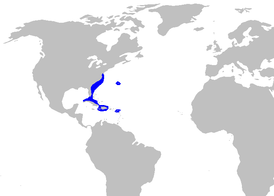
Caribbean prickly sharks live in the northwest and west-central Atlantic Ocean off the coast of Anguilla , the Bahamas , Cuba , the Dominican Republic , Haiti , St. Kitts and Nevis , the United States and the Virgin Islands . These sharks are found on the island and mainland slopes at a depth of 311 to 695 m. They prefer a sandy bottom [4] .
The maximum registered size is 32 cm, the average length is about 25 cm. The body is elongated, slender, with a long tail. Large oval eyes are elongated horizontally. Behind the eyes are tiny splatter . The distance from the beginning of the base of the ventral fins to the imaginary vertical drawn through the base of the lower lobe of the caudal fin is approximately equal to the distance from the tip of the snout to the second branchial fissure, 1.3 times the distance between the bases of the pectoral and ventral fins and approximately equal to the distance between the dorsal fins. In adult sharks, the distance between the bases of the pectoral and ventral fins is quite substantial and 1.2 times the length of the head. The distance from the snout tip to the first dorsal spine is approximately equal to the distance between the first dorsal spine and the beginning of the base of the second dorsal fin. The width of the head is equal to the distance from the tip of the snout to the mouth, about 1.5 times the distance from the sprayer to the base of the pectoral fins. The base of the first dorsal fin is closer to the pectoral fins. Gill slits are very short, equal in width to sprinklers and are 1/3 or less of the length of the eye. The upper teeth are equipped with three or less pairs of teeth. The distance between the dorsal fins is slightly less than the distance between the tip of the snout and the third branchial fissure. The body is loosely covered with chaotically arranged posterior conical scales with teeth. On the sides, they form regular longitudinal rows.
The nostrils are placed on the tip of the snout. Corrugated spikes are located at the base of both dorsal fins. The second dorsal fin and spine are larger than the first. The pectoral fins are small and rounded. The color on top is chocolate brown, the lower part of the head and belly are black, the color border is sharp. Above the abdominal fin and behind it there is a short black mark [4] .
Caribbean prickly sharks breed by egg-laying. In the litter of 4-5 newborns with a length of about 9 cm. Males and females reach puberty with a length of 25-57 cm and 30 cm, respectively.
The species is not subject to commercial fishing. Sometimes by-catch is caught in deep-sea nets. Caught sharks are probably thrown overboard. The International Union for Conservation of Nature has assigned this species a conservation status of “Least Concerns” [6] .
- ↑ Reshetnikov Yu.S. , Kotlyar A.N. , Russ T.S. , Shatunovsky M.I. Fish. Latin, Russian, English, German, French. / edited by Acad. V. E. Sokolova . - M .: Rus. Yaz., 1989 .-- S. 35 .-- 12,500 copies. - ISBN 5-200-00237-0 .
- ↑ Gubanov E.P., Kondyurin V.V., Myagkov N.A. Sharks of the World Ocean: A Guide-Guide. - M .: Agropromizdat, 1986. - S. 200. - 272 p.
- ↑ 1 2 Compagno, LJV & Ebert, DA & Smale, MJ Guide to the sharks and rays of Southern Africa. - London: New Holland, 1989 .-- 158 p. - ISBN 1853680656 .
- ↑ 1 2 3 4 Compagno, Leonard JV 1. Hexanchiformes to Lamniformes // FAO species catalog. - Rome: Food and Agricultural Organization of the United Nations, 1984. - Vol. 4. Sharks of the World: An Annotated and Illustrated Catalog of Shark Species Known to Date. - P. 78. - ISBN 92-5-101384-5 .
- ↑ Poey, F. (1858) Memorias sobra la historia natural de la Isla de Cuba, acompañadas de sumarios Latinos y extractos en Francés. Tomo 2. La Habana. Vluda de Barcina, Havana, 2: 1-442, pls 1-19
- ↑ Herndon, AP & Burgess, GH 2006. Etmopterus hillianus . In: IUCN 2012. IUCN Red List of Threatened Species. Version 2012.2. <www.iucnredlist.org>