Hugo IV de Lusignan ( fr. Hugues IV de Lusignan , d. Approx. 1025/1032 ), nicknamed Brown ( fr. Le Brun ) - Senior de Lusignan from approx. 1012 , Senor de Cue, son of Hugo III the White , Senor de Lusignan, and Arsenda de Vivon.
| Hugo IV Brown | |||||||
|---|---|---|---|---|---|---|---|
| fr. Hugues IV le Brun | |||||||
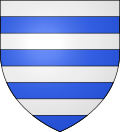 Coat of arms of Luzinyanov | |||||||
| |||||||
| Predecessor | Hugo III White | ||||||
| Successor | Hugo V the Pious | ||||||
| Birth | |||||||
| Death | OK. 1025/1032 | ||||||
| Kind | Lusignan | ||||||
| Father | Hugo III White | ||||||
| Mother | Arsenda de Vivon | ||||||
| Spouse | Odegard | ||||||
| Children | Hugo V the Pious , Rorgon, Renault | ||||||
Content
Biography
Constantly fought with his neighbors - the Viscounts de Tuar , Emery I de Rankon and Bernard I , Count de La March . Marrying the daughter of Raul I de Tuar Odearda (Aldiard, Adalard), he received a castle as a dowry by the Museum, which he added to the ones he already had: Lusignan , built by his grandfather Hugo II the Good , and Cue, received from the Duke of Aquitaine. However, after Raoul’s death, his successor Geoffrey de Tuar was again captured by the Museum.
He waged a long war with Emery I de Rankon, who seized Senor Sivre from the Count de La March. Joining forces with Guillaume V of Aquitaine and Bernard de La Marsh, Hugo seized this possession from Emery and received it as a fief , however, he soon lost it again. He tried to get investment from his lord the duke of Aquitaine for the Viscountry of Chatellerault , but Guillaume V escaped with vague promises. Having quarreled with the duke, Hugo IV tried to seize the lord Vivon, who at one time belonged to his uncle Joslen de Lusignan, who died in 1015 childless. Guillaume V in response took from Lusignan the proceeds from the Saint-Mexain Abbey, which the mother of the duke Emma had once granted to Hugo's father.
In 1024/1025, he exchanged one of his villages for a plot of land near the Lusignan castle, owned by the Abbey of Saint-Hilaire-de-Poitiers, and began on this site the construction of the Notre-Dame de Lusignan priority. The Duke of Aquitaine received two charters from King Robert II for the founding of the Hugo monasteries in Lusignan and Cue (Saint-Martin-de-Cue), and Hugo, along with Isambard, Bishop of Poitiers, obtained immunity from Pope John XIX [1] for the mansions founded by him .
Hugo also reconciled with the Duke of Aquitaine in 1024/1025 by signing a treaty ( Conventum inter Guillelmum ducem Aquitaniae et Hugonem Chiliarchum ), a wonderful example of feudal law, prescribing the mutual obligations of the lord and vassal. According to researchers, the compilers of this document advised St. Fulbert of Chartres .
Marriage and children
Wife: Odegard . Its exact origin is unknown, but probably it was related to the Shabann family [2] , according to another it was the daughter of Raul I de Tuar [3] . Children:
- Hugo V the Pious (d. Oct. 8, 1060), seigneur de Lusignan from 1025/1032
- Rorgon (d. After 1043/1048), monk at the Monastery of Saint-Cyprian in Poitiers
- (?) Renault (d. After 1029)
Notes
- ↑ The so-called exemptio (exemption) - exemption from the jurisdiction of local church authorities and subordination directly to the pope.
- ↑ Sires de Lusignan (English) . Foundation for Medieval Genealogy. Date of treatment June 14, 2013. Archived on April 9, 2012.
- ↑ Hugo IV. le Brun Graf von Lusignan (German) . Mittelalterliche Genealogie im Deutschen Reich bis zum Ende der Staufer. Date of treatment June 14, 2013.
Literature
- Painter Sidney. The Lords of Lusignan in the Eleventh and Twelfth Centuries // Speculum. - Jan., 1957. - T. 32 , No. 1 . - P. 27–47.
Links
- Sires de Lusignan (English) . Foundation for Medieval Genealogy. Date of treatment June 14, 2013. Archived on April 9, 2012.
- Hugo IV. le Brun Graf von Lusignan (German) . Mittelalterliche Genealogie im Deutschen Reich bis zum Ende der Staufer. Date of treatment June 14, 2013.
- LUSIGNAN (Fr.) . Date of treatment June 14, 2013. Archived June 15, 2013.