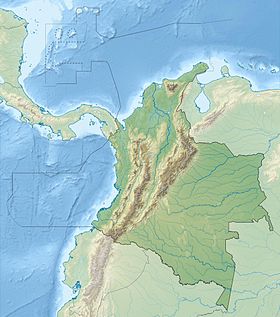
Gorgona ( Spanish: Isla Gorgona ) is an island of volcanic origin in the Pacific Ocean . Belongs to Colombia , administratively belongs to the Department of Cauca . Since 1985, the whole island with the surrounding water area has been a national natural park of the same name.
| Gorgon | |
|---|---|
| Spanish Isla gorgona | |
 | |
| Specifications | |
| Square | 26 km² |
| Highest point | 338 m |
| Population | 0 pax (2012) |
| Location | |
| Water area | Pacific Ocean |
| A country |
|
| The Department | Cauca |



Geography

The island is located 26 kilometers from the mainland. Length - 8.5 km, width - 2.3 km (in the widest part), area - 26 km². The highest point of the Gorgon is Mount Cerro La Trinidad (338 meters [1] ). The eastern part of the island is shallow, it has several beaches with white sand, the western - steep and rocky [1] . A little southwest of the Gorgon is its “satellite” - Gorgonilla Island [1] (size - 1.4 by 0.4 km, area - 0.5 km², the highest point - 90 meters). Gorgon is separated from Gorgonilla by the narrow Strait of Task . Before the earthquake of March 31, 1983 at low tide it was possible to cross from one island to another ford, but now the strait has deepened. Not far from Gorgonilla, several rocks rise from the water [1] , the most famous of which is called El Viudo (“Widower”).
Climate
The average annual air temperature is 27 ° С, humidity - 90% [2] . Frequent rains and fogs, precipitation are about 6700 mm per year. The rainiest months are September and October, and the driest months are February and March [2] . The water temperature off the coast is from 23 ° C at a depth of 25 meters to 27 ° C on the surface.
Fauna
Due to its isolation from the mainland for millions of years, rare species of animals and plants are found on the island, many of which are Gorgon endemic . There are 17 species of mammals, 155 species of birds (including 75 - migratory), 41 species of reptiles (including 12 - snakes)
- Deadly Venomous Snakes
- two species of
- Weak and poisonous snakes
- Common boa
- Mussurana
- Bezhuk
- Mexican Pointed Snake
- Mammals
- Capuchin
- Brown-throated sloth
- Soft-needle bristled rat
- Central American Agouti
- More than a dozen species of bats
- Birds
- Shrike Ant
- Banana singer
- Turquoise Tanagra Medosos
- Blue-footed booby
- American brown pelican
- Magnificent frigate
- Brown booby
- Other animals
- Anolis-gorgon - a lizard that is on the verge of extinction due to the appearance on the island of an enemy - crested basilisk
- Elegant Harlequin - Toad Endangered [3]
- Every year, in June-October, during the seasonal migrations, humpback whales pass by the island.
History
On the island, the remains of human settlements dating from the 13th century BC [4] , in particular, petroglyphs [5], were found . In 1524, the European's foot first set foot on Gorgon - the Spanish conquistador Diego de Almagro , who named the island of San Felipe, is considered the discoverer. Three years later, another conquistador Francisco Pizarro escaped from the Indians on the island with his detachment of 13 people. They spent seven months on the island, waiting for help and provisions, and during this time more than half of the detachment died from the bites of numerous poisonous snakes - therefore Pizarro gave the island its current name, referring to the famous Gorgon Medusa [6] .
In 1679, an English pirate Bartholomew Sharp lived on the island for more than a month, in 1709 another pirate, Roger Woods, was saved on it. In general, due to the abundance of fresh water and good wood, the island regularly served as an intermediate stop for ships traveling from Panama to Peru and back.
In the 1820s, Simon Bolivar presented the island to one of his commanders, Federico D'Cross, as a sign of his merits in the . By 1870, a small community of mestizos living on fishing lived on the island. Around those years, a certain Ramon Ryan bought part of the island from the heirs of D'Cros, and soon the first Hacienda appeared on Gorgon, which, however, did not last long, since it was destroyed in the very first year of the Thousand-Day War .
The first half of the XX century Gorgon was practically not inhabited. In 1959, the island was transformed into a maximum security prison [7] , where mainly murderers and rapists were kept. The prison was organized in the likeness of Nazi concentration camps : the prisoners slept without mattresses and pillows, the bathrooms were ordinary holes in the floor. Escape was hindered by numerous poisonous snakes on the ground and sharks in the ocean. Nevertheless, one successful escape from this prison was still committed. Serial killer Daniel Camargo Barbosa , sentenced to 25 years, left the island on September 24, 1984, constructing a small raft. The next day, he landed on the continent, while at first the authorities of Colombia announced that Camargo had died in the ocean. Immediately taking up “the old,” Camargo killed and raped 71 girls in Ecuador in a year and a half before being caught by police in Quito . The second time he was sentenced to 16 years in prison, but was killed by a cellmate in 1994. Immediately after the escape of Camargo, the prison was closed, now its buildings are densely covered with vegetation of the jungle and almost indistinguishable [6] .
Soon after these events, the island was declared a national natural park. Its area (together with the adjacent water area) is 619.8 km². There is no permanent population on Gorgon, only employees and guests of the park; a hotel and restaurant have been built, the maximum simultaneous stay on the island of more than 70 guests is not yet possible, another hotel is being built for 50 guests [4] . "Wild" campsites are forbidden, because of snakes you cannot walk without high boots anywhere except your room and beach.
Gallery
The Rock of El Viudo (The Widower)
Rock of El Horno
Anorgis-gorgon - the endangered endemic of the Gorgon
- the island's most dangerous snake
Notes
- ↑ 1 2 3 4 Gorgon Island (English) on coastal.er.usgs.gov
- ↑ 1 2 Gorgona Island, ecological paradise of Colombia (inaccessible link) . Archived April 23, 2012. on mantarayatravel.com
- ↑ Fritz Nieden: Anura II. In: FE Schulze, W. Kükenthal, K. Heider (Hrsg.): Das Tierreich, Walter de Gruyter & Co., Berlin und Leipzig 1926, S. 83-84.
- ↑ 1 2 Gorgon Island (Spanish) (unavailable link) . Archived January 3, 2012. on colparques.net
- ↑ Petroglifos en la isla Gorgona (Pacífico colombiano) (Unavailable link) . Date of treatment June 12, 2013. Archived March 25, 2015. (Spanish) on rupestreweb.info
- ↑ 1 2 Our Colombian beaches see I know them on the site playasdecolombia-colombia.ru
- ↑ Gorgon Island on paisatours.com
Links
- Gorgon National Natural Park (Spanish) (unavailable link) . Archived January 24, 2013. on parquesnacionales.gov.co
- Gorgon Island (Spanish) (inaccessible link) . Archived on November 16, 2013. on colparques.net
- Gorgon Island and its ecosystems (Spanish) at banrepcultural.org
- List of animal species found on the island (Spanish) on uky.edu
- Diving on the island (English) (inaccessible link) . Archived July 13, 2013. at pacific-diving.com
- Gorgon island (rus.) On the site latino-america.ru
- Environmental issues (at aupec.univalle.edu.co (Spanish) ):
- En Gorgona: Contaminación por petróleo , March 18, 1998
- En Gorgona, riqueza en peligro , March 20, 1998
- En Gorgona: Monitoreo biológico por contaminación , April 16, 1998