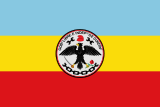
The Free and Independent State of Kundinamarca ( Spanish: Estado Libre e Independiente de Cundinamarca ) - a state that existed in South America in 1811-1814.
| Historical state | |||||
| Free and Independent State of Kundinamarka | |||||
|---|---|---|---|---|---|
| Estado Libre e Independiente de Cundinamarca | |||||
| |||||
 The capital province in 1810. | |||||
←   → →1811 - 1814 | |||||
| Capital | Bogota | ||||
| Languages) | Spanish | ||||
| Currency unit | Spanish Colonial Real | ||||

History
Proclamation of independence from Spain
In 1808, Napoleon forced Charles IV and Ferdinand VII to abdicate the Spanish throne, and made his brother Joseph king of Spain. However, this led to a popular uprising , resulting in a protracted war . The Royal Supreme Council of Castile declared the royal abdication to be void, and the Central Supreme Ruling Junta of the Kingdom was declared the bearer of the highest power in the country. On January 29, 1810, the Junta self-dissolved, transferring power to the Regent Council of Spain and India.
In the spring of 1810, South America received news of the self-dissolution of the Central Junta and the creation of the Regent Council. In response to this, juntas began to form on the ground, declaring their non-recognition of the Regency Council. On May 10, the Junta was formed in Cartagena de Indias , July 3 - in Santiago de Cali , July 4 - in Pamplona , July 9 - in Socorro . On July 20, in the capital of the Viceroyalty Kingdom of New Granada, Santa Fe de Bogota, the Supreme People's Junta of New Granada was elected at an open public meeting, which on July 26 announced the non-recognition of the Regency Council.
Independent State
The junta in Bogota, in spite of its name, controlled only the city; many local juntas did not want to submit to the former capital of the vice kingdom. Then, in the province of Cundinamarca, which included Santa Fe de Bogota, the provincial Constitutional Assembly was assembled, electing Jorge Tadeo Lozano as president of the province. The constitution declared the independence of Cundinamarca, but formally recognized the Spanish king as a monarch, rejecting his representatives in the person of vice-kings.
Soon, power in Cundinamarca passed to Antonio Narinho . He defended the idea of creating a strong centralized power in New Granada, but most other provinces did not want to return to Bogotá, and those who chose the path to independence preferred to see the state as federal rather than centralized. The “federalists” united in the United Provinces of New Granada , while Kundinamarca remained independent and began to expand. In 1811, Kundinamarca annexed the province of Marikita and part of the Neiva province, which led to the first civil war in Colombian history .
On July 19, 1813, Kundinamarca declared complete independence from Spain, and signed an agreement with the United Provinces on a common struggle against Spain. Narinho went south with the combined army, but was captured by the royalists. Taking advantage of the situation, the United Provinces sent an army to Kundinamarka , led by Simon Bolivar , who took Bogotá on December 10, 1814 and put an end to the independence of Kundinamarka, joining the United Provinces.