Crested Tooth Black Shark [1] ( lat. Etmopterus decacuspidatus ) is a species of the genus of black spiny sharks of the family Etmopteridae of the cataract- like order .
| Toothless Black Shark |
| Scientific classification |
|---|
| No rank : | Bilateral symmetrical |
| Gender: | Black Spiky Sharks |
| View: | Toothless Black Shark |
|
| International scientific name |
|---|
Etmopterus decacuspidatus ( WLY Chan , 1966) |
| Area |
|---|
|
| Security status |
|---|
Not enough data IUCN Data Deficient : 161585 |
|
Known for only one individual, recognized as a holotype . It lives in the western part of the Pacific Ocean at depths up to 692 m. The maximum recorded size is 29 cm. The body is slender, elongated. There are spikes at the base of both dorsal fins. Anal fin absent [2] [3] .
Content
The species was first described in 1966 [2] . The holotype is an adult male 29.2 cm long, caught off Hainan Island (16 ° 40.5 'N and 109 ° 49.9' E) at a depth of 512–691 m [4] . The specific name comes from the words dr. Greek. δεκάς - “ten” and lat. cuspis is the "tip" [5] [6] .
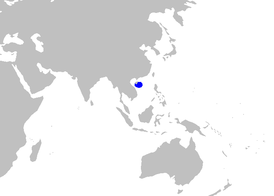
Black-toothed black sharks live in the western Pacific Ocean, in the South China Sea , between Hainan Island and Vietnam at a depth of 512–691 m.
The maximum registered size is 29 cm. The body is slim, elongated. The caudal peduncle is rather short. There are spikes at the base of the dorsal fins. The second dorsal fin is larger than the first. The pectoral fins are small and rounded. Large oval eyes are elongated horizontally. Behind the eyes there are splashes . The distance from the beginning of the base of the ventral fins to the beginning of the lower lobe of the caudal fin is approximately equal to the length of the head, 1.2 times the distance between the pectoral and ventral fins and the distance between the dorsal fins. The distance between the ventral and pectoral fins is 1.2 times the width of the head.
The distance from the snout tip to the first dorsal spine slightly exceeds the distance from the first dorsal spine to the base of the second dorsal fin. The width of the head is 1.4 times the distance from the tip of the snout to the mouth. The distance from the tip of the snout to the sprayer is 1.4 times the distance from the sprayer to the base of the pectoral fins. Gill slits are very short, approximately equal in width to sprinklers and make up 1/3 or less of eye length. The base of the first dorsal fin begins slightly behind the free tip of the pectoral fins. The distance between the dorsal fins is approximately equal to the distance from the tip of the muzzle to 3 pairs of gill slits. The color on top is brown, the lower part of the head and belly are black, the border between the flowers is clear. Before and behind the ventral fins, as well as at the base of the caudal fin, there is an elongated mark [3] .
The upper teeth are arranged in 3 rows. Each tooth of the front row has 10 notches, of which the third on the inside is the longest. The lower teeth are lined up in a row [2] .
Currently, only one individual of this species has been caught. There is insufficient data to evaluate the conservation status of the species by the International Union for Conservation of Nature [7] .
- ↑ Reshetnikov Yu.S. , Kotlyar A.N. , Russ T.S. , Shatunovsky M.I. The Bilingual Dictionary of Animal Names. Fish. Latin, Russian, English, German, French. / edited by Acad. V. E. Sokolova . - M .: Rus. Yaz., 1989 .-- S. 35 .-- 12,500 copies. - ISBN 5-200-00237-0 .
- ↑ 1 2 3 Chan, WL New sharks from the South China Sea // Journal of Zoology. - 1966. - Vol. 146, No. 2 . - P. 218-237.
- ↑ 1 2 Compagno, Leonard JV 1. Hexanchiformes to Lamniformes // FAO species catalog. - Rome: Food and Agricultural Organization of the United Nations, 1984. - Vol. 4. Sharks of the World: An Annotated and Illustrated Catalog of Shark Species Known to Date. - P. 75. - ISBN 92-5-101384-5 .
- ↑ Etmopterus decacuspidatus (neopr.) . Shark-References.com. Date of treatment May 17, 2013. Archived May 22, 2013.
- ↑ [slovarus.info/grk.php The Great Ancient Greek Dictionary] (neopr.) . Date of treatment February 21, 2013.
- ↑ My etymology. A universal etymology dictionary (neopr.) . Date of treatment March 21, 2013. Archived on April 9, 2013.
- ↑ McCormack, C. 2009. Etmopterus decacuspidatus . In: IUCN 2012. IUCN Red List of Threatened Species. Version 2012.2. <www.iucnredlist.org>.
