
The 18th century was the time of the rapid and rapid growth of London, which was facilitated by the increase in the country's population, the beginnings of the Industrial Revolution and the role of London as the center of the developing British Empire .
In 1707, the Act was passed, combining the Scottish and English parliaments, resulting in the formation of the Kingdom of Great Britain . A year later, in 1708, St. Paul's Cathedral , a work of Christopher Wren , celebrated his birthday; however, the first service was held on December 2, 1697, that is, more than 10 years earlier. The building replaced the original St. Paul's Cathedral, completely destroyed during the Great Fire of London . The cathedral is considered one of the best examples of baroque architecture in the UK [1] .

In the Georgian era, London spread rapidly beyond its former borders. In the West End, new neighborhoods were built for wealthy citizens such as Mayfair , and new bridges across the Thames accelerated the development of South London and the East End, while the Port of London also expanded downstream. The uprising of the American colonies dates back to the same time. In 1780, the American (the only president of the Continental Congress Henry Lawrence ) was imprisoned in the Tower (the only one during its existence). In 1779, on behalf of Congress, he sought in Holland the support of the revolution. On the way back to America, was captured by the Royal Navy and charged with high treason. He was released from prison on December 21, 1781 in exchange for Charles Cornwallis .
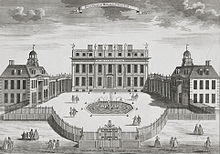
In 1762, George III purchased the Buckingham Palace from the Duke of Buckingham. Over the next 75 years, it was expanded by several architects, but John Nash did the bulk of the work. However, the palace became a permanent royal residence only in the 19th century, which was not originally intended [2] .

In the 18th century, cafes spread in London, which became a popular place for discussing various political and creative ideas. Increased literacy and the spread of printing presses made the rapid dissemination of news more accessible. For a century, the center where the London press was born was Fleet Street [3] .
In the eighteenth century, the effectiveness of the crime investigation system increased ; in 1750 a professional police force was created - Bow Street Runnerss . The punishment for the crimes was quite severe, and the death penalty was awarded even for minor misconduct. In London, public hangings were widespread, which were popular and gathered crowds of people.
In 1780, London shocked Lord Gordon 's Revolt, a Protestant uprising against the increase of Catholic public rights, led by George Gordon . The Catholic churches and parishioners' homes suffered severe damage; after the suppression of the riot, 285 people were executed.
Until 1750, the only bridge across the Thames was the London Bridge , but that year the Westminster Bridge was opened, which, in a sense, became a rival to the London Bridge.
In the XVIII century there was a separation of the American colonies from Great Britain, as well as a number of other tragic events, which, along with the Enlightenment, changed the lives of citizens by the XIX century.
Notes
- ↑ Welcome to St Paul's Cathedral, London
- ↑ http://www.royal.gov.uk/output/page555.asp Buckingham Palace - official page.
- ↑ Fleet Street's finest . Christopher Hitchens, The Guardian Review. December 3, 2005.
Bibliography
- John Trusler Neopr (1790). Date of treatment June 11, 2013. Archived June 11, 2013.
- Pennant, Thomas Of London . Date of treatment June 11, 2013. Archived June 11, 2013.