Northern one-feather rasp [1] ( lat. Pleurogrammus monopterygius ) is a marine species of fish of the rasp family ( Hexagrammidae ). Distributed in the northern part of the Pacific Ocean . Valuable fishing facility .
| Northern one-rasp |
 |
| Scientific classification |
|---|
| No rank : | Bilateral symmetric |
| Superfamily : | Terraces ( Hexagrammoidea ) |
|
| International Scientific Name |
|---|
Pleurogrammus monopterygius Pallas , 1810 |
|
Content
Distributed in the northern part of the Pacific Ocean. Along the Asian coast - from the southern Kuril Islands along the eastern coast of Kamchatka to the Anadyr Bay and Cape Navarin in the Bering Sea . It is found in the northern part of the Sea of Japan , in the Sea of Okhotsk and at the Commander Islands . Along the American coast - from the Aleutian Islands and the Gulf of Alaska to California [2] .
The maximum body length is 56.5 cm, body weight - up to 2 kg [3] . The maximum life expectancy is 15 years [4] .
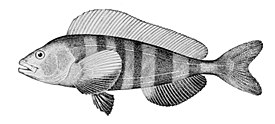
The body is elongated, somewhat compressed laterally. The dorsal fin is one long, with 21 rigid, unbranched rays and 25–29 soft rays, the prickly and soft parts are not separated by a notch. In the anal fin there are 1 prickly and 24-26 soft rays. Five side lines run along the sides of the body. Between the 3rd and 5th lateral lines 7–9 scales. In the second lateral line, 143–162 pores. The third lateral line is short, does not reach the end of the anal fin; The 4th lateral line is also short, does not extend beyond the vertical end of the pectoral fin. The first and fifth lateral lines diverge on the caudal stem and again converge in front of the caudal fin. The vertebrae are 59-60. The mouth is final. The back is dark olive in color; Dark stripes are brownish-olive in color, light - from golden yellow to reddish-orange with a copper tint. The dorsal fin is high gray with a narrow black border. The underside of the head and abdomen are yellow.
Males first mature at the age of 4-5 years, females at the age of 5 years. Spawning periods vary depending on the area of habitat: June — September (eastern coast of Kamchatka and the northern Kuril Islands), May — August (Commander and Aleutian Islands), November (Alaska Bay). Portion spawning, females can lay 3-4 laying eggs (up to 12). Fertility is from five to 120 thousand eggs [1] .
Caviar bottom, sticky, is deposited at a depth of up to 20 m in large portions in crevices of rocky or rocky soil. The male protects the clutch for 30-45 days before hatching of the larvae. Larvae and juveniles lead a pelagic lifestyle and are carried by ocean currents over considerable distances. At the age of 2 years, they come closer to the shores and move to a near-bottom lifestyle.
Daily northern migrations are characterized by daily vertical migrations.
Juveniles and adults feed on zooplankton , primarily euphausids . The diet may include benthic organisms and fish roe, including their own. Large individuals also consume juvenile fish, for example, pollock ( Theragra chalcogramma ).
Fishing is conducted by the USA and Russia . The maximum US catch was recorded in 1996 - 88 thousand tons [1] .
In Russia, fishery statistics are compiled for both types of common rasp (northern and southern ). In 1995-1999 About 60–70% of the total catch was the northern one-feathered rasp, in 2000-2001. its share in the total catch fell to 50% due to the rapid growth of stocks of southern one-feathered rasp. They are mined by bottom trawls near eastern Kamchatka and the northern Kuril Islands [5] .
Russian catches of odnoporodny rasp| Year | 1998 | 1999 | 2000 | 2001 | 2002 | 2003 | 2004 | 2005 |
| Catch, thousand tons | 40.9 | 40.3 | 52.8 | 49.2 | 55,6 | 60.8 | 49.0 | 44.5 |
