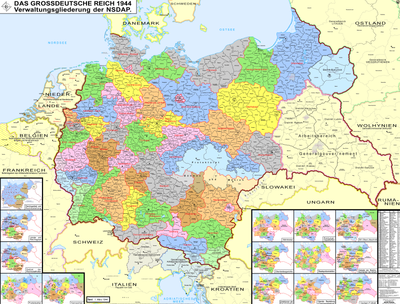
Białystok District ( German: Bezirk Bialystok ) is a territorial-administrative unit of the Third Reich , created in 1941 in the occupied territory of the Soviet Union during the Second World War. The district was located southeast of the province of East Prussia and included the territories of today's northern Poland and the border territories of today's Belarus. The district was under German civil administration until 1945, but was not formally included in the German Empire. After the war, the bulk of the region returned to Poland. The area of the district was 31,426 km².
Content
History
The territories of the Bialystok region (today included in the Republic of Poland) in 1941 were part of the Byelorussian SSR , which was part of the USSR . These territories were annexed to the BSSR according to the results of the Polish campaign of the Red Army of 1939 , as part of western Belarus .
The Third Reich planned to include these lands in its composition, based on the historical claims of Prussia arising from the conditions established by treaties between Prussia , Russia and the Austrian Empire according to the third partition of Poland , which transferred Bialystok to Prussia . From 1795 to 1806, this territory was part of New East Prussia .
After the attack of Nazi Germany on the USSR on June 22, 1941, these border territories were among the first to be captured by the German Wehrmacht. The special Bialystok district was created on July 22, 1941 in connection with the formation of the German civil administration in Bialystok region. She replaced the military occupation authorities operating in this territory since the capture. The administration was headed by Gauleiters surrounded by SS men of East Prussia [1] .
After the start of Operation Barbarossa in Bialystok County, 379 people were exterminated, 30 villages were destroyed and 640 houses and 1385 industrial buildings were burned to intimidate [2]
The first decree to implement civil administration plans in these newly occupied eastern territories was issued on July 17, 1941. The boundaries of this region lay southeast of the ledge of East Prussia not far from ( the Suwalki triangle ), following the Nemunas river and the cities of Western Belarus, except for the Grodno region , including the Pruzhany district , but also the Bug , located west of Brest district , and then passing by the borders of the Governor General and East Prussia.
Since the creation of the district in July 1941, an intensive Germanization of the population was carried out. On August 1, 1941, the Bialystok District was declared part of the Reich, becoming part of the Gau East Prussia.
After the start of Operation Bagration at the end of June 1944, the front quickly moved back to the eastern borders of the Reich, and already on July 16 of that year, troops of the 2nd Belorussian Front entered the territory of the Bialystok District and were actually the first to reach the borders of Germany.
The completely former territory of the district was liberated by August 1944. As a result of the military operation, the district virtually ceased to exist.
Administrative structure
The special Białystok district was divided into eight district administrative units called “military control areas” ( German kreiskommissariate , Polish komisariatów powiatowych ):
- Bialystok (District Commissariat Nikolaus);
- Bielsk Podlaski (District Commissariat Tubenthal);
- Graevsky (district commissariat Pyachor, then Knispel);
- Grodno (district commissariat Ploetz);
- Lomzhinsky (district commissariat Greben);
- Sokolsky (district commissar Zeiler);
- Volkovysk (District Commissioner Pfeiffer);
- Białystok city (district commissariat Bialystok).
On August 1, 1941, Erich Koch was appointed "civil commissar" ( German: Zivilkommissar ), and then served as head of the civil administration ( German: Chef der Zivilverwaltung ) in Białystok until July 27, 1944. During this period, he was a Gauleiter of East Prussia and the Reich Commissioner of Ukraine [3] . In practice, his functions were performed by his permanent deputy; from August 15, 1941 to January 31, 1942, he was the head of the NSDAP branch in Koenigsberg, Waldemar Magunia , from February 1, 1942 to July 27, 1944, Frederick de Brich , also a landrat (head of the district ; ( German: Landratsamt ) in Tilsit .
However, the Białystok district was not directly included in East Prussia, although it was likely to be a part of it in the future. On July 16, 1941, Hitler at a secret conference with Goering , Keitel , Lammers and Alfred Rosenberg promised to include this district in the Third Reich [4] . The only real difference was the border between them. To cross it, it was necessary to obtain permission. The borders of customs control were removed in November 1941 [5] .
Demographics
At the time of its formation, Bialystok County had a population of 1,383,000 inhabitants. Of these, 830,000 were Poles , 300,000 were Belarusians , 200,000 were Ukrainians , 50,000 were Jews and 3,000 were Germans .
Pogrom in Edwabna
Between the seizure of the region by the Wehrmacht and the formation of a civil administration in the town of Edvabne, Bialystok region of the BSSR, local Poles massacred their Jewish neighbors ( pogrom in Edvabna ). According to various estimates, from 340-350 to 1,600 people were killed during the pogrom, some of them were burned alive. Further investigations undertaken in Poland showed that Edvabne was not an isolated case [6] . In 2001, Polish President Alexander Kwasniewski formally apologized to the Jewish people for this crime.
Notes
- ↑ encyclopediya_3go_reicha.academic.ru
- ↑ Markevich M. Hitler’s repressions against the Belostotsk village. Bulletin of the Institute of National Memory . T. 121.P. 65-68.
- ↑ Datner S. German occupational security apparatus in Białystok district (1941-1944) in the light of German materials (study of Waldemar Maholla). Bulletin of the Institute of National Memory . T. XV. S. 7.
- ↑ Mozhaisk, “The Politics of the Third Reich” in Occupied Poland, vol. 1., Warsaw 1970, p. 132, 138.
- ↑ Mozhaisk, “Third Reich Politics” in Occupied Poland, t. 1., Warsaw 1970, p. 212
- ↑ It was only the beginning of the "Central Jewish Resource SEM40. Israel, Middle East, Jews
Literature
- Vestnik IPP, No. 35-36 (12 / 2003-1 / 2004) - ISSN [//www.worldcat.org/search?fq=x0:jrnl&q=n2:1641-9561 1641-9561]
- Gnatowski M. "Bialystok group of partisan detachments." Bialystok, 1994.