In the statement of the theorem {\ displaystyle \ lambda _ {k}} - characteristic numbers of the core {\ displaystyle K (t, s)} , {\ displaystyle f_ {k} = (f, \ phi _ {k})} - Fourier coefficients of the function {\ displaystyle f (t)} regarding eigenfunctions {\ displaystyle \ phi _ {n} (t)} of this kernel: {\ displaystyle \ phi _ {n} (t) = \ lambda _ {n} \ int \ limits _ {a} ^ {b} K (t, s) \ phi _ {n} (s) ds} . Symmetric core {\ displaystyle K (t, s)} called closed in {\ displaystyle L_ {2} [a, b]} if each function {\ displaystyle \ sigma (t) \ in L_ {2} [a, b]} satisfying equality {\ displaystyle \ int \ limits _ {a} ^ {b} K (t, s) \ sigma (s) ds = 0} vanishes almost everywhere on the segment {\ displaystyle [a, b]} . For a closed core, its eigenfunctions form an orthogonal complete {\ displaystyle L_ {2} [a, b]} system of functions.
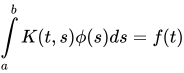
Suppose there is a solution {\ displaystyle \ phi (t) \ in L_ {2} [a, b]} equations {\ displaystyle \ int \ limits _ {a} ^ {b} K (t, s) \ phi (s) ds = f (t)} .
Find the Fourier coefficients of the function {\ displaystyle f (t)} regarding eigenfunctions {\ displaystyle \ phi _ {n} (t)} of this kernel: {\ displaystyle f_ {n} = \ int \ limits _ {a} ^ {b} f (t) \ phi _ {n} (t) dt = \ int \ limits _ {a} ^ {b} \ left \ {\ int \ limits _ {a} ^ {b} K (t, s) \ phi (s) ds \ right \} \ phi _ {n} (t) dt = \ int \ limits _ {a} ^ { b} \ left \ {\ int \ limits _ {a} ^ {b} K (t, s) \ phi _ {n} (t) dt \ right \} \ phi (s) ds = {\ frac {1 } {\ lambda _ {n}}} \ int \ limits _ {a} ^ {b} \ phi _ {n} (s) \ phi (s) ds} .
Here in the second equality we used that, by virtue of the hypothesis of the theorem {\ displaystyle f (t) = \ int \ limits _ {a} ^ {b} K (t, s) \ phi (s) ds} , in the fourth equality, which, due to the symmetry of the nucleus {\ displaystyle \ int \ limits _ {a} ^ {b} K (t, s) \ phi _ {n} (t) dt = {\ frac {1} {\ lambda _ {n}}} \ phi _ {n} (s)} .
Equality {\ displaystyle f_ {n} = {\ frac {1} {\ lambda _ {n}}} \ int \ limits _ {a} ^ {b} \ phi _ {n} (s) \ phi (s) ds } can be rewritten as {\ displaystyle \ lambda _ {n} f_ {n} = \ int \ limits _ {a} ^ {b} \ phi _ {n} (s) \ phi (s) ds} . It follows that the numbers {\ displaystyle \ lambda _ {n} f_ {n}} are the Fourier coefficients of the function {\ displaystyle \ phi (t) \ in L_ {2} [a, b]} . By virtue of the well-known theorem of mathematical analysis, the series {\ displaystyle \ sum _ {k = 1} ^ {\ infty} \ lambda _ {k} ^ {2} f_ {k} ^ {2}} of the squares of these coefficients is convergent.
Assume, on the contrary, that the series {\ displaystyle \ sum _ {k = 1} ^ {\ infty} \ lambda _ {k} ^ {2} f_ {k} ^ {2}} converges. Then, by virtue of the Riesz-Fisher theorem, there exists a unique function {\ displaystyle \ phi (t) \ in L_ {2} [a, b]} for which numbers {\ displaystyle \ lambda _ {n} f_ {n}} are the Fourier coefficients for the system of functions {\ displaystyle {\ mathcal {f}} \ phi _ {n} (t) {\ mathcal {g}}} , i.e., the equalities hold {\ displaystyle \ lambda _ {n} f_ {n} = \ int \ limits _ {a} ^ {b} \ phi _ {n} (s) \ phi (s) ds} for all {\ displaystyle n (n = 1,2, ...)} . This function {\ displaystyle \ phi (t)} satisfies the integral equation {\ displaystyle \ int \ limits _ {a} ^ {b} K (t, s) \ phi (s) ds = f (t)} , since by the very construction {\ displaystyle \ phi (t)} the functions {\ displaystyle f (t)} and {\ displaystyle \ int \ limits _ {a} ^ {b} K (t, s) \ phi (s) ds} have the same Fourier coefficients with respect to the complete system {\ displaystyle {\ mathcal {f}} \ phi _ {n} (t) {\ mathcal {g}}} native kernel functions {\ displaystyle K (t, s)} . So functions {\ displaystyle f (t)} and {\ displaystyle \ int \ limits _ {a} ^ {b} K (t, s) \ phi (s) ds} identical in metric {\ displaystyle L_ {2} [a, b]} .

![f (t) \ in L _ {{2}} [a, b]](https://wikimedia.org/api/rest_v1/media/math/render/svg/646f0aaf31528611d9903c1f03b439132d416661)
![L _ {{2}} [a, b]](https://wikimedia.org/api/rest_v1/media/math/render/svg/bafa3185131d7d3bc5443a5185912d5afb11bcf2)
