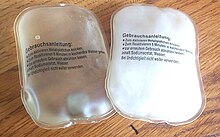
Salt heater (self-heating heater, salt applicator) - reusable chemical heater , the basis of which is based on the effect of heat when changing the phase state of some materials , often - crystallization of salts from a supersaturated solution . Can be used not only for heating, but also for cooling.
Content
Principle of action
A hot-water bottle is a container with a supersaturated saline solution, most often an oversaturated sodium acetate solution is used as such. The solution is in equilibrium . Inside the solution a stick or circle floats - “starter” or applicator. When the applicator is bent, the solution goes out of equilibrium, the bent applicator becomes the center of crystallization, causing a phase transition from a liquid to a solid state. The transition is accompanied by the release of heat and the heating pad is heated to a temperature of about 50–54 ° С. [1] Operating time is 3-4 hours depending on its size and external temperature.
The recovery process is reversible: the heating pad is wrapped in cloth and placed in boiling water for 5–20 minutes. The dissolution of salt crystals occurs with the absorption of heat, after which the heating pad is again ready for reuse.
Application
Salt heaters are widely used in medicine, as well as for heating hands and equipment ( photo and video cameras ) when working in the cold. As a means of heating are often used by fishermen and hunters. The advantage of salt heaters is their simplicity and low cost, the lack of random operation due to the slightest bend of the applicator during transport.
Notes
- ↑ (inaccessible link from 09/03/2016 [1051 day]) Salt reusable hot water bottle | self-heating hot water bottle | catalytic heater Archival copy of April 18, 2012 on Wayback Machine
See also
- Warmer
- Catalytic heating pad is a similar device working due to the catalytic oxidation of organic fuels.
Links
- Analogous to Heat Resource Mediums , 2009
- Review on thermal energy and energy storage , doi: 10.1016 / j.rser.2007.10.005 , 2009 (Eng.)