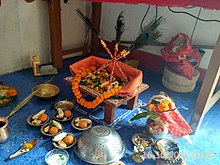
Puja ( Skt. पूजा , pūjā IAST ) is one of the main rites of worship and reverence in Hinduism . God is the object of worship, however, given the divine aspects seen by Hindus in a wide range of objects, the puja can be dedicated to living people - a spiritual teacher , swami or relatives , as well as animals or even inanimate objects. Presumably rooted in ritual roots in the rites of reverence for guests, as well as appeasing spirits .
The idea of the puja is direct, often personified , contact with the deity in order to express his loyalty, love, or to receive his mercy, blessing and disposition [1] . The ceremony involves serving in various forms, including offering food, burning incense , washing, performing dances, sacred hymns and reading mantras [2] . Within each of the sampradayas - the theological and philosophical traditions of Hinduism - developed its own rules for conducting puja [1] .
General information
Pooja can be addressed to a wide range of veneration objects. The main object is a deity, but the puja is also intended for any revered person or object endowed with sacred qualities. These include a spiritual teacher, or guru , as well as a respected person, or swami . Sacred animals or plants identified with deities are also worshiped. Finally, relatives are honored in puja, including the deceased. The ritual is held indoors, primarily in the home environment and in temples. In open spaces, puja is performed near a sacred object, for example, a sacred tree or a confluence of rivers [3] . The variety of pujas and their wide distribution gave rise to the British professor of anthropology Christopher Fuller call puja "the main ritual of popular theistic Hinduism" [4] .
The purpose of the puja can be both an expression of devotion, love and selfless service to the deity, as well as the desire to receive his mercy, blessing and disposition [1] . God is the transcendental Supreme Reality, or Brahman . However, from mercy to a person he descends into his material image, accessible to the believer. The puja divine image is treated as a visible likeness of God himself [3] . During the pooja, offerings are offered to the worshiper. These include incense and fruit, flowers and leaves of sacred trees, water and drinks, sweets, as well as the lamp fire . After the puja, offerings as a manifestation of mercy are given to the participants of the puja as sacred food or objects [3] .
The person performing the puja, that is, performing the entire set of necessary actions, from offerings to prayers, is called “ pujari ”. Depending on the nature and location of the ritual, the role of pujari is performed by men of various social groups. At home, he is the head of the family, in the temple - the brahmana , and in the countryside - one of the worshipers of the deity, not necessarily related to the Varna of the brahmanas. For large and special pujas, the participation of a brahmana is mandatory. One brahmana or a group of brahmanas can be invited to the houses of believers to perform the ritual in accordance with all the rules. In some Brahmin sects, puja is treated as an inappropriate ritual, instead of which a yajna should be performed [5] .
A puja dedicated to the deity, Hinduism is performed in front of a sanctified image called murti , as well as in front of the artistic image of the deity. In temples, the object of worship is treated as the owner of a holy place and the face of royal blood. Puja repeats the ceremony of the royal court with the reception of a dear guest. Pujas in temples and, less commonly, homes are held several times a day. The first is held in the morning at dawn, when the deity "wakes up." They sing the morning hymn “Suprabhatam” to him, after which they wash, dress, feed. Then there is a ritual of worship with the reading of hymns, mantras and sacred texts. The last puja is performed in the evening, when the deity is "laid to sleep." After the evening puja darshan , that is, access to the deity for his sight, ends before the morning service [3] .
The temple pooja is a complicated daily ceremony. In home use, puja is carried out in a simplified form. On holidays, the temple murti is transported in a chariot through the streets, which is called “ ratha-yatra ”. The pooja has changed another, earlier, Vedic form of worship - sacrifice, or yajna. The bloody animal sacrifices characteristic of early Hinduism were almost completely supplanted by the more humane puja. However, they are preserved in some Shivaite sects, as well as among worshipers of the goddess Kali and Durga [2] .
In Jainism, puja is performed only in the svetambara sect. However, among its members there is a division into those who honor images in temples, and those who refuse to do so. The former are called “murti-pujaka” ( murtipujaka ), while the others are called sthanakvasa and terapanthi. When a Jain performs puja in honor of Tirthankara or Arhat, he does not expect any grace from him in return. Tirthankara is considered a liberated being, and not a deity giving mercy. At the same time, the Jains of the Shvetambara sect address pujas to secondary gods and goddesses, as well as spiritual personalities who can bring positive results for practice [3] .
Puja to the local saint, deity, tirthankara and river
As a result of migrations of the Indian population outside South Asia, the puja penetrated the cultural and religious environment of other peoples, sometimes with some changes. For example, the Kalimai healing ritual practiced in South American Guyana is a local adaptation of the pooja to mother Kali , the goddess introduced by Hindus who massively migrated here during the period of British colonial rule [6] .
Etymology
Scholars disagree about the origin of the ritual and etymology of puja. Many Indologists believe that puja was originally a Dravidian spiritual practice - in other words, practiced in pre-Aryan Ancient India in the cults of local and tribal deities. Signs of this are the distinction between Aryan , that is, Brahman, Yajna and Dravidian puja; refusal of orthodox sects of brahmanas following the Vedic traditions to participate in puja; puja popularity in village cults; as well as the role of low-caste, and therefore non-Aryan, hereditary pujari in village pujas. However, for the hypothesis of the Dravidian origin of the term, there are not enough linguistic arguments. In 1926, the Swedish orientalist Jarl Charpentier ( Swede. Jarl Charpentier ) proposed to consider “puja” as a derivative word from the Tamil “beam” ( pucu ) or Kannada “pusu” ( pusu ), which means “to spread” [7] . Both Tamils and Kannada have Dravidian roots, and “beam” or “push” may indicate the use of paste or powder of sandalwood , turmeric or kumkum in puja [8] .
An alternative hypothesis was put forward by the German Sanskrit scientist Paul Thieme in 1939 [9] . He suggested that the term comes from the Sanskrit word puja, which means to mix. The rationale was the use of a mixture of honey and water called “madhuparka” ( madhuparka ), which was offered to guests in ancient India. Analyzing the use of the term “puja” in sutras and epic literature , Paul Thyme concludes that the word was used in the ritual of greeting or worshiping guests. The ritual acts and gestures characteristic of the puja are still used in India to honor guests, as well as other respected personalities, sacred plants and animals, weapons or sacred items. In addition, parts of the ancient ritual for guests, such as offering a place and washing their feet, play an important role in modern pujas. However, it is noted that traces of the guest ritual are less common in rural practice, as well as in pujas of unorthodox traditions, in particular, Buddhist and Jain. Thus, the question of the origin of the term remains open [8] .
Puja and Sacrifice
Pooja as a ritual has been preserved since the time of Ancient India. In early Hinduism, two methods of gaining divine grace were practiced. The first was yajna - a fiery ritual of sacrifice, in which the god of fire Agni acted as an intermediary between man and the gods. The second was the puja, during which the believer showed his devotion, service and love for the deity [8] . A distinctive feature of the puja is the fact that God is represented in a symbolic form. It can be a murti , an art image or a sacred symbol. In the Vedic period, yajna was the main ritual. A properly conducted yajna might surpass the gods themselves. To achieve the desired result, it was enough to conduct a yajna in compliance with all requirements. A yajna master who knew the intricacies of the ritual was highly respected in society, which led to a special attitude towards the brahmanas. The puja, accessible to every mortal, on the contrary, was a means of direct communication with the deity. For the first time, puja is mentioned in sacred texts supplementing the Vedas and known as sutras . The early sutras date back to 600-400 BC. e., which can provide a temporary guideline for the appearance of the ritual. The puja was developed and spread as the Vedic deities of the natural forces receded into the background and the formation of anthropomorphic cults. In puja, “moral” purity was appreciated, while in yajna, “ritual” purity [10] .
The generally accepted point of view is that the nomadic pastoralist tribes settled in northern India in the 1500s BC. e., who were then called the Aryans , preferred to communicate with divine powers through the ritual of yajna. They poured ghee oil into the fire, sang sacred hymns and called on the deities of nature. The sedentary communities of the Indian subcontinent, engaged in agriculture and called the Dravids , worshiped the deities with flowers and fruits. By the year 500 BC e. the practice of yajna has narrowed significantly, mainly under the influence of Buddhism . Puja became the main ritual of Hinduism, whose rules are described in detail in temple texts known as agamas . As the culture of bhakti puja spreads, it gained great popularity. In modern Hinduism, puja prevails, but yajna is preserved in tribal rituals such as weddings, as well as in the community of temple brahmanas [8] .
The worship of Vishnu and Shiva , the deities of the trimurti , was based on puja. In Walking Over Three Seas , the Tver merchant Athanasius Nikitin , who traveled to Medieval India from 1468-1475, outlines worship during a visit to the famous Mallikardzhuna temple on Mount Srishailam near Hyderabad . The temple Nikitin calls the Persian word "butkhan", and the idol - "buta" [11] . Without understanding the pantheon of gods, the merchant describes a puja in honor of Shiva, which can be identified by the presence of trishula and Nandi's mount: “In the butkhan, the boot is cut out of black stone, huge, but its tail is thrown over it, and his right hand is raised high and extended as Justinian, king of Tsaregrad , and in his left hand a spear in the boot. He is not wearing anything, only the hips of the bandage are wrapped, and the face of the monkeys. And the other butas are completely naked, nothing is put on them (the shame is not covered), and the wives of the butova are carved naked, with shame and with children. And in front of the boot is a huge bull, carved from black stone and all gilded. And they kiss him on the hoof, and pour flowers on him. And flowers are pouring on buta ” [12] .
| Characteristic | The Age of Karma Kanda | The Age of Gyana Kanda | The Age of Upasana Kanda |
|---|---|---|---|
| Period | 1800-800 BC e. | 800s BC e. - 800s e. | 800s is our time |
| The predominant religion | Vedism | Buddhism | Hinduism |
| Cultural and social changes | the formation of brahmanism and the birth of the caste system | the decline in popularity of Vedic ritualism, the rise of unorthodox traditions, the spread of tantra and yoga | the influence of Alvars and Nayanars , the integration of mysticism and Brahmanism, the birth of Vedanta schools, the penetration of Islamic and Christian beliefs |
| Sacred texts | Vedas in the form of samhit (collections of hymns), brahmanas (guides for performing sacrifices) | Aranyakas and Upanishads (mystical and spiritual revelations), sutras (philosophical aphorisms), sastras (guides on subject areas), itihasas (epics) | Puranas (chronicles of gods, kings and sages), agamas (temple rules), tantras (occult manuals) and folklore, bhashya (comments on philosophical works) |
| Religious paradigm | through sacrifice to higher powers all human aspirations can be satisfied | the illusory nature of worldly desires; attachment as a cause of suffering and an endless cycle of rebirth; the path of liberation of the soul through control of the body, feelings and mind; awareness and rejection of earthly attachments | God as the Highest reality , eternal and unchanging, the cause of the universe, the “inner” ruler, abiding in all living beings; the divine nature of the soul, the path of its liberation through approaching and merging with the personified God; gaining divine grace and overcoming karmic consequences; achievement of four goals: liberation, righteous behavior, prosperity and bliss |
| Primary Religious Activities | life sacrifice and rituals | tapas and austerities | puja, home rituals, yajna |
| Expression of religious beliefs | ritualism , observance of ritual rules | mindfulness and mysticism | bhakti |
- In some rituals, the Vedic yajna has become an integral part of the puja
Group Yajna in honor of Bhumi-devi , or Mother Earth, with the invitation of honored guests
Homemade Satya-Narayana-puja (in honor of Vishnu) in a brahmana family
Upachara: sequence of actions
Upachara is the ordered sequence of actions performed during the puja [14] . In puja, the deity is offered fruits, specially prepared food, water, incense, flowers and other offerings. As an act of devotion, the ritual is at the same time a service to the deity and a means to win its favor. The home-made ritual is an abridged version of the ministry performed in the temples. Four groups of upachar are distinguished. First, a deity is called upon and invited to enter his image. Secondly, the deity is washed, they bring him water for washing his feet and water for rinsing his mouth. In the third, main, group, the deity is offered various offerings, from clothing and incense to perfumes and flowers. In the fourth, last, group, the deity is shown reverence and escorted to him. Although the upachara differs depending on the nature of the puja, a typical set consists of 16 upachars, or actions. The final action is arati , or the consecration of the murti with a lamp with ghee or camphor ghee . The murti is sanctified in a circular motion, after which those present are invited to sanctify themselves from fire [15] .
The most common ritual acts include the following [14] :
| Action (eng) | Action (rus) | Value |
|---|---|---|
| avahana | avahana | invocation or invitation of a deity |
| asana | asana | offer of a deity's place |
| svagata | swagata | greeting |
| padya | paddy | offer of water for washing feet |
| arghya | arghya | offer mouthwash and hand water |
| acamaniya | achaman | offer a few sips of water |
| madhuparka | madhuparka | water supply with honey |
| snana, abhisheka | snana or abhisheka | bath or bath |
| vastra | vastra | dressing or offering clothes |
| gandha | anulepana or gandha | perfume spray |
| yagnopavit, mangalsutra | lambnavit or mangansutra | putting on a sacred cord (male image) or a bride’s necklace (female image) |
| pushpa | pushpa | flower offer |
| dhupa | dhupa | incense incense |
| dipa | dipa or arati | offer of fire in the form of a lit lamp with camphor or oil |
| naivedya, prasada | Naiveda or Prasada | food offer |
| namaskara, pranama | namaskar or pranama | salute or stretch |
| parikrama, pradakshina | parikrama or pradakshina | walk around the deity * |
| visarjana | visarjana | goodbye or farewell |
* in a temple or home altar room, allowing to go around the murtis around .
Separate Upachars
Ritual accessories
To perform the Upachar, several ritual objects are necessary [14] :
| Subject (eng) | Subject (rus) | Function |
|---|---|---|
| sruva | shruva | spoon for offering ghee or water |
| panapatra | panapatra | bowl to offer the deity water |
| ghanta | ghanta | колокольчик, в который звонят перед божеством |
| patra | патра | металлическая тарелка для прасада |
| padma | падма | символический цветок лотоса, который должен быть открыт во время поклонения |
| dipa | дипа | подставка для масляной лампы с несколькими фитилями |
| arati-dipa | арати-дипа | лампа для предложение огня в виде зажжённой масляной лампы или горящей камфоры |
- Набор ритуальных принадлежностей для пуджи
Домашняя пуджа
Дева-пуджа, или пуджа для богов, проводится в четырёх местах. К ним относятся [8] :
- семейные святилища, где почитается домашнее божество;
- храмы, посвящённые богам общеиндийского пантеона, таким как Вишну или Шива;
- открытые пространства во время религиозных праздников, проводящихся либо храмами, либо местными общинами;
- святилища или храмы местных деревенских божеств.
В каждом из перечисленных случаев пуджа исполняется по-разному, включая как ритуальные жесты и последовательность действий, так и минимально необходимый набор подношений божеству. Пуджи проводятся в соответствии с установленными правилами, которые отличаются в зависимости от традиций сампрадаи , территории и почитаемого божества. Большинство верующих индусов проводят пуджи ежедневно в домашних условиях [8] .
Божествами для домашней пуджи выступают гриха-девата ( griha-devata ), или «божество дома», кула-девата ( kula-devata ), или «родовое божество», ишта-девата ( ishta-devata ), или избранное божество отдельного члена семьи. В прошлом, по всей видимости, ими были образы предков или якша — дух природы, которого почитали предки. Божественные образы передаются из поколения в поколение. В семьях ими обычно выступают камешки с отметками или без них. Каждый из них обмывается и украшается сандаловой пастой, куркумой или кумкумом, освещается лампадой, окуривается благовониями. Каждое божество уникально: у него есть любимые цветы и фрукты, особый день и свой ритуал. В отдельные дни одному из семейных божеств уделяется индивидуальное внимание. В остальное время наследственные образы являются неотъемлемой частью группы домашних божеств. Главное место в домашнем пантеоне отводится патриархальным и матриархальным божествам, что отражает семейную иерархию. Новые члены семьи — невестки — приходят в дом со своим собственным ишта-деватой. Он присоединяется к домашнему пантеону, а по мере взросления хозяйки и появления детей и внуков божество смещается во главу группы домашних божеств [16] .
В то же время семья может почитать божество, которое может быть избранной формой божества из общеиндийского пантеона. Божество или группа божеств устанавливается на алтаре или в отдельной небольшой комнате, которая отведена исключительно для поклонения. В Индии алтарное место называют «пуджасала» ( pujasala ). На алтаре находятся изображения божеств, или мурти, которые могут стоять на столе или на низкой платформе. Кроме того, изображения божеств, или мурти, нередко размещаются в деревянном «храмовом» шкафу, двери которого открывают только во время службы [8] .
Домашняя пуджа и алтарь
В качестве объектов домашнего поклонения выступают не только изображения божеств, или мурти. Ими могут быть символические формы бога. У вайшнавов такую роль выполняют каменные шалаграмы , у шайвов — лингамы . Как отмечали англичане ещё в XIX столетии, пуджа в честь лингама состояла главным образом из омывания его водой и подношения цветов [17] . Глава семьи или её старейший член берёт на себя функции пуджари. Остальные члены семьи присутствуют во время пуджи или выполняют отдельные вспомогательные задачи, например, подают воду, цветы, подношения или овевают мурти особым опахалом — чамарой . Участники пуджи предлагают свои поклоны и простирания божеству, а также совместно воспевают ему гимны и мантры. В вайшнавской традиции пищу, предложенную Вишну, после завершения пуджи раздают всем присутствующим как благословение божества, или прасаду . В шиваизме верующие пьют воду, которой омывали лингам. Освящённую еду употребляют сразу после пуджи, после чего её участники некоторое время остаются возле алтаря в умиротворении и молчании [8] .
Особый ритуал проводится в честь богини процветания и счастья Лакшми . Нередко богиню представляют символически как металлический горшок с водой, стоящий на насыпи сырого риса и увенчанный кокосовым орехом и короной из листьев манго. Кроме того, Лакшми поклоняются в форме янтр — сакральных диаграмм, отражающих её божественные качества [18] . Пуджи Лакшми организуются по пятницам. Забота о поклонении богине лежит на женской части семьи. Рано утром воспеваются имена Лакшми, днём выполняется пуджа и читаются шлоки , ночью не ложатся спать, памятуя Лакшми и произнося ей молитвы и мантры [19] . На пудже Лакшми предлагаются цветы лотоса, сладкая пища и свадебный наряд невесты. Лакшми олицетворяет богатство и успех, поэтому считается, что её почитание должно приводить к улучшению финансового положения. Пуджа Лакшми широко распространена в торговле и финансах. Ещё в 1839 году «Журнал Королевского азиатского общества Великобритании и Ирландии » писал об обычае: «В день новой луны происходит поклонение Лакшми. Лавочники и банкиры вынимают все свои бухгалтерские книги, кладут на каждую по монетке, а затем проводят пуджу, предлагая им пасту из сандалового дерева и цветы, после чего совершают поклонение. Это они делают для процветания в течение всего года, который только начинается» [20] .
- Подношения на домашней пудже
Подношение на пудже: кокос , банан и сладости
Принадлежности для пуджи Кришне
Подношение цветов и еды для пуджи на Бали ( Индонезия )
Пуджа живым людям
К варианту домашней пуджи может быть отнесена неортодоксальная пуджа, посвящённая живому человеку. Объектом поклонения выступает духовный учитель — гуру или ачарья [21] . Пуджа носит публичной характер и привлекает последователей учителя. На пудже к гуру относятся как к живому богу или воплощению божества . Гуру подносят гирлянды и другие украшения, воскуривают ему благовония, омывают ноги и смазывают их сандаловой пастой, а также преподносят пищу и напитки. В заключении пуджи на гуру медитируют и получают его благословение . Воду с предварительно омытых ног последователи могут пить. Пуджа в честь гуру получила широкое распространение в буддизме и кришнаизме [22] .
Писатель Ромен Роллан в жизнеописании учителя и мистика Рамакришны отмечает проведение им в честь своей жены тантрической пуджи:
Когда в 1872 году его жена Сарададеви в первый раз приехала к нему в Дакшинесвар, Рамакришна, преисполненный нежности к ней и глубокого, почти религиозного уважения, свободного от желанья, от малейшего налёта чувственности, признал в ней божество и оказал ей подобающие почести. В одну майскую ночь, сделав все требуемые культом приготовления, он усадил Сарададеви на трон Кали и совершил ритуальный обряд — « шораши пуджа » — поклонение женщине. Оба они впали в экстатическое полусознательное (или сверхсознательное) состояние. Придя в себя, он приветствовал в лице своей подруги святую Мать, которая, по его убеждению, воплотилась в этот живой символ непорочной человечности.
— Жизнь Рамакришны [23]
В современной Индии и за её пределами Рамакришна как выдающийся духовный деятель сам стал объектом поклонения на пудже. Основанная его учеником Миссия Рамакришны проводит «Шри Рамакришна Парамахамса Гуру-пуджу». Ритуал проводится последователями Рамакришны в честь своего учителя в первое воскресенье каждого года с 1930-х годов [24] .
Храмовая пуджа и ратха-ятра
Полная пуджа в домашних условиях, состоящая из шестнадцати упачар, является сокращённой версией храмового служения. Ежедневное обязательное храмовое богослужение, или «нитья-пуджа», перед главным мурти храма отличается как по масштабу, так и по числу ритуалов. В зависимости от традиции и достатка храма пуджа выполняется от трёх до шести раз в день. В качестве пуджари выступают брахманы или представители касты священников. В некоторых храмах пуджари являются потомственными, то есть брахманская семья обслуживает один и тот же храм из поколения в поколение. Однако в брахманском сообществе храмовые служители имеют менее высокий статус, чем те, кто выполняет ведийские ритуалы, то есть представители немногочисленной традиции вайкханаса [25] .
За исключением пуджи в честь Шивы, которая всегда адресуется неантропоморфному лингаму, объектом поклонения в храмах является антропоморфный, то есть человекоподобный образ. Храмовая пуджа обращена к мурти двух типов. Главное храмовое мурти, как правило, состоит из камня твёрдых пород, реже — особой цементной смеси. Его называют «мула виграха» ( mula vigraha ). Многотонное мурти никогда не передвигается со своего места. Вокруг главного божества проводятся ежедневные службы. Вторая форма храмового мурти известна как «утсава виграха» ( utsava vigraha ) — это малое подобие главного божества. Малое мурти можно переносить, и оно служит для праздничных процессий и пуджи за пределами храма. Утсава виграха строит из сплава пяти металлов «панча-лока», включая медь, олово, свинец, железо, серебро, реже — золото [25] .
Храмовая пуджа
Главное божество храма почитается как хозяин храма и всего, что принадлежит храму, включая дары и пожертвования верующих. К божеству храма относятся как к лицу царских кровей. Ритуал ежедневной храмовой пуджи меняется в зависимости от времени суток. Утром божество «пробуждается» ото сна, в то время как в домашней пудже оно призывается в свой образ. Его храм подобен дворцу, а храмовые священники выступают дворцовыми слугами. Соответственно, «местом» бога служит трон, а в набор украшений обязательно входит корона. Переносное мурти ежедневно выносится за пределы храма, после чего совершается обход вокруг храмовой территории, подобно тому, как в прошлом раджи в Индии обходили свои владения [25] .
Храмовые пуджи различаются в зависимости от традиции и региона. К примеру, в Южной Индии во время пуджи могут выступать танцующие девушки, называемые девадаси . Храмовые танцовщицы, посвящённые божеству при рождении или по обету родителей, входят в состав персонала храма. Пуджа Шиве включает множество тантрических элементов. В частности, брахман начинает пуджу, призывая бога Шиву в своё собственное тело. В вайшнавской традиции в крупных храмах задействованы приглашённые танцовщицы, музыканты и певцы. Число социальных групп, обслуживающих храмовую пуджу, может достигать десятка. К ним относятся брахманы, обеспечивающие божество и паломников едой, садоводы, выращивающие туласи и цветы для ритуалов, и прочие. Ежедневные обязанности каждой группы чётко регламентированы [25] .
Храмовые пуджи не считаются коллективным действием, как в домашней пудже, где пуджари действует во благо всех членов семьи. В храме верующие могут реализовать свои индивидуальные просьбы посредством специальных подношений. Эта практика известна как «камья-пуджа», или пуджа для достижения личных целей. Посетитель храма попросит брахмана или особое лицо, отвечающие за камья-пуджу, о проведении для него ритуала. Взамен посетитель делает пожертвование храму или брахману. Подобные «факультативные» пуджи чаще всего проводятся в небольших святынях, располагающихся на территории храмового комплекса. Брахман от имени просителя возлагает к стопам божества фрукты и цветы или надевает на него гирлянду или украшения [25] .
Храмовые пуджи могут адресоваться духовным личностям, которым приписываются божественные качества. В Индии к ним причисляют одного из идеологов движения за независимость Индии Махатму Ганди . В Мангалуре ( Карнатака ) в 1948 году на территории храма «Шри Брахма Байдаркала Гаради Кшетра» ( ) установлена глиняная статуя Махатмы Ганди, которую в 2013 году заменили на гранитную. Трижды в день в честь Ганди выполняется пуджа, а 2 октября каждый год на его день рождения организуется специальная пуджа [26] .
Крупные храмы проводят праздники, связанные с божествами, которым они посвящены. Наиболее популярным храмовым праздником является ратха-ятра , или «праздник колесницы». Во время ратха-ятры переносное храмовое мурти устанавливается на большой колеснице. Она представляет собой церемониальную телегу, высота которой может достигать нескольких этажей. В колесницу садится пара брахманов, обслуживающих мурти. Саму колесницу вручную тянут несколько десятков верующих, для которых катание божества считается большим благом. Процессию сопровождает колонна участников, формирующаяся по социальным группам. Процессия движется по заранее намеченному маршруту, как правило, вдоль кварталов, окружающих храм. На ратха-ятре все желающие получают возможность лицезрения божества, что получило название « даршан ». По ходу движения верующие бросают колеснице цветы, бьют кокосовые орехи или окропляют повозку водой. Местные сообщества могут также проводить «фестивали», на которых происходят публичное явление мурти и празднование в его честь. Общественные объединения или состоятельные семьи заказывают глиняные изваяния божества для праздничной пуджи. Изваяние сопровождают с музыкой и танцами, после чего его погружают в воды реки, где оно растворяется. Праздничные пуджи с временными образами божества особенно популярны в Бенгалии на северо-востоке Индии [25] .
Public associations in the form of associations for organizing pujas became widespread after India gained political independence. They are created and act to sponsor annual citywide pujas. Members of the association collect donations from neighbors and friends, order the manufacture of divine images for worship in temporary sanctuaries on holidays, and also hire brahmanas for the ritual [27] .
Ratha Yatra in honor of Jagannath is celebrated both in India and in Europe.
Village Pooja
Puja in rural areas is significantly different from urban traditions. The village puja is dedicated to local deities called "gramadevata." According to some signs, deities of the pan-Indian pantheon can be recognized in them, but more often they are not connected in any way with each other. Gramadevata are worshiped exclusively by the local community. Among them, cults of angry goddesses predominate, in the image similar to Kali or Durga [25] . Under the influence of syncretism, there was a fusion of cults of local goddesses with trimatics, or goddesses of trimurti . In the past, Vedic animal sacrifice was common in village pujas. In the Vedic period, sacrifice was considered as a universal ritual to achieve any goals. The killing of an animal was not considered an act of violence, since it was prescribed by the Vedas and could lead to the degeneration of the animal in a new body in better conditions [28] . Human sacrifices also met and were intended primarily to angry goddesses. During British rule, authorities' reports kept evidence of regular human sacrifices in the 19th century in Kamakhaya ( Assam ) and Tanjavur ( Tamil Nadu ) in honor of the “Devi,” that is, Durga or Kali . These rare events persisted in selected areas, despite the disapproval of animal killings and the prohibition of human casualties [28] .
The cult of village goddesses is best known in South India. The local deity is most often represented by a clan or communal goddess. An integral part of her name is “Amma,” or “Mother.” Village temples for Amma are very common and popular, although in rural conditions they can be the simplest religious building. Sometimes venues are nothing more than a fenced area outside the village. The image of the goddess is brought to the place for the ritual. If the image is permanent, then it can be a symbolic form - for example, a mark on a stone rock, a clay pot or a lamp for fire. The village temple serves the hereditary pujari from the low caste , that is, not a brahmana. It may be one of the worshipers of the pottery caste goddess, playing the role of a medium in a mystical connection with the goddess. Village pujas are not necessarily performed on a regular basis and all upachars are not performed in them. A village puja may include the simplest offering of coconut, banana, neem or betel leaves, as well as turmeric and boiled rice. This is the most common list of offerings in a humane village puja. In the case of a sacrifice, the victims are sheep, goats, poultry or buffalo. Holiday pujas include solemn processions around the village, often with a torchlight procession [29] .
Village pooja
Notes
- ↑ 1 2 3 Klostermaier, 2003 , p. 142.
- ↑ 1 2 Erman, 1996 , p. 339.
- ↑ 1 2 3 4 5 Jones, 2007 , p. 336.
- ↑ Fuller, 2004 , p. 57.
- ↑ Krasnodembskaya, 1996 , p. 339.
- ↑ Khan A. Kali-mai puja in Guyana: Religious function and affirmation (Eng.) // Religion. - 1977. - Vol. 7 , no. 1 . - P. 35-45 . - DOI : 10.1016 / 0048-721X (77) 90006-9 .
- ↑ Charpentier J. Über den Begriff und die Etymologie von Pūjā / Kirfel W. .. - Beiträge zur Literaturwissenschaft und Geistesgeschichte Indiens: Festgabe Hermann Jacobi. - Bonn, 1926 .-- P. 276-297.
- ↑ 1 2 3 4 5 6 7 8 Falk, 2005 , p. 7493.
- ↑ Thieme P. Puja (Eng.) // Journal of Oriental Research. - 1957-1958. - Vol. 27 . - P. 1-16 .
- ↑ Pattanaik, 2003 , p. 34.
- ↑ Vanina E. “And I went to India from many troubles ...” // Around the world . - 2007. - No. 8 .
- ↑ Walking across the three seas Athanasius Nikitin / Translation by L. S. Semenov . - Monuments of literature of Ancient Russia. The second half of the XV century. - M .: Hudozh. lit., 1982. - S. 444-477.
- ↑ Pattanaik, 2003 , p. 59–61.
- ↑ 1 2 3 Klostermaier, 2003 , p. 142, 143.
- ↑ Klostermaier, 2011 , Chapter 6.
- ↑ Pattanaik D. Successful leaders need to share space with others at the workplace // The Economic Times. - 2015 .-- April 3.
- ↑ Sellon E. Linga Puja, or Phallic Worship in India // Journal of the Anthropological Society of London. - 1865. - T. 3 . - P. CXVI. - DOI : 10.2307 / 3025310 .
- ↑ Pattanaik, 2002 , p. 73.
- ↑ Pattanaik, 2002 , p. 82.
- ↑ Stephenson J. On the Ante-Brahmanical Worship of the Hindús // Journal of the Royal Asiatic Society of Great Britain and Ireland. - 1839. - Vol. 5 , no. 2 . - P. 266.
- ↑ Chapter 8. Contentious Spaces: Guru Pujas as Public Performances and the Production of Political Community // From the margins to the mainstream: institutionalizing minorities in South Asia / Gorringe H., Jeffery R. and Waghmore S. - Thousand Oaks: SAGE Publications India, 2016.
- ↑ Sedinko A.S. International Society of Krishna Consciousness in Russia. - The dissertation ... of the candidate of philosophical sciences: 09.00.13. - SPb. , 2001 .-- S. 36.
- ↑ Rolland R. Life of Ramakrishna / Per. Polyak A.A., Schlosberg E.B. - SPb. : Alphabet, 2000.
- ↑ Gurupuja celebrated (Eng.) // The Hindu. - 2016 .-- 5 January.
- ↑ 1 2 3 4 5 6 7 Falk, 2005 , p. 7494.
- ↑ Raghava M. Where Mahatma is idolised, literally // The Hindu. - 2018 .-- October 2.
- ↑ Sarma J. Pūjā Associations in West Bengal (English) // The Journal of Asian Studies. - 1969. - Vol. 28 , no. 3 . - P. 579. - DOI : 10.2307 / 2943180 .
- ↑ 1 2 Klostermaier, 2003 , p. 157.
- ↑ Falk, 2005 , p. 7495.
Literature
- Albedil M.F. Vishnuism // Peoples and religions of the world: Encyclopedia / Ch. ed. V.A. Tishkov . - M .: Big Russian Encyclopedia , 1999. - S. 702-703. - 928 s. - 100,000 copies. - ISBN 5-85270-155-6 .
- Pooja // Brockhaus and Efron Encyclopedic Dictionary : in 86 volumes (82 volumes and 4 additional). - SPb. , 1890-1907.
- Krasnodembskaya N. Pujari // Hinduism. Jainism. Sikhism: Dictionary / Ed. ed. Albedil M.F. and Dubyansky A.M. - M .: Republic , 1996 .-- S. 339 . - ISBN 5-250-02557-9 .
- Erman V. Pooja // Hinduism. Jainism. Sikhism: Dictionary / Ed. ed. Albedil M.F. and Dubyansky A.M. - M .: Republic , 1996 .-- S. 339 . - ISBN 5-250-02557-9 .
- Falk N. Puja: Hindu Puja / Jones L. - Encyclopedia of Religion. - New York: Thomson Gale, 2005 .-- S. 7493-7495. - (Vol. 11).
- Fuller C. The Camphor Flame: Popular Hinduism and Society in India. - Princeton: Princeton University Press, 2004.
- Jones C. Encyclopedia of Hinduism / Jones C. and Ryan J. - New York: Facts On File, 2007.
- Klostermaier K. A Concise Encyclopedia of Hinduism. - Oxford: Oneworld Publications, 2003.
- Klostermaier K. Hinduism: A Beginner's Guide . - Oxford: Oneworld Publications, 2011.
- Pattanaik D. . Indian Mythology: Tales, Symbols, and Rituals from the Heart of the Subcontinent. - Rochester: Inner Traditions, 2003.
- Pattanaik D. . Lakshmi, the goddess of wealth and fortune: an introduction. - Mumbai: Vakils, Feffer and Simons, 2002.