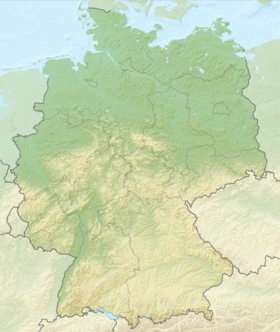
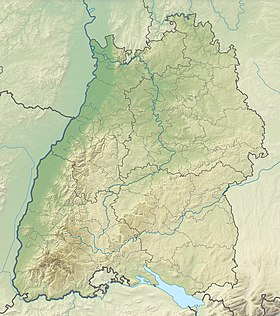
The Steinheim Crater is a shock crater formed as a result of an impact event near the village of Steinheim am Albuch , Baden-Württemberg , Heidenheim .
| Steinheim crater | |
|---|---|
| him. Steinheimer becken | |
 | |
| Characteristics | |
| Diameter | 3.8 km |
| Type of | Shock |
| Title | |
| Eponym | |
| Location | |
| A country |
|
| Earth | Baden-Wurttemberg |


Content
- 1 View
- 2 Origin
- 3 Geology and paleontology
- 4 View Gallery
- 5 Panoramas
- 6 Details
- 7 Literature
- 8 References
View
The Steinheim Crater has a view close to a circle with an average diameter of about 3.8 kilometers. In the center of the crater is a hill, Steinhirt , about 50 meters high relative to the modern bottom of the crater, while the modern bottom of the crater lies about 100 meters below the surrounding Albuch plateau.
Steinheim County, which has local government, is located in the crater.
Origin
The Steinheim crater was formed about 14-15 million years ago as a result of an impact event when a meteorite fell in size of about 100-150 meters at a speed of approx. 20 kilometers per second (72,000 km / h). In this case, an explosion occurred that released energy of about 10 18 joules (corresponding to about 18,000 bombs dropped on Hiroshima ), which led to the formation of a huge desert in the Olstalb region. Initially, a crater with a depth of about 200 meters was formed, in the center of which a rock swelled, forming a hill about 100 meters high ( Central Hill ). [1] [2] [3]
After the meteorite fell, a crater lake formed, which then became shallow and dried up, forming the Valley of Vental . Fossilia found in sedimentary rocks up to 50 meters thick suggest that the Steinheim Crater was formed simultaneously with the Nerdlingen Ries Basin, located about 40 kilometers northeast at the so-called Ries event . Therefore, we are talking about a cosmic body, the consequence of the fall of which are both craters, about an asteroid , which was accompanied by a smaller satellite . [2] Recent studies have suggested that the Steinheim meteorite consisted of rock (or gland-iron) rock. [four]
Geology and Paleontology
Crater shaft consists of shifted and overturned blocks of Jurassic limestone . Partially, the blocks of limestone are also fragmented and form breccias from fragments of different sizes with sharp edges. Wells show that at the bottom of the crater under sedimentary rocks there are also breccias, which consist of stones thrown upward when a meteorite falls and again fall to the bottom (secondary breccias). In some places, the impact breccias of the Steinheim Crater are of a spectacular nature. [4] The central hill consists mainly of limestone and sandstone of the Middle and Late Jurassic , which can be found in pristine deposits outside the crater only at a depth of about 300 meters.
The so-called cracking cones were also found in the limestone of the central hill. Such surface structures are formed when a shock wave passes through a stone during impact. Cracking cones were first found in the world in the Steinheim Crater and described around 1905, of course, without explanation of their origin. Today they are known for many other earthly craters and are considered unambiguous signs of an impact event .
Sedimentary rocks are rich in fossils of the Miocene era, so the Steinheim crater is one of the most important finds of this geological era. Along with numerous vertebrate finds (including fish , reptiles , birds and mammals ), these sedimentary rocks are famous, first of all, for the large number of mollusk shell fossils found in them (the so-called Steinheim shell sand ). [5] In 1862, paleontologist Franz Hilgendorf examined the shell of the fresh-water snail gyraulus , a species of the coil family, and found that the shape of the shell found in younger layers of sedimentary rocks gradually changed compared to the shell found in older layers. Findings of shells became, thus, the first confirmation of the 1859 publications of Charles Darwin's theory of evolution . [6]
In the Steinheim area of Zontheim, the meteorite crater museum , opened in 1978, is the starting point for the geological tourist route through the Steinheim Crater. [3]
View Gallery
Central hill
Steinhirt limestone cliffs on top of a central hill
Steinheim Crater Cracking Cone
Panoramas
Details
- ↑ Mattmüller, 1994
- ↑ 1 2 Stöffler, Artemieva und Pierazzo, 2002
- ↑ 1 2 Baier und Scherzinger, 2010
- ↑ 1 2 Schmieder und Buchner, 2009
- ↑ Baier, 2012
- ↑ Heizmann und Reiff, 2002
Literature
- J. Baier: Der Steinheimer Schneckensand - eine miozäne Fossillagerstätte von Weltformat. In: Fossilien. 29 (6), 2012, 368-371.
- J. Baier & A. Scherzinger: Der neue Geologische Lehrpfad im Steinheimer Impakt-Krater . - Jber. Mitt. oberrhein. geol. Ver, NF 92, 9-24, 2010.
- EPJ Heizmann, W. Reiff: Der Steinheimer Meteorkrater . Verlag Dr. Friedrich Pfeil, München, 2002. ISBN 3-89937-008-2
- CR Mattmüller: Ries und Steinheimer Becken . Ferdinand Enke, Stuttgart 1994. ISBN 3-432-25991-3
- D. Stöffler, NA Artemieva, E. Pierazzo: Modeling the Ries-Steinheim impact event and the formation of the moldavite strewn field. , in Meteoritics & Planetary Science , vol. 37, 2002, p. 1893-1907
- M. Schmieder, E. Buchner: Fe-Ni-Co sulfides from the Steinheim Basin, SW Germany: Possible impactor traces (PDF; 20 kB), 72 nd Annual Meteoritical Society Meeting (2009), abstract no. 5073.
- E. Buchner, M. Schmieder: Steinheim suevite - A first report of melt-bearing impactites from the Steinheim Basin (SW Germany) , in Meteoritics & Planetary Science 45 (7), 1093-1107.
Links
- Informationen zum Steinheimer Becken
- Meteorkrater-Museum Steinheim
- Albtraum auf der Alb - Ein kosmischer Irrläufer schuf das Steinheimer Becken unopened (link not available) . Archived on April 14, 2011.