

Ichthyophages are animals that are characterized by ichthyophagy , that is, they feed on fish . The term is a compound word with Greek roots and comes from two words - “ichthis” ( Greek ἰχθύς ) - fish and “phage” ( φάγειν ) - eating. In ancient times, people called fish-eating ethnic groups and tribes as ichthyophages. In animals, ichthyophages usually include typical predators , whose diet is based on live fish.
The term "ichthyophages" is used mainly in characterizing the type of food for animals. There are quite large groups of aquatic and semi-aquatic animals in different classes of vertebrates , which in the process of evolution have adapted exclusively to feeding on fish. First of all, these are the fish themselves - representatives of the classes of cartilaginous fish ( Chondrichthyes ), ray-finned fish ( Actinopterygii ) and lobed-tailed fish ( Sarcopterygii ). In cephalopods mollusks are many types of squids and, to a large extent, octopuses and cuttlefish . Among reptiles ( Reptilia ) are mainly representatives of aquatic turtles and snakes, among birds ( Aves ) - mainly sea birds , and among mammals ( Mammalia ) - aquatic and semi-aquatic species, especially marine mammals .
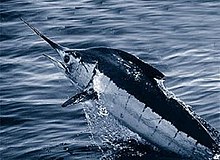
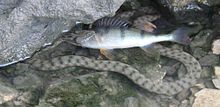
There are typical ichthyophages (obligate ichthyophages), in which the fish forms the basis of nutrition, and temporary ichthyophages (facultative ichthyophages), in which fish can play a significant role in the diet only at certain periods of life or in a particular season of the year. For example, representatives of typical ichthyophages among squid are deep-water species — giant squid and giant Antarctic squid ; in fish, common pike , barracuda , marlin , pearl-eyed ; among reptiles, there is a fringed turtle , a water torch , sea snakes and gaviala ; birds have cormorants , pelicans , dead ends ; among mammals, dolphins , most seals and otters . The optional ichthyophages are many bears , in particular the brown bear .
Content
Ichthyophage people
In ancient Greece, the coastal tribes that lived along the shores of the southern seas were called ichthyophages. These peoples were known or assumed to feed mainly on fish. The most famous of them are listed in the F. Lubkert Dictionary [1] :
- lived in the extreme east - between the equator and the Siam (Thailand) Bay of the South China Sea on the territory of Indochina and the Malay Peninsula;
- on the coast of Gedrosia by the Eritrean Sea - the ancient name of the area corresponding to modern Baluchistan (Iran and Pakistan) on the coast of the Gulf of Oman;
- on the northeast coast of Happy Arabia by the Persian Gulf (corresponds to the present-day Yemen Republic, as well as to the Red Sea and Gulf of Aden);
- in the African region of Troglodith near the Arabian Gulf, above Egypt and Ethiopia (the present-day western coast of the Red Sea, belonging to Egypt);
- on the west side of Africa in the region of the present Gambia.
Much later, starting from the 17th century, the first information about “fish skin people” from the Amur Region, Sakhalin and other regions of the Far East appeared in Russia — the peoples who mainly ate sea and freshwater fish and wore fish skin clothes [2] .
Ichthyophage animals
- Cephalopod ichthyophagous mollusks
- Ichthyophagous fish
- Reptiles-ichthyophages
- Ichthyophagous birds
- Ichthyophagous mammals
Notes
- ↑ Lubker F. (2007): A Real Dictionary of Classical Antiquities [Trans. with him.]. - M .: DirectMedia Publishing, 2007. - CD-ROM.
- ↑ Glebova E. (2010): From the life of “fish-skin people”. Culture No. 38 (7750) October 7–13, 2010
Links
- Life of animals. T. 4. Fish. 2nd ed., Pererab., Ed. TS Rass. (1983): M .: Enlightenment. 575 s. PDF (41.99 MB)
- Jefferson TA, Leatherwood S., Webber MA (1993): FAO species identification guide. Marine mammals of the world. Rome, FAO. 1993. 320 p. 587 figs.