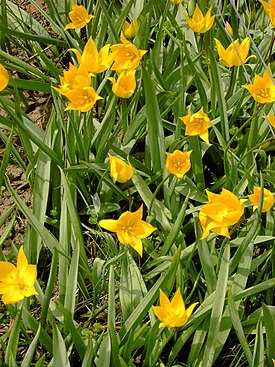
Forest Tulpan ( Latin: Túlipa sylvéstris ) is a species of monocotyledonous flowering plants included in the genus Tulip ( Tulipa ) of the Liliaceae family.
| Forest Tulip | |||||||||||||||||||||||||
|---|---|---|---|---|---|---|---|---|---|---|---|---|---|---|---|---|---|---|---|---|---|---|---|---|---|
 | |||||||||||||||||||||||||
| Scientific classification | |||||||||||||||||||||||||
| |||||||||||||||||||||||||
| International scientific name | |||||||||||||||||||||||||
Tulipa sylvestris L. , 1753 | |||||||||||||||||||||||||
Content
- 1 Botanical Description
- 2 Distribution and habitat
- 3 Economic value and application
- 4 Taxonomy
- 4.1 Synonyms
- 5 notes
- 6 Literature
- 7 References
Botanical Description
Forest Tulip is a perennial bulbous herbaceous plant . The bulb is ovoid or broad-egg-shaped, up to 5 cm long and up to 2.5 cm in diameter, with a black-brown husk.
Leaves are usually in the amount of two to four, bent down, dark green in color, linear-lanceolate in shape, bare on both surfaces, the bottom sheet is up to 25–35 cm long.
The flower is usually solitary, drooping in the bud, then rising. Perianth is divided into six to eight lobes of golden yellow color, sometimes greenish at the base. External lobes of a narrowly elliptical or rhomboid shape, not more than 6.5 cm long, internal elliptical-inverse lanceolate, smaller in size. Stamens with flat pubescent filaments and orange anthers. The ovary is bright green.
The fruit is a box of 15-30 × 14-16 mm.
The number of chromosomes is 3n = 36.
Distribution and habitat
The natural habitat of the forest tulip is not precisely defined; it is located in Europe and North Africa . Introduced to Siberia and Central and South-West Asia , as well as to North America .
Economic Significance and Application
In the XVI century it was used in decorative gardening along with Tulipa gesneriana brought from Turkey; in modern floriculture almost never used. Isolated populations of Tulipa sylvestris in northern Germany are feral descendants of cultivated tulips that once adorned noble and church gardens. Some such populations grow on the site of former gardens for several centuries, while others settled down along the river valleys [2] .
Taxonomy
| 9 more families (according to APG III System ) | about 110 more species | ||||||||||||
| order lily | clan Tulip | ||||||||||||
| Department of Flowering, or Angiosperms | Lily family | view of the forest tulip | |||||||||||
| another 58 orders of flowering plants ( APG III System ) | 15 more births | ||||||||||||
Synonyms
Tulipa sylvestris subsp. australis ( Link ) Pamp. , 1914
- Tulipa abatinoi var. aurea Borzí & Mattei , 1913
- Tulipa acrocarpa Jord. ex Baker , 1874, nom. inval.
- Tulipa alpestris Jord. & Fourr. , 1868
- Tulipa australis Link, 1800 basionym
- Tulipa australis subsp. mauritii Sennen , 1933, nom. nud.
- Tulipa australis subsp. montana ( Kunze ) K. Richt. , 1890
- Tulipa australis subsp. transtagana ( Brot. ) K. Richt., 1890
- Tulipa australis var. campestris Willk. , 1862
- Tulipa australis var. fragrans ( Munby ) Levier , 1884
- Tulipa australis var. melillensis Sennen & Mauricio , 1936
- Tulipa australis var. montana (kunze) willk., 1862
- Tulipa australis var. parviflora Willk., 1862
- Tulipa australis var. transtagana (Brot.) Levier, 1884
- Tulipa biebersteiniana var. aurantiaca baker, 1874
- Tulipa breyniana Ker Gawl. , 1804, nom. illeg.
- Tulipa brujniana Roxb. , 1814, nom. nud.
- Tulipa caucasica Orph. ex Nyman , 1882, nom. inval.
- Tulipa celsiana var. alpestris (Jord. & Fourr.) Nyman, 1882
- Tulipa celsiana var. fragrans (Munby) Batt. & Trab. , 1895
- Tulipa celsiana var. maculata Regel , 1873
- Tulipa celsiana var. montana (kunze) batt. & Trab., 1895
- Tulipa celsiana var. transtagana (Brot.) Nyman, 1882
- Tulipa fragrans Munby, 1866
- Tulipa fragrans var. montana (Kunze) T. Durand & Schinz , 1894
- Tulipa gallica f. armoricana Hy , 1912
- Tulipa gallica var. australis (Link) Hy, 1912
- Tulipa maculata Roth , 1821
- Tulipa paschalis Sennen, 1924
- Tulipa pumila Moench , 1794
- Tulipa sylvestris f. aurea (Borzí & Mattei) Pamp., 1914
- Tulipa sylvestris f. fragrans (Munby) Pamp., 1914
- Tulipa sylvestris f. montana (kunze) pamp., 1914
- Tulipa sylvestris f. scappuccii Pamp., 1914
- Tulipa sylvestris var. alpestris (Jord. & Fourr.) O. Bolòs & Vigo , 2001
- Tulipa sylvestris var. herbetei Sennen & Mauricio, 1936
- Tulipa sylvestris var. mauritii Sennen ex Valdés , 1996
- Tulipa sylvestris var. mediterranea Pamp., 1914
- Tulipa sylvestris var. melillensis Sennen & Mauricio, 1936
- Tulipa sylvestris var. montana kunze, 1846
- Tulipa thirkeana K.Koch , 1849
- Tulipa tchitounyi Azn. , 1918
- Tulipa transtagana Brot., 1804
Tulipa sylvestris subsp. cuspidata (Regel) Maire & Weiller , 1958
- Tulipa cuspidata Regel, 1884 basionym
- Tulipa elwesii Regel, 1884
Tulipa sylvestris L. subsp. sylvestris
- Lilium bononiense EHLKrause , 1906
- Liriopogon sylvestre (L.) Raf., 1837
- Tulipa abatinoi Borzí & Mattei, 1912
- Tulipa australis subsp. gallica ( Loisel. ) K. Richt., 1890
- Tulipa australis var. gallica (Loisel.) Levier, 1884
- Tulipa balcanica Velen. , 1893
- Tulipa gallica Loisel., 1829
- Tulipa gallica var. occidentalis Hy, 1912
- Tulipa grandiflora Hy, 1912
- Tulipa florentina baker, 1874
- Tulipa Marshalliana Andrz. ex baker, 1874
- Tulipa grisebachiana Pant. , 1873
- Tulipa grisebachii Borbás , 1883
- Tulipa sylvestris subsp. balcanica (Velen.) Hayek , 1932
- Tulipa sylvestris subsp. grandiflora (Hy) Hayek, 1932
- Tulipa sylvestris subsp. grisebachiana (Pant.) Hayek, 1932
- Tulipa sylvestris var. gallica (Loisel.) Kunze, 1846
- Tulipa turcica Roth, 1797
Notes
- ↑ For the conventionality of indicating the class of monocotyledons as a superior taxon for the plant group described in this article, see the APG Systems section of the Monocotyledonous article .
- ↑ Kowarik, I., Wohlgemuth, J. Tulipa sylvestris (Liliaceae) in Northwestern Germany: a non-indigenous species as an indicator of previous horticulture // Polish Botanical Studies. - 2006 volume = 22. - P. 317-331.
Literature
- Straley, GB, Utech, FH 1. Tulipa sylvestris Linnaeus // Flora of North America. - 2003. - Vol. 26. - P. 200.