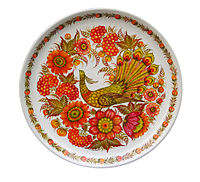
Petrikov painting ( Ukrainian Petrikivsky list ) or Petrikovka ( petrikivka by the name of Petrikovka village, the regional center of the Dnipropetrovsk region , Ukraine) is a Ukrainian decorative and folk painting that was formed in the Dnipropetrovsk region in the village of Petrikovka , from where the name of this art comes from.
Separate things with patterns in the style of Petrikov painting have been preserved since the XVIII century. However, in the modern sense, this direction was formed at the end of the 19th century - the beginning of the 20th century. The origin of the Petrikov painting is associated with the Cossacks and the settlement of the Dnieper region by natives of the Poltava region , Slobozhanshchina and Podillia in the 18th century and in the first half of the 19th century. However, it is not known where and when exactly the traditions developed that formed the basis of this direction of painting.
On December 5, 2013, Petrikov painting was included in the Representative List of the Intangible Cultural Heritage of Humanity by UNESCO [1] [2] [3] . One of the two forms of cultural heritage of Ukraine that fell into this list, along with Cossack songs of the Dnipropetrovsk region [4] .
Content
History
Samples of painting became known thanks to the work of D. I. Yavornitsky , E. K. Evenbach ; developed in the form of wall painting (at the beginning of the 20th century, due to the increased demand for wall painting, paper “little things” were also made for interior decoration), decor of household items (chests, folk instruments, seeders, sledges), decorative painting on wood especially developed podlaknaya painting, overglaze and underglaze painting of porcelain, glass painting technology was recreated, modern masters paint towels and blouses made of fabric, leather wallets; formed as an independent type of easel decorative graphics and spread widely as an art school.
It got its name thanks to the giftedness of the inhabitants of the village of Petrikovka, the rural teacher Stativa Alexander Fedoseevich (1898-1966), the organizer of the Petrikov school of decorative painting (1936-1941), which was taught by Tatyana Akimovna Pata and her daughter Vekla Kucherenko. Among the most famous masters of Petrikovka painting, one can distinguish Patu Tatyana Akimovna (1884-1976), Belokon Nadezhda Avramovna (1894-1981), Pavlenko Praskovya Nikolaevna (1881-1983), Yarina Ulyanovna Pilipenko (1893-1979), Pelageya Ivanovna Glushchenko (1908 —1983), Vera Klimenko-Zhukova, Zoya Valentinovna Kudish (1925-1998), Tamara Kudish, Vera Ivanovna Pavlenko (1912-1991), Galina Ivanovna Pavlenko-Chernichenko (1919-2008), Fedor Savvich Panko (1924-2008), Vasily Sokolenko (1922-2018), Martha Ksenofontovna Timtchenko (1922-2002), Evdokia Iakovlevna Klyupa (1921-1995), Anna Nikolaev from Samara (born in 1941.), Nina Turchin (born in 1941). - and all their numerous students whose activities led to the revival and comprehensive development of this art.
Petrykivsky painting is characterized by a floral floral ornament that continues the traditions of Ukrainian Baroque. A variety of coloristic and compositional solutions, materials and techniques used.
It can be made with colored clays, vegetable dyes, aniline, oil, watercolor, acrylic paints, tempera, gouache, with the addition of egg yolk, milk, alcohol, home-made (especially from cat wool) and factory brushes, as well as fingers, pipettes, reed sticks , on a light, colored or black background, often each master has his own handwriting, approach to stylization, his own interpretation of traditional painting elements.
Until 2004, the Petrikov Painting Factory [1] was operating in Petrikovka, with an art workshop for 90 jobs and a creative workshop for 10 craftsmen. A museum of the history of decorative painting was opened at the factory. In April 16, 2004, the Petrikovsky Painting factory went bankrupt and ceased operations. In 2006, on February 20, the Petrikovsky Painting factory was liquidated as a subject of industrial activity. In July 2011, the Petrikovskaya art painting factory was destroyed, property and equipment were removed and removed [5] [6] .
Today, the Petrikovka Folk Art Center operates (about 40 craftsmen work in it), enterprises that mass-produce souvenirs with Petrikov painting in Kiev and Dnepropetrovsk work. Many masters in Petrikovka and throughout Ukraine work in their own, home workshops, sell their products in art salons, souvenir shops, at festivals, fairs, train their family members and everyone, or teach in schools and studios, participate in official government events . In Petrikovka works children's art school. T. A. Pata, the regional museum of ethnography, life and folk art, collections of Petrikov painting are stored in local history, historical and art museums (list of museums), in Ukraine and abroad, circles of Petrikov painting are organized, exhibitions are held (list of exhibitions) .
In January 2013, the Ministry of Culture of Ukraine, by an appropriate order of the department, determined the first objects (elements) of the intangible cultural heritage of Ukraine which indicate:
- Cossack customs, traditions, games, dances, tricks and exercises: skillful use of a whip, saber, spear, bow and arrow, vaulting techniques (acrobatic exercises on horseback on a moving horse), which were used by Ukrainian Cossack warriors in the XV-XVIII centuries (geographical area historical and modern habitat - the city of Zaporozhye, the island of Khortitsa; carrier - equestrian theater "Zaporozhye Cossacks");
- Kosovo ceramics as a traditional craft of the Carpathian region of the 16th – 21st centuries (area - Ivano-Frankivsk region , Kosovo district , Kosovo ; carrier - Kosovo Institute of Decorative and Applied Art of the Lviv National Academy of Arts);
- Krolevets woven towels - the use of traditional busting techniques with heald-shuttle weaving, a combination of red and white flowers, ornamentation (area - Sumy region, Krolevets district, Krolevets town; carrier - KP “Krolevets artistic weaving”);
- Oposhnia ceramics - mural manufacturing technique (area - Poltava region, Zenkovsky district, village of Oposhnia; carrier - PE "Potter's wheel");
- Petrikov painting - Ukrainian decorative and ornamental painting of the 19th — 21st centuries (area - Dnepropetrovsk region, Petrikovsky district, Petrikovka town; carrier - Petrikovsky Communal Center “Center for Folk Crafts of Petrikovschina”);
- Pysankarism (area - the entire territory of Ukraine, as well as places of compact residence of Ukrainians outside Ukraine; carrier - the Pysanka Museum in Kolomyia, Ivano-Frankivsk Region).
Petrikov painting and Kosovo ceramics in 2012 were nominated on the Representative List of the Intangible Cultural Heritage of Humanity by UNESCO. [2] [3] , and in 2013 entered it [4] .
Gallery
Sketches Samokish N. S. ornaments of Ukrainian folk embroideries XVII - XVIII centuries.
Sketches Samokish N. S. ornaments of Ukrainian folk embroideries XVII - XVIII centuries.
Sketches Samokish N. S. ornaments of Ukrainian folk embroideries XVII - XVIII centuries.
Sketches Samokish N. S. ornaments of Ukrainian folk embroideries XVII - XVIII centuries.
"Malevka". 1913 year
See also
- Khokhloma
Literature
- Українська radyansk encyclopedia: At 12 t. 2nd species. - K .: Head office of the Ukrainian Radian Encyclopedia. T. 8 1
- The history of the Petrikivsky decorative list in the collection of the Dnepropetrovsk National History Museum ime. D. І. Yavornitsky 1
- History of cities and villages of the Ukrainian SSR: In 26 t. Kiev / AN USSR. Institute of History; The main editorial board: P. T. Tronko (previous) and others - K .: The main edition of the Ukrainian Soviet Encyclopedia of the Academy of Sciences of the Ukrainian SSR, 1982. 1 1
- Samokish N. S. Motives of Ukrainian ornament. - 40 sheets of color illustrations
- Tishchenko O. R. Іstorіya decorative and applied mystery of Ukraine XIII-XVIII centuries. - K., 1992
- Ukrainian folk life (set of leaflets). T.V. Kosmina, Z. O. Vasina. - K .: Mystetsvo, 1986
- N. Deaf. Petrikovka. Dnipropetrovsk, Promin, 1975.
- Petrikivsky list. Set of leaflets. Dnіpropetrovsk, Dnіprokniga, 1992.
Notes
- ↑ Eleven new inscriptions on the Representative List of the Intangible Heritage of Humanity . Date of treatment November 29, 2016. Archived June 19, 2015.
- ↑ Petrikivsky list having been beaten up to the UNESCO list . Date of treatment November 29, 2016. Archived June 19, 2015.
- ↑ Petrikov painting became the cultural heritage of mankind (Neopr.) . The circulation date was 19 th of 2015. Archived on June 19, 2015.
- ↑ UNESCO Lists of Intangible Cultural Heritage . Official site of UNICEF. Date of circulation 2 April 2016.
- ↑ The factory of Petrikov painting is destroyed - photo report
- ↑ Ukraine put its Khokhloma under the knife